
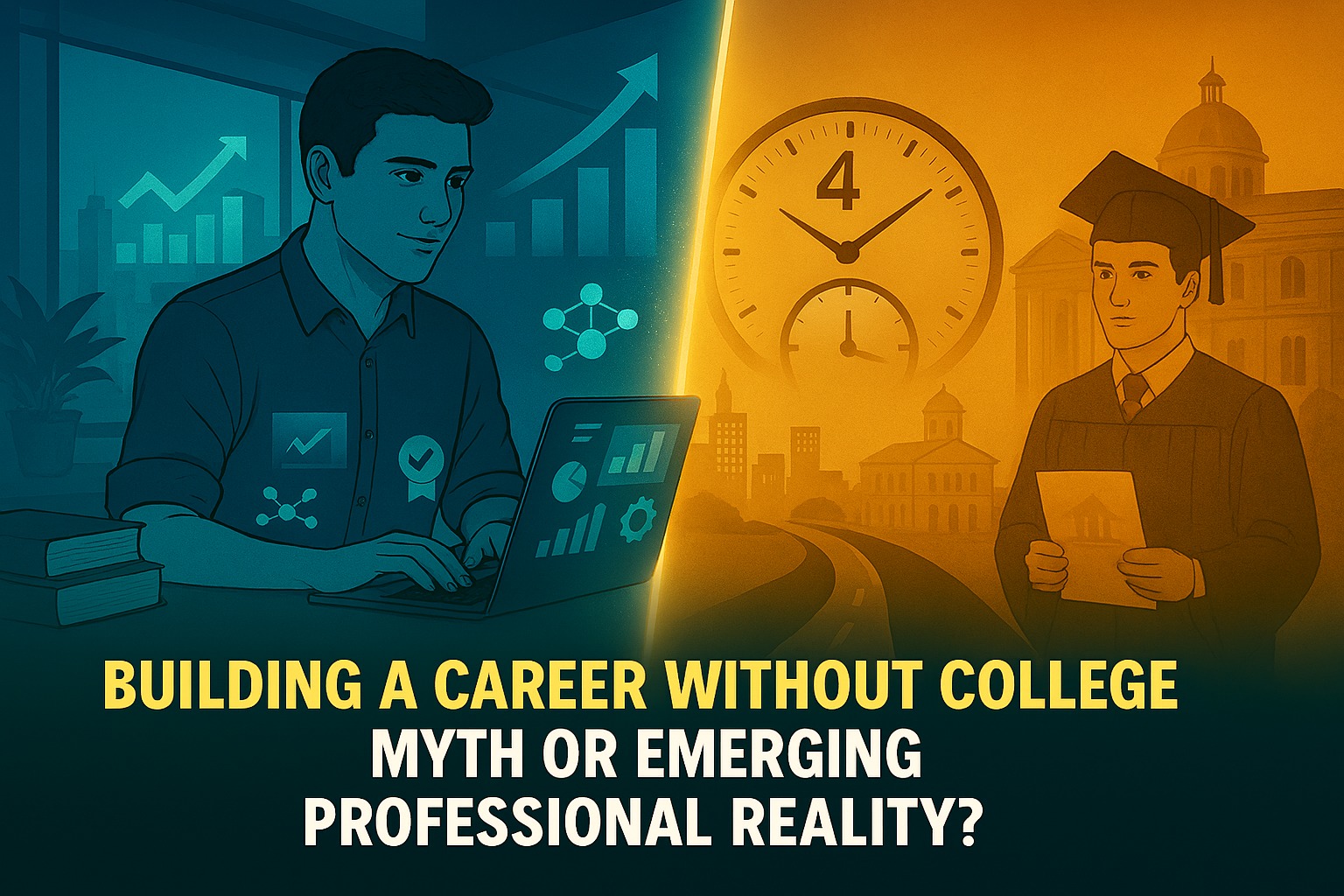
For generations, earning a college degree has been considered the primary pathway to professional success. Parents encouraged it, schools prepared for it, and employers required it. But in today’s rapidly evolving economy, a new question is gaining attention: Is building a career without college just a myth, or is it an emerging professional reality?
As industries transform and digital opportunities expand, alternative career paths are becoming more visible. This article explores whether skipping college is a risky gamble or a viable strategy in the modern job market.
THE TRADITIONAL ROLE OF COLLEGE IN CAREER DEVELOPMENT
Higher education has long served as a structured bridge between adolescence and professional life. College provides academic knowledge, critical thinking skills, networking opportunities, and exposure to diverse perspectives.
A degree has traditionally functioned as proof of discipline and competence. In many fields such as medicine, engineering, law, and education, formal qualifications remain mandatory. For decades, statistical data also showed that degree holders generally earned higher lifetime incomes compared to non-graduates.
Because of these advantages, college became synonymous with stability and upward mobility.
THE RISE OF ALTERNATIVE CAREER PATHS
However, the modern workforce is shifting. Technology, remote work, and the creator economy have opened doors that do not always require formal degrees. Many professionals now build careers through online certifications, vocational training, apprenticeships, freelancing, or entrepreneurship.
Industries like software development, digital marketing, graphic design, and content creation increasingly prioritize skill mastery and portfolios over diplomas. Employers in these sectors often evaluate candidates based on practical performance rather than academic transcripts.
This shift has created space for individuals to pursue success through non-traditional routes.
WHY SKILLS ARE BECOMING THE NEW CURRENCY
In a competitive and fast-changing job market, adaptability matters more than ever. Companies seek individuals who can solve real problems, collaborate effectively, and learn continuously.
Online learning platforms and intensive training programs allow people to acquire targeted skills quickly. Instead of spending four years earning a broad academic degree, learners can focus on specific competencies aligned with market demand.
For some careers, demonstrable ability and a strong portfolio may outweigh formal educational credentials.
THE RISKS AND LIMITATIONS
Despite these emerging opportunities, building a career without college is not without challenges. Certain professions still require accredited degrees. Additionally, some corporate environments continue to view college education as a key benchmark during hiring and promotion decisions.
Without a degree, individuals may need to work harder to prove credibility and secure initial opportunities. Networking, mentorship, and consistent skill development become even more crucial.
It is also important to consider long-term growth. While short-term skill acquisition can open doors, leadership roles and career advancement sometimes favor candidates with formal academic backgrounds.
A BALANCED AND STRATEGIC APPROACH
The debate is not about declaring college obsolete. Instead, it is about recognizing that multiple pathways now exist. Some individuals thrive within structured academic environments, while others excel through independent learning and hands-on experience.
A strategic approach may involve combining methods. Many professionals pursue certifications, build portfolios, and gain work experience regardless of whether they attend college.
The modern professional landscape rewards initiative, continuous learning, and adaptability more than adherence to a single traditional path.
CONCLUSION
Building a career without college is no longer merely a myth. For certain industries and individuals, it is becoming an emerging professional reality. However, it is not a universal solution.
College remains valuable for many fields and long-term career trajectories. At the same time, skill-based pathways offer flexibility and speed in a rapidly evolving economy.
Ultimately, success depends not solely on whether one attends college, but on the ability to develop relevant skills, seize opportunities, and adapt to change in an increasingly dynamic job market.
About the Author
Gusti Ayu Tita
Author — STEKOM University
An active author focused on academic issues, educational technology, and human resource development in the campus environment.



