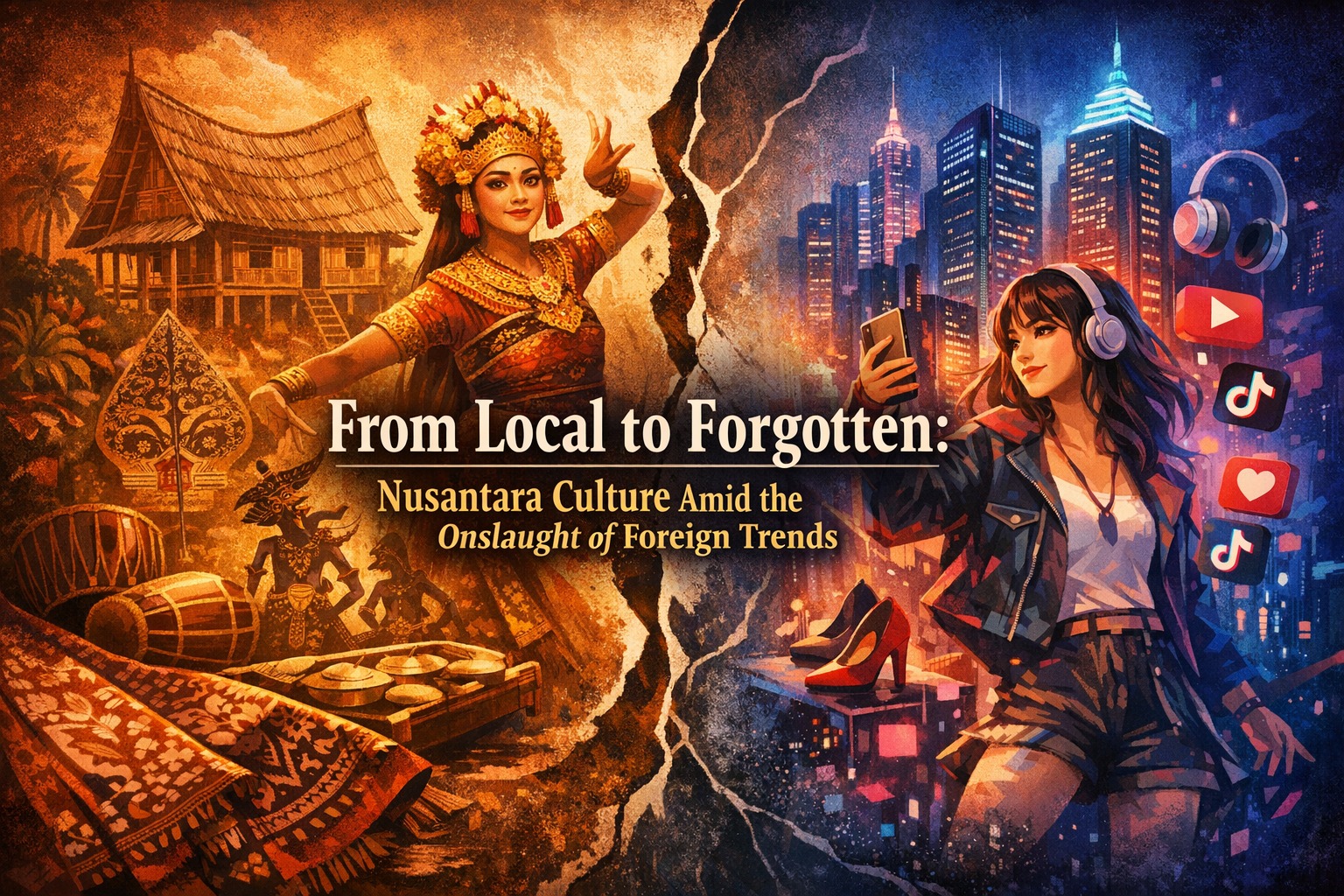
Indonesia is known as a country with extraordinary cultural richness. From Sabang to Merauke, every region has unique traditions, languages, arts, and values. However, amid the rapid flow of globalization and foreign trends that increasingly dominate digital spaces, Nusantara culture is gradually shifting. What was once familiar now feels distant, and what was local is slowly forgotten. This phenomenon calls for collective reflection on the future direction of our cultural identity.
THE STRONG FLOW OF FOREIGN TRENDS IN THE GLOBAL ERA
The development of technology and the internet has opened unlimited access to foreign cultures. Music, films, lifestyles, and languages appear daily through social media and digital platforms. Foreign trends often seem more attractive because they are packaged in modern ways, go viral quickly, and are supported by major industries. This condition makes society—especially younger generations—more exposed to global culture than to local culture. Unconsciously, excessive consumption of foreign culture can shift attention away from one’s own cultural heritage.
THE LOW VISIBILITY OF NUSANTARA CULTURE
One of the biggest challenges facing Nusantara culture is its minimal presence in popular spaces. Local culture often appears only in ceremonial contexts, traditional events, or school lessons, rather than as part of everyday lifestyles. When local culture does not appear in media frequently accessed by young people, it is natural that interest gradually declines—not because Nusantara culture is irrelevant, but because it is not creatively and contextually presented.
SHIFTING INTERESTS OF THE YOUNGER GENERATION
The younger generation grows up in a fast-paced digital culture. They tend to be attracted to things considered trendy and socially valued. Foreign trends often become symbols of social belonging, existence, and modern identity. As a result, local culture is often perceived as outdated and unattractive. If this perception continues, the gap between young people and Nusantara culture will widen.
BETWEEN ADAPTATION AND LOSS OF IDENTITY
Adopting foreign culture is not inherently wrong. Cultural interaction is natural in a globalized world. Problems arise when adaptation is not balanced with awareness of one’s own identity. Nusantara culture should not only be preserved but also developed. With the right innovation, local values can transform without losing their original meaning.
THE ROLE OF MEDIA AND LOCAL CREATIVITY
Media and the creative industry play a strategic role in revitalizing Nusantara culture. Digital content, films, music, and fashion can serve as effective means to introduce local culture through modern approaches. Collaboration between cultural practitioners and young creators can produce new and more relevant narratives. When local culture is presented in engaging formats, the chances of renewed interest increase significantly.
PRESERVING CULTURE SO IT DOES NOT BECOME HISTORY
If Nusantara culture is only stored as a historical archive, it will gradually lose its social function. Culture must live, be practiced, and be experienced by its people. Collective awareness is the key to preventing local culture from truly being forgotten. Knowing one’s own culture does not mean closing oneself off from the world but strengthening identity in the midst of global change.
CONCLUSION
The onslaught of foreign trends is an unavoidable reality. However, the shift from local to forgotten is not inevitable. Nusantara culture still has space to survive and grow, as long as it is given opportunity, innovation, and attention. Preserving local culture is a long-term investment in national identity. In a constantly changing world, Nusantara culture must remain a strengthening root, not merely a forgotten memory.
**Keywords:**
About the Author
Gusti Ayu Tita P
Author — STEKOM University
An active author focused on academic issues, educational technology, and human resource development in the campus environment.