
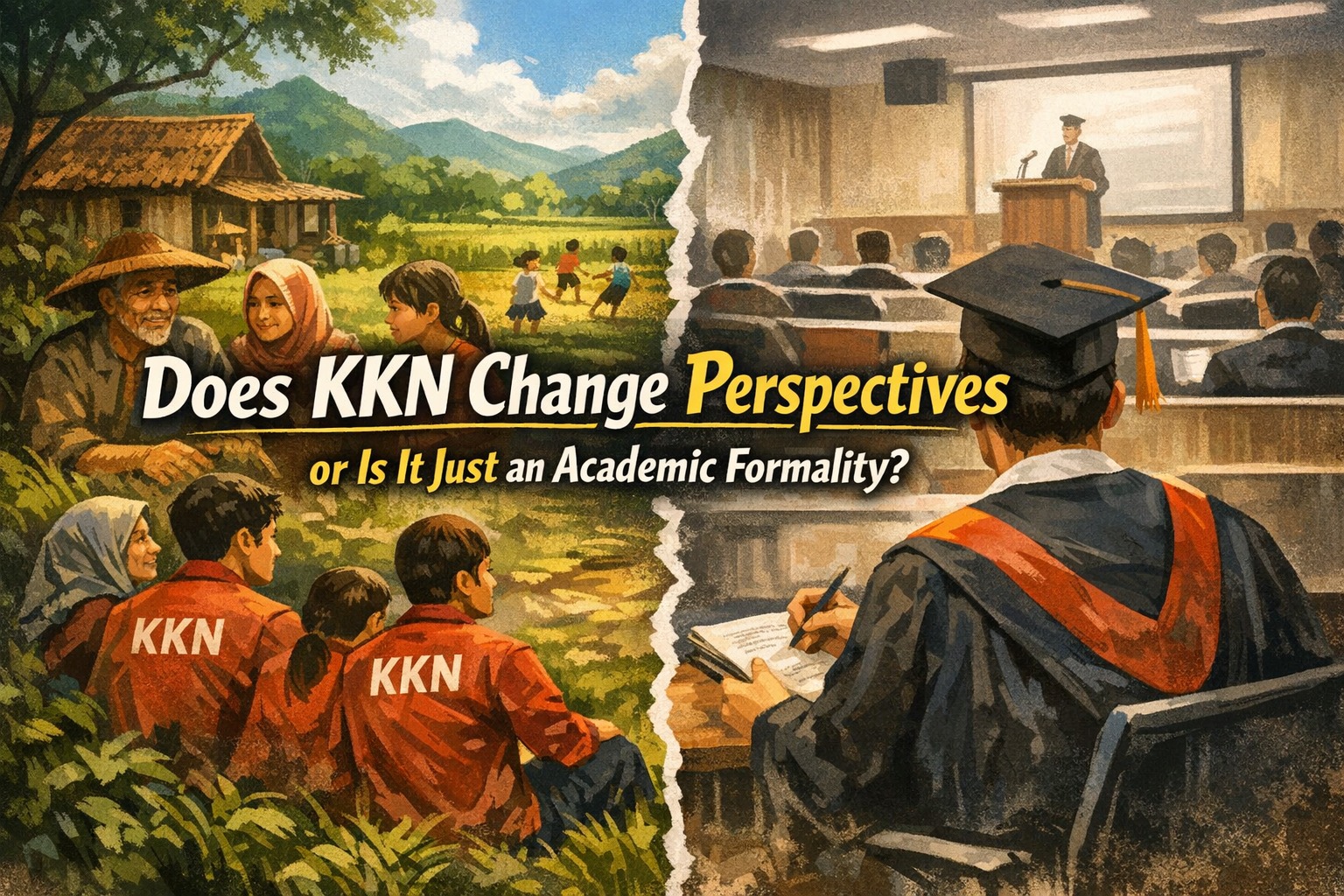
For many university students in Indonesia, KKN (Kuliah Kerja Nyata) is a compulsory academic program that bridges classroom learning with real-world community service. Designed to immerse students in social realities, KKN is often promoted as a transformative experience. But a critical question remains: does KKN truly change students’ perspectives, or has it become merely an academic formality to fulfill graduation requirements?
This article explores both sides of the debate by examining the goals, realities, challenges, and potential impacts of KKN on students and communities.
WHAT IS KKN AND WHY DOES IT EXIST?
KKN was created to connect higher education with society. Through this program, students are placed in villages or local communities to identify problems, design solutions, and implement small-scale development initiatives. In theory, KKN encourages social responsibility, empathy, teamwork, and problem-solving skills.
Universities expect students to step outside their comfort zones, interact with diverse communities, and apply academic knowledge in practical ways. Ideally, KKN becomes a learning laboratory for social awareness rather than a mere academic task.
THE IDEAL PROMISE OF KKN
At its best, KKN can be a powerful eye-opening experience. Students who previously lived in urban or campus-centered environments may encounter social issues such as limited access to education, healthcare inequality, or economic hardship for the first time.
Many participants report positive outcomes, including:
- Increased empathy toward marginalized communities
- Better communication and leadership skills
- A deeper understanding of social and cultural diversity
- Awareness that real-world problems are complex and interconnected
In these cases, KKN genuinely changes perspectives, reshaping how students see society, privilege, and their future roles as educated citizens.
WHEN KKN FEELS LIKE A FORMALITY
Despite its noble goals, not all KKN experiences are impactful. For some students, KKN becomes a routine checklist item—complete the program, submit the report, earn the credits, and move on.
Several factors contribute to this perception:
- Programs that are poorly planned or lack clear objectives
- Minimal supervision or guidance from academic mentors
- Short program durations that limit meaningful engagement
- Activities that focus more on documentation than real impact
When KKN prioritizes administrative completion over learning quality, students may feel disconnected, viewing it as an obligation rather than an opportunity.
THE GAP BETWEEN IDEALISM AND REALITY
One of the biggest challenges in KKN is the gap between student idealism and field realities. Students often arrive with ambitious plans but face constraints such as limited funding, local resistance, or bureaucratic barriers.
This gap can lead to frustration. Some students feel their ideas are ignored, while others struggle to adapt academic concepts to practical conditions. Without proper reflection and support, these challenges may reduce KKN to symbolic activities with little long-term effect.
However, this struggle can also be a learning moment. Understanding limitations, negotiating with stakeholders, and adjusting expectations are valuable life skills—if students are guided to reflect on them.
DOES KKN REALLY CHANGE STUDENTS?
The impact of KKN largely depends on how it is implemented and how students engage with it. KKN changes perspectives when:
- Students actively interact with the community, not just observe
- Reflection is encouraged through discussions and evaluations
- Projects are relevant to real community needs
- Learning outcomes matter more than formal reports
On the other hand, KKN feels like an academic formality when participation is passive and outcomes are measured only by paperwork.
In short, KKN is not automatically transformative. Its value lies in meaningful engagement, critical reflection, and genuine collaboration.
HOW KKN CAN BECOME MORE MEANINGFUL
To ensure KKN remains relevant, several improvements can be considered:
- Stronger collaboration between universities and local communities
- Clear learning objectives beyond credit fulfillment
- Longer-term or follow-up programs for sustainability
- Greater emphasis on reflection rather than mere output
When designed thoughtfully, KKN can evolve from a symbolic academic requirement into a powerful educational experience.
CONCLUSION
So, does KKN change perspectives or is it just an academic formality? The answer is both—depending on its execution and the mindset of those involved.
KKN has the potential to be a transformative journey that shapes students’ social awareness and values. Yet without proper structure and engagement, it risks becoming a procedural obligation. Ultimately, the true impact of KKN lies not in its title or credit value, but in the depth of learning and reflection it inspires.
About the Author
Gusti Ayu Tita
Author — STEKOM University
An active author focused on academic issues, educational technology, and human resource development in the campus environment.



