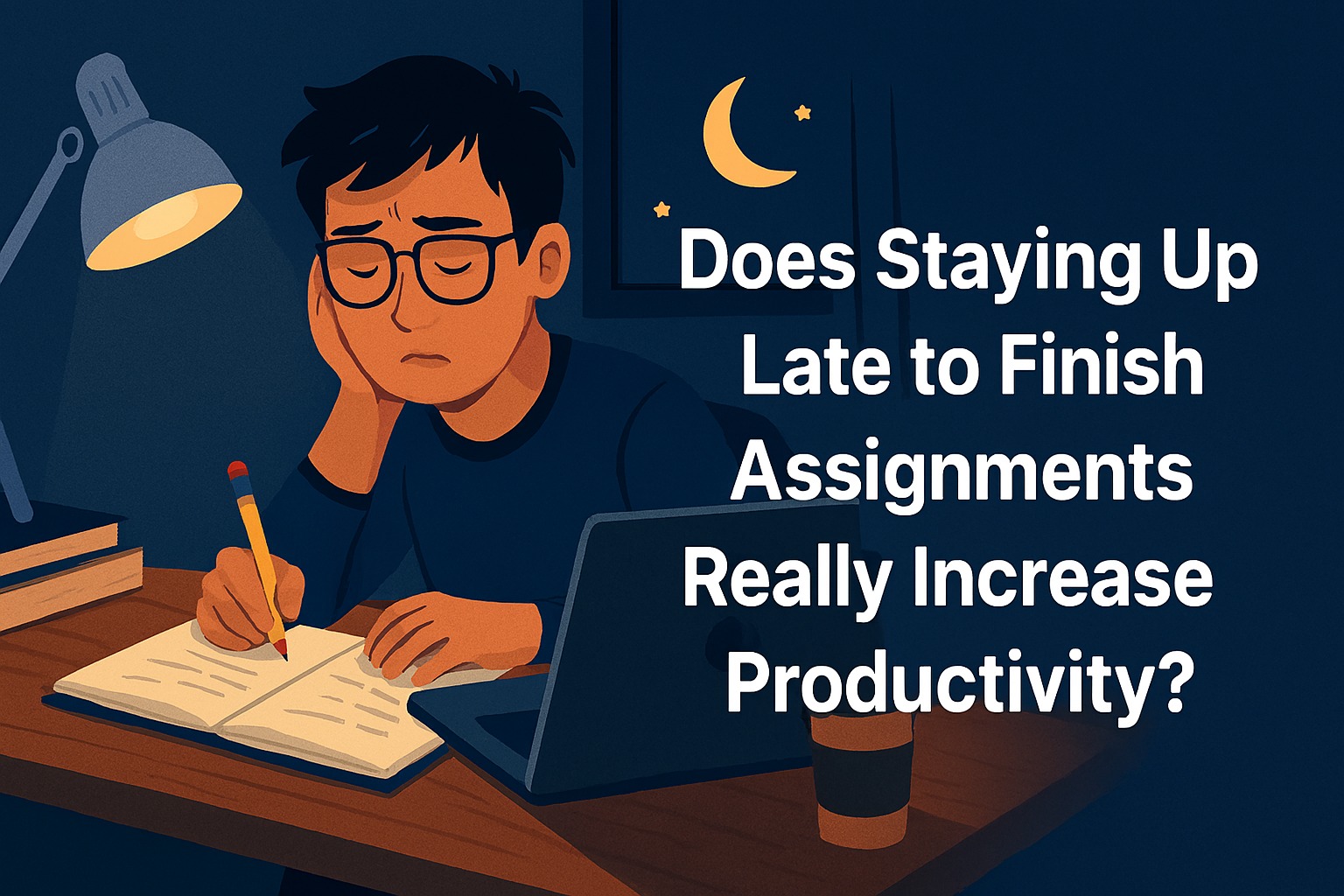
Staying up late to finish assignments has become an unwritten culture among university students. When deadlines get closer, nighttime is often seen as the “safest” time to focus without distractions. However, an important question arises: does staying up late truly increase productivity, or does it become a harmful habit in the long run?
This article discusses the impact of staying up late on productivity, work quality, and physical and mental health.
WHY STAYING UP LATE IS OFTEN CONSIDERED PRODUCTIVE
Many people feel more focused at night because the atmosphere is quieter. With fewer distractions from social media, messages, or daily activities, time feels more effective. In addition, deadline pressure can trigger adrenaline, temporarily increasing concentration.
In certain situations, staying up late can help complete assignments faster. The brain enters an “emergency mode,” pushing someone to work without delaying anymore. This is why many students feel more productive when working late at night.
However, being productive quickly does not always mean being productive optimally.
THE IMPACT OF STAYING UP LATE ON WORK QUALITY
Lack of sleep affects cognitive functions, including memory, analytical skills, and decision-making. When the body is tired, concentration decreases and the risk of mistakes increases. The assignment may be completed on time, but the quality is not necessarily at its best.
Staying up late also makes thinking less clear. Creative ideas that seem brilliant at night often require many revisions after sleeping and reviewing the work the next day.
This means staying up late may increase the quantity of work completed, but not necessarily improve its quality.
LONG-TERM HEALTH RISKS
Productivity is not only about results, but also about sustainable performance. Constantly staying up late can disrupt sleep patterns, weaken the immune system, and increase stress.
Chronic sleep deprivation also affects mood and emotional stability. A person becomes more easily exhausted, struggles to focus during the day, and becomes more vulnerable to burnout. If this happens repeatedly, productivity will decline in the long term.
In other words, staying up late may feel effective temporarily, but it can sacrifice health and consistency.
HEALTHIER STRATEGIES TO STAY PRODUCTIVE WITHOUT STAYING UP LATE
Instead of relying on last-minute overnight work, here are healthier and more sustainable strategies:
1. Create a daily work schedule with realistic targets.
2. Break large assignments into smaller tasks.
3. Use time management techniques such as the 25-minute focus method.
4. Set priorities based on urgency and difficulty.
5. Get at least 7 hours of sleep to keep your body functioning optimally.
With good planning, tasks can be completed gradually without sacrificing rest.
CONCLUSION: PRODUCTIVE OR JUST FORCED?
Staying up late to finish assignments does not always mean increased productivity. In some situations, it may help complete work quickly. However, if it becomes a habit, it can harm both work quality and health.
True productivity is not only about finishing tasks on time, but also about maintaining balance between performance and physical well-being. Managing time with discipline is far more effective than relying on temporary energy in the middle of the night.
In the end, the choice is personal: do you want to look productive for a moment, or truly be productive sustainably?
About the Author
Gusti Ayu Tita P
Author — STEKOM University
An active author focused on academic issues, educational technology, and human resource development in the campus environment.