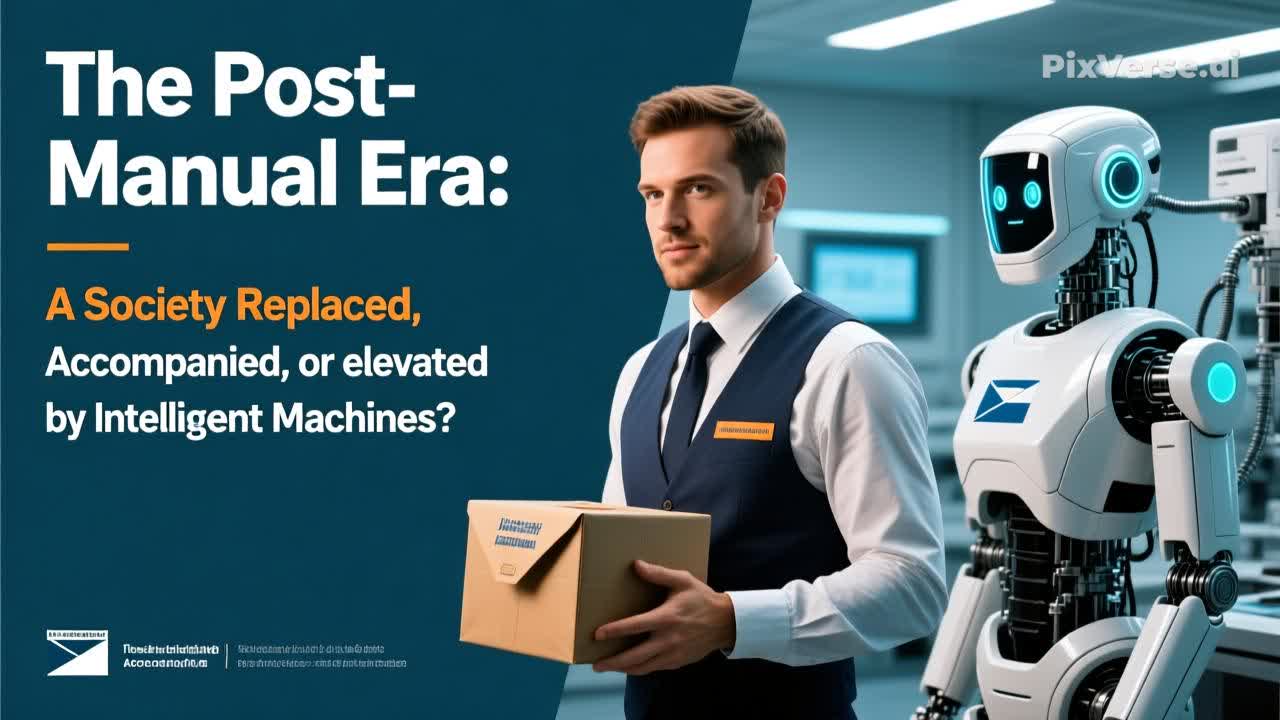
Buttons, touchscreens, and voice commands have now replaced many hand movements that once relied entirely on manual effort. In factories, offices, and even households, intelligent machines have become new “work partners.” The question is no longer whether technology will affect our lives, but how far it will reshape the role of humans within it.
Amid the rise of artificial intelligence, robotics, and automation, society stands at a crossroads: will humans be pushed aside, merely accompanied, or elevated by machines? This article explores the face of the post-manual era—a phase in which human dexterity negotiates with machine intelligence.
FROM MANUAL TO AUTOMATED: THE SHIFT IN THE EXPERIENCE OF WORK
Automation does not only remove repetitive tasks—it transforms the very feel of working. If in the past work was measured by physical energy and hours spent, today it is measured by accuracy, creativity, and decision-making. Physical labor declines, cognitive work rises.
However, this transition is uneven. Some sectors advance rapidly, others lag behind. Skill inequality becomes a tangible challenge. Thus, the core issue is not “machines replacing humans,” but “who is ready to collaborate with machines.”
INTELLIGENT MACHINES AS COMPANIONS
Rather than taking over, many technologies are emerging as tools that enhance human capability. In healthcare, algorithms help interpret radiology scans with high precision. In finance, intelligent systems filter risks in real time. In the classroom, adaptive learning adjusts material to each student’s abilities.
Here are forms of human–machine collaboration that have become today’s reality:
- Augmented Decision
Machines process vast amounts of data at high speed, while humans remain the principal decision-makers. The result: faster decisions, grounded in evidence, with fewer errors.
- Productivity Boost
Machines handle repetitive and technical tasks, allowing humans to focus on strategic, creative, and high-value work.
- Creative Amplifier
Machines assist in generating ideas, concepts, and variations—but humans still define direction, meaning, and value.
This collaboration shows that machines excel at speed and pattern recognition, while humans excel at intuition, empathy, and meaning. The relationship is not competition, but complementarity.
WHEN JOBS CHANGE THEIR FACE
The post-manual era creates new professions while phasing out old ones. Prompt engineers, robotics technicians, data analysts—titles that were almost unheard of a decade ago are now essential roles.
This shift demands continuous reskilling and upskilling. Education is no longer a life-opening phase but a lifelong cycle. Without this, structural unemployment may rise, even in a world full of new opportunities.
A SOCIETY THAT IS “REPLACED”: MYTH OR REALITY?
Fears of humans being replaced often stem from video games and sci-fi films. In reality, replacement is selective: repetitive tasks are easy to automate, contextual work is not.
However, there are social consequences that must be addressed—unequal access to technology, algorithmic bias, and erosion of privacy. Without regulation and ethics, machine intelligence could reinforce existing inequalities.
Key risks to anticipate include:
Job Polarization
Middle-class jobs shrink as skill gaps widen.
Algorithmic Bias
Flawed data leads to unfair decisions.
Surveillance Creep
Convenience comes at the cost of intruding on private spaces.
Managing risks is just as important as celebrating innovation.
A SOCIETY THAT IS “ELEVATED”: THE OPPORTUNITY OF THE INTELLIGENT ERA
History shows a pattern: technology frees humans from heavy labor so they can move into more meaningful work. The post-manual era opens pathways to professions centered on empathy, imagination, and leadership.
As machines handle the “how,” humans nurture the “why.” Human dignity thrives not in efficiency alone, but in purpose.
BRIDGING TECHNOLOGY AND HUMANITY
The key to this era lies in governance: adaptive regulations, relevant education, and strong digital literacy. Companies must uphold ethical design; governments must craft worker-centered policies; societies must cultivate critical habits.
Healthy transformation emerges from dialogue—among technologists, workers, educators, and policymakers. Machines may be intelligent, but the direction must remain human.
CONCLUSION
The post-manual era is not about humans losing to machines, but about the quality of collaboration we build. We may be “replaced” if we stop learning, “accompanied” if we adapt, and “elevated” if we lead technology with values.
The future will not be defined by the sophistication of algorithms alone, but by humanity’s courage to design systems that are fair, inclusive, and meaningful. It is in that space that machines stop casting shadows—and begin to illuminate.
About the Author
Gusti Ayu Tita
Author — STEKOM University
An active author focused on academic issues, educational technology, and human resource development in the campus environment.