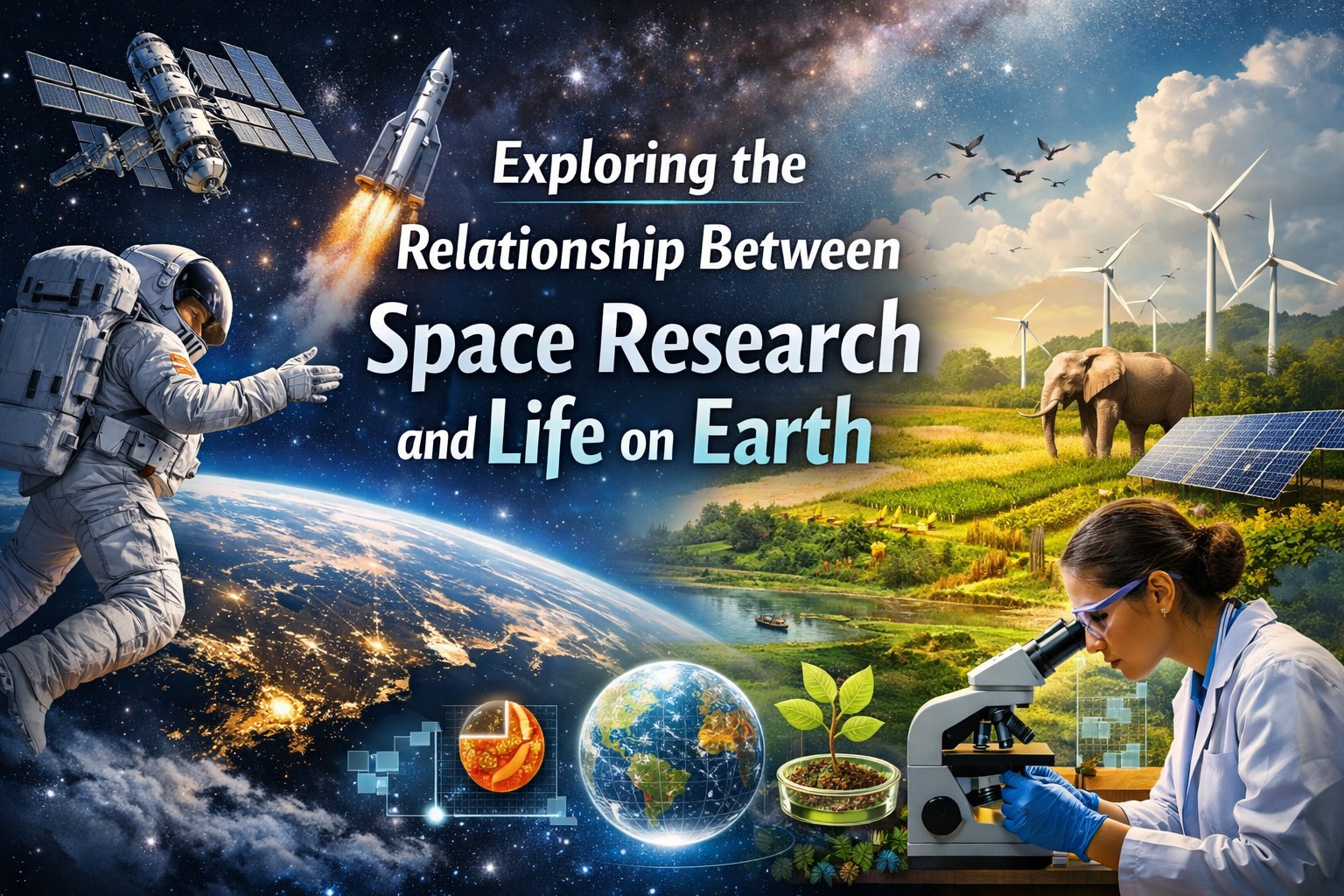
Space exploration is often seen as something distant, expensive, and disconnected from daily human life. However, space research has a profound and practical impact on life on Earth. From communication systems to climate monitoring and medical advancements, discoveries made beyond our planet continuously shape how humanity lives, works, and evolves. Understanding this relationship reveals that space science is not just about exploring the universe, but also about improving conditions here on Earth.
THE ROLE OF SPACE RESEARCH IN TECHNOLOGICAL ADVANCEMENT
One of the most visible contributions of space research is technological innovation. Many tools and systems used in everyday life were originally developed for space missions. For example, satellite technology enables global communication, GPS navigation, weather forecasting, and internet connectivity. Without satellites orbiting Earth, modern transportation, logistics, and digital communication would be far less efficient.
Additionally, materials developed for spacecraft—such as heat-resistant coatings and lightweight composites—are now used in industries like automotive manufacturing, aviation, and construction. This transfer of technology, often called “spin-off technology,” demonstrates how space exploration drives innovation across multiple sectors.
EARTH OBSERVATION AND CLIMATE UNDERSTANDING
Space research plays a critical role in monitoring Earth's environment. Satellites equipped with advanced sensors continuously collect data about the planet’s atmosphere, oceans, forests, and ice caps. This information is essential for understanding climate change and predicting natural disasters.
For instance, meteorological satellites help scientists track hurricanes, typhoons, and storm patterns in real time. Earth observation systems also monitor deforestation, rising sea levels, and carbon emissions. These insights allow governments and organizations to make informed decisions about environmental protection and disaster preparedness.
Without space-based observation, it would be nearly impossible to obtain a global perspective of Earth’s rapidly changing climate systems.
SPACE RESEARCH AND MEDICAL INNOVATION
Space exploration has also contributed significantly to the medical field. Research conducted in microgravity environments—such as aboard the International Space Station—has led to new discoveries in human biology and disease treatment.
For example, studies on bone density loss in astronauts have helped improve treatments for osteoporosis on Earth. Microgravity research has also enhanced understanding of muscle atrophy, immune system behavior, and cardiovascular health. In addition, space technology has improved medical imaging devices, robotic surgery systems, and telemedicine services, making healthcare more accessible and precise.
IMPROVING DAILY LIFE THROUGH SATELLITE APPLICATIONS
Many aspects of modern daily life depend on satellite systems. Navigation apps, emergency response systems, agricultural planning, and financial transactions all rely on space-based infrastructure.
Farmers, for instance, use satellite data to monitor soil conditions and optimize crop production. Disaster response teams use satellite imagery to assess damage and coordinate rescue operations. Even banking systems depend on precise time synchronization provided by satellites to process secure transactions.
These applications show that space research is deeply integrated into essential services that support global society.
THE FUTURE CONNECTION BETWEEN SPACE AND EARTH
As space research continues to advance, its connection to Earth will become even stronger. Emerging projects in space mining, lunar bases, and Mars exploration may lead to new energy sources, materials, and scientific discoveries that could reshape human civilization.
At the same time, continued investment in space science encourages global collaboration and inspires future generations to pursue careers in science, technology, engineering, and mathematics (STEM). The benefits of space research are not limited to exploration—they extend to solving some of Earth’s most pressing challenges.
CONCLUSION
The relationship between space research and life on Earth is deeply interconnected and constantly evolving. Far from being separate worlds, space and Earth influence each other in powerful ways. From improving technology and healthcare to protecting the environment and enhancing daily life, space research plays a vital role in shaping a better future for humanity.
About the Author
Gusti Ayu Tita
Author — STEKOM University
An active author focused on academic issues, educational technology, and human resource development in the campus environment.