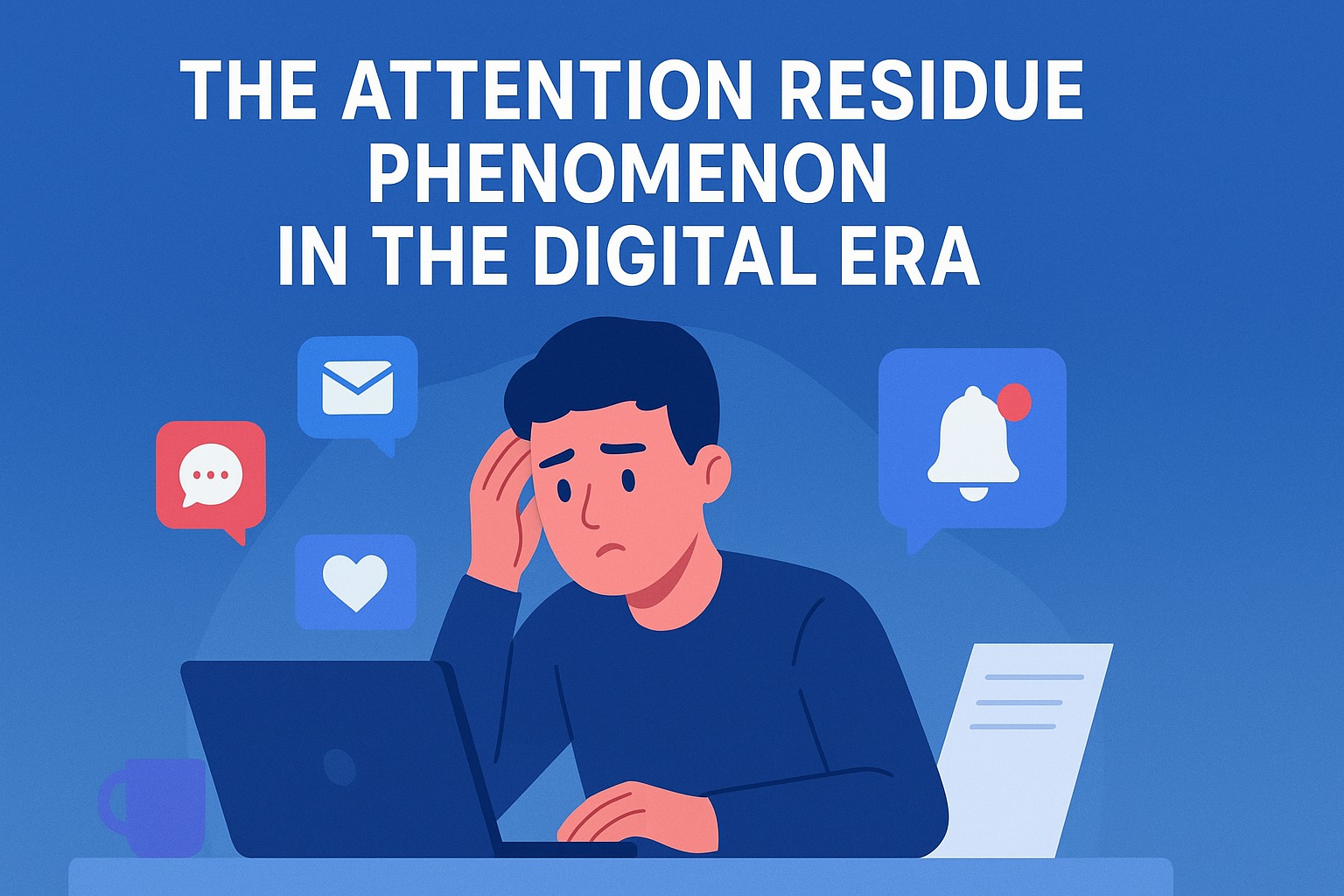
In today’s fast-paced era, focus has become one of the most valuable mental assets. Yet without realizing it, many people experience attention residue = a phenomenon in which leftover attention from a previous activity carries into the next one. This condition makes it difficult to concentrate fully, increases distractibility, and reduces the ability to work optimally. In a digital world filled with notifications, short-form content, and multitasking, attention residue appears more easily than ever. To understand how this phenomenon works and its impact on daily life, let’s explore it further.
WHAT IS ATTENTION RESIDUE?
Attention residue is a state in which the mind remains partially attached to the previous task even after someone has switched to a new one. This leftover attention reduces the quality of focus because the brain has not fully “shifted.”
The phenomenon was first introduced by Sophie Leroy, a researcher who found that switching tasks too quickly can impair cognitive performance. In other words, multitasking is not a sign of productivity—it is a trigger for reduced work quality.
HOW THE DIGITAL ERA AFFECTS ATTENTION RESIDUE
Today's digital environment accelerates the emergence of attention residue. Several factors contribute to this:
1. Excessive Notifications
Notifications from messages, social media, or productivity apps create small but frequent interruptions.
Each time a notification appears, the brain performs *micro-switching*, a brief shift of focus that triggers leftover attention.
2. Fast-Paced Content Consumption
Short-form content such as reels, shorts, and quick videos trains the brain to switch focus rapidly.
This habit shortens attention span over time.
3. Multitasking Habits
Many people work with multiple tabs open, listen to music, and check social media simultaneously.
Each activity leaves behind a trace of attention that accumulates.
4. Information Overload
The massive flow of information overwhelms the brain’s processing capacity.
As a result, portions of information remain “unfinished,” creating attention residue.
NEGATIVE IMPACTS OF ATTENTION RESIDUE
This phenomenon is more than a minor inconvenience. Its effects can be felt across various aspects of life:
Reduced Productivity
The brain cannot work at full capacity because part of its attention is held by previous tasks, making work feel slower.
More Mistakes
Fragmented focus increases the likelihood of errors, especially in tasks requiring precision.
Stress and Overthinking
Because many tasks remain mentally unfinished, the brain juggles multiple thoughts at once, causing mental overload.
Difficulty Completing Important Tasks
Incomplete focus transitions make major tasks feel harder to finish.
HOW TO REDUCE ATTENTION RESIDUE IN THE DIGITAL AGE
Several strategies can help minimize attention residue in daily life:
1. Finish Small Tasks Completely
Completing tasks fully helps the brain close the mental loop, preventing leftover attention.
2. Use Monotasking Techniques
Focus on one task per work session. Monotasking keeps the brain in deep work longer.
3. Manage Notifications
- Turn off unnecessary notifications
- Use Do Not Disturb mode while working
- Batch message checking into specific times
4. Schedule Breaks
Short breaks allow the brain to reset and reduce mental buildup.
5. Reduce Unnecessary Tabs
Limit the number of browser tabs to prevent distraction from unfinished tasks.
6. Keep Your Phone Out of Reach
Place your phone somewhere less accessible to reduce the urge to check it.
7. Create a Task-Closing Ritual
For example:
- Writing down completed points
- Marking your to-do list
- Doing a brief review before switching tasks
This ritual helps the brain close its “attention loop.”
CONCLUSION
Attention residue has become a major issue in the digital era because human activities are faster and more fragmented. By understanding what attention residue is and how to reduce it, we can improve focus quality, productivity, and mental well-being. Focus is not just a skill—it is a habit shaped by the digital environment we build every day.
About the Author
Gusti Ayu Tita
Author — STEKOM University
An active author focused on academic issues, educational technology, and human resource development in the campus environment.