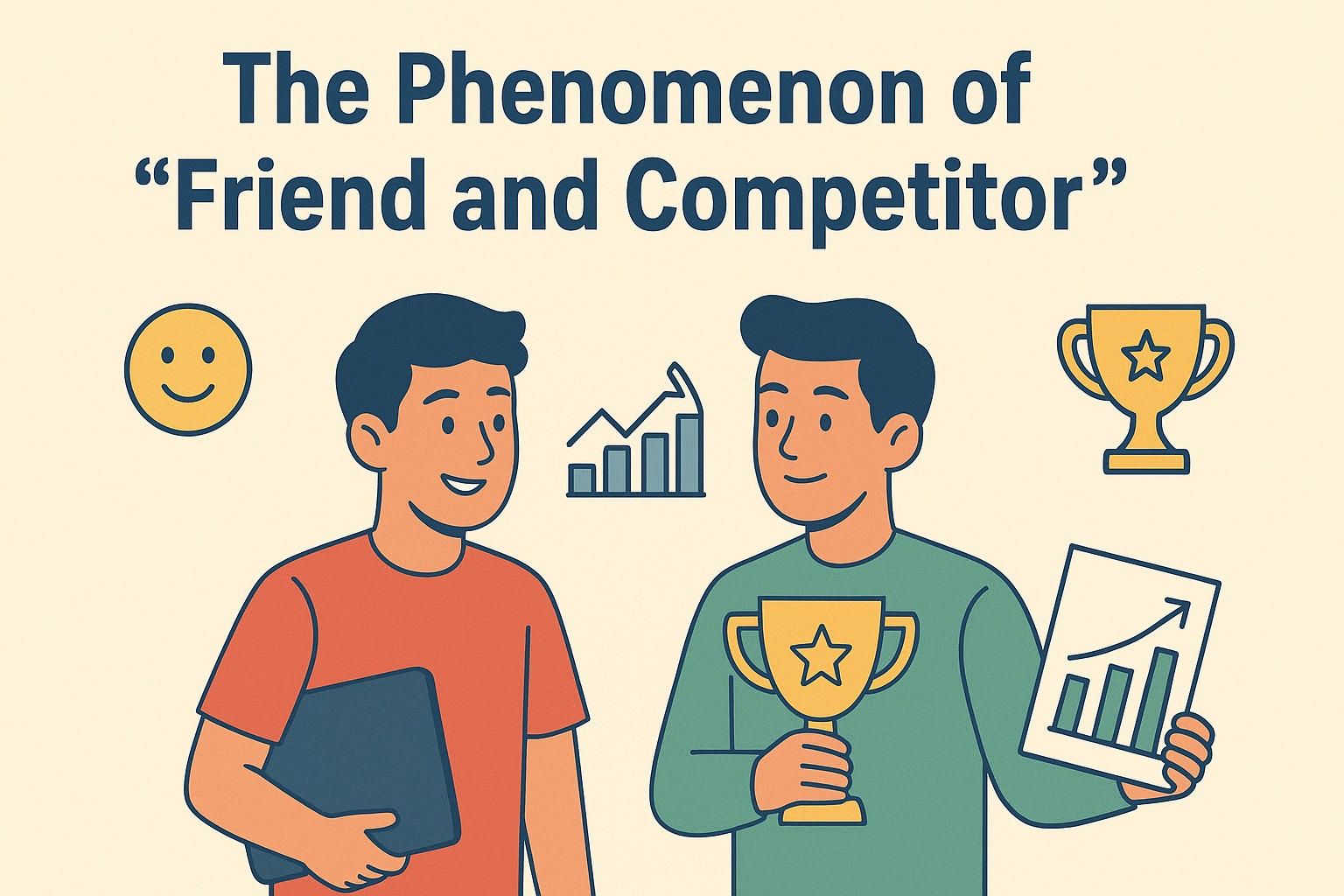
In a fast-moving world, the line between friendship and competition is growing thinner. Social media displays friends’ achievements in real time, workplaces demand collaboration while maintaining individual targets, and schools promote group projects yet still assign personal rankings. At any moment, someone can be a supportive friend and a quiet competitor. This is why modern relationships feel warm yet tense at the same time.
Many relationships today exist on two opposing forces: closeness and competition. We laugh together, share stories, yet secretly monitor who’s moving faster. The phenomenon of “friends who are also competitors” is not merely an individual issue—it reflects a culture that glorifies performance. To understand it, we must look at how this dynamic forms, its impact on mental health, and how to preserve relationships without dimming ambition.
ROOTS OF DUAL RELATIONSHIPS
Dual relationships don’t appear out of nowhere. There are social landscapes that encourage competitive friendships:
- Visibility Culture
Publicized achievements shrink private space. When everyone sees everything, comparison becomes inevitable.
- Meritocracy Narrative
Hard work is promoted as the single ticket to success. This fuels the belief that everyone is a “dolphin in the same racing lane.”
- Resource Scarcity Mindset
Opportunities are seen as limited. If one rises, it feels like the other must fall.
- Digital Amplification
Algorithms magnify the winners and hide the process. Results look instant, effort becomes invisible.
THE PSYCHOLOGICAL DYNAMICS BEHIND COMPETITIVE FRIENDSHIPS
These relationships carry emotional ambiguity. On one side, there is genuine support; on the other, a quiet desire to “win.” When a friend gets promoted, we feel happy yet wonder, “When is my turn?” This internal tension is not merely envy—it’s a natural response to an environment that measures worth through achievements
If left unexamined, these mixed emotions can erode warmth. Compliments feel half-hearted, jokes carry hints of sarcasm, and emotional distance begins to widen. Conversely, when acknowledged, they can trigger reflection: Is our ambition aligned with our values, or are we simply following the rhythm around us?
IMPACT ON MENTAL HEALTH AND RELATIONSHIP QUALITY
This phenomenon has a double-edged effect—strengthening and weakening at the same time:
Positive Pressure
- Drives growth
- Sharpens competence
- Builds discipline
Hidden Costs
- Comparison anxiety
- Harshness toward oneself
- Strained trust
When positive pressure exceeds limits, relationships turn into mental testing grounds. The sense of safety—the foundation of friendship—erodes into subtle suspicion. Without psychological safety, collaboration loses meaning.
SIGNS THE RELATIONSHIP IS BECOMING UNHEALTHY
Several signals should be watched:
- Comparison Loop
Conversations always end in achievements, rarely emotions
- Withholding Information
Hesitating to share tips out of fear of “losing.”
- Performance Persona
Presenting a version of yourself that “always succeeds” to maintain image.
- Emotional Distance
Avoiding sensitive topics to prevent emotional flare-ups.
When these appear, it’s time to recalibrate the relationship.
STRATEGIES TO MAINTAIN FRIENDSHIP WITHOUT KILLING AMBITION
Here are practical approaches for preserving relationships amid competition:
- Radical Honesty
Express feelings sincerely and respectfully. Honesty dissolves assumptions.
- Mutual Growth Contract
Agree to be “growth partners” instead of silent rivals.
- Boundary Awareness
Separate areas of competition (career) from areas of connection (friendship).
- Celebration Ritual
Consciously celebrate one another’s wins—without competitive undertones.
- Self-Definition
Set personal success metrics so you don’t drown in others’ standards.
THE ROLE OF COMMUNITIES AND ORGANIZATIONS
Environment plays a critical role. Communities that value collaboration soften competitive tension. Organizations can create team-based rewards, transparent processes, and cross-role mentoring to reduce structural jealousy.
In education, formative assessments and collaborative projects foster a sense of “us,” not “me versus you.” The earlier this approach is introduced, the healthier the culture that forms.
TURNING COMPETITORS INTO COLLABORATORS
Rather than avoiding competition, redirect its energy. Healthy competition teaches discipline collaboration teaches wisdom. When paired, friendship becomes a launchpad—never a battlefield.
We can aim to excel without pulling others down. We can run fast while still holding hands. The key lies in intention: Do we want to win alone, or win together?
CONCLUSION
The phenomenon of “friends who are also competitors” reflects an era that measures value through results. It’s not entirely negative, but it can become harmful if unmanaged. The key lies in emotional awareness, honest communication, and the courage to set boundaries.
By shifting focus from comparison to growth, friendships don’t need to lose to ambition. In fact, that’s where ambition finds its anchor—allowing us to grow further without losing each other.
About the Author
Gusti Ayu Tita
Author — STEKOM University
An active author focused on academic issues, educational technology, and human resource development in the campus environment.