
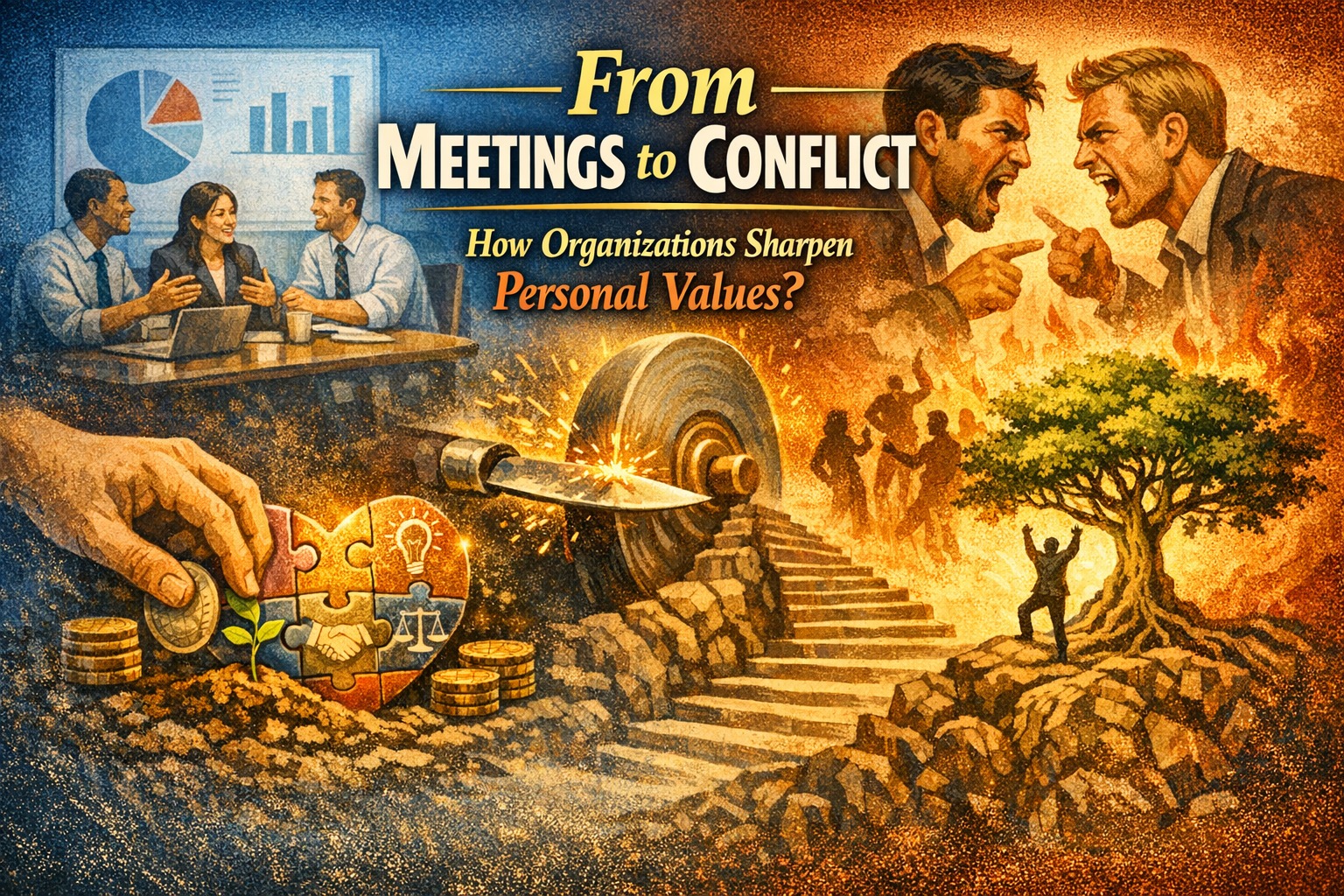
Organizations are often seen as places for coordination, planning, and execution. Meetings fill calendars, and conflicts sometimes create tension. Yet behind these everyday activities lies a deeper function that is frequently overlooked. Organizational life plays a critical role in shaping and sharpening personal values that guide behavior far beyond the workplace or campus.
This article explores how routine meetings and inevitable conflicts within organizations become powerful tools for personal value development.
MEETINGS AS A SPACE FOR VALUE FORMATION
Meetings are more than formal discussions or agenda reviews. They are environments where individuals practice respect, discipline, and responsibility. Arriving on time, listening actively, and contributing thoughtfully reflect personal values in action.
In meetings, individuals learn how to express opinions without dominating others and how to disagree without disrespect. These moments slowly shape values such as professionalism, patience, and accountability, even when the meeting itself seems ordinary.
COMMUNICATION AND HONESTY IN DAILY INTERACTIONS
Organizational settings demand clear and honest communication. Misunderstandings can affect team performance, deadlines, and trust. As a result, individuals are encouraged to communicate transparently and ethically.
Over time, this environment sharpens values related to honesty and clarity. People begin to understand the importance of choosing words carefully, delivering feedback constructively, and maintaining integrity in both success and failure.
CONFLICT AS A TEST OF PERSONAL VALUES
Conflict is unavoidable in any organization where different backgrounds, perspectives, and interests meet. While conflict is often viewed negatively, it actually serves as a powerful test of personal values.
In moments of disagreement, values such as fairness, empathy, and self-control are challenged. Individuals must decide whether to react emotionally or respond thoughtfully. Through repeated exposure to conflict, people learn to manage emotions, respect differences, and seek solutions rather than personal victories.
DECISION-MAKING UNDER PRESSURE
Organizations frequently require decisions to be made under pressure, with limited information and time constraints. These situations reveal true personal values more clearly than planned discussions.
Choosing what is right over what is easy strengthens ethical awareness. Individuals learn to prioritize collective goals, take responsibility for outcomes, and accept consequences. This process gradually refines moral judgment and personal integrity.
TEAMWORK AND THE VALUE OF EMPATHY
Working within a team exposes individuals to different working styles and personalities. Success depends not only on individual competence but also on mutual understanding.
Through teamwork, empathy becomes a practical value rather than an abstract concept. Understanding others’ challenges, offering support, and sharing responsibility help individuals grow into more considerate and socially aware members of society.
LONG-TERM IMPACT BEYOND THE ORGANIZATION
The values sharpened through meetings and conflict do not stay within organizational walls. They influence how individuals interact in families, communities, and professional careers.
People who have experienced organizational dynamics tend to approach problems with maturity, communicate with clarity, and handle disagreements calmly. These qualities become part of their identity, shaped through repeated real-life practice.
CONCLUSION
From routine meetings to challenging conflicts, organizations provide a continuous learning environment for personal values. What may seem like everyday activities are actually powerful moments of character formation.
By engaging actively and reflectively in organizational life, individuals sharpen values that define how they lead, collaborate, and respond to challenges. In the long run, these values become one of the most meaningful outcomes of organizational experience.
About the Author
Gusti Ayu Tita
Author — STEKOM University
An active author focused on academic issues, educational technology, and human resource development in the campus environment.



