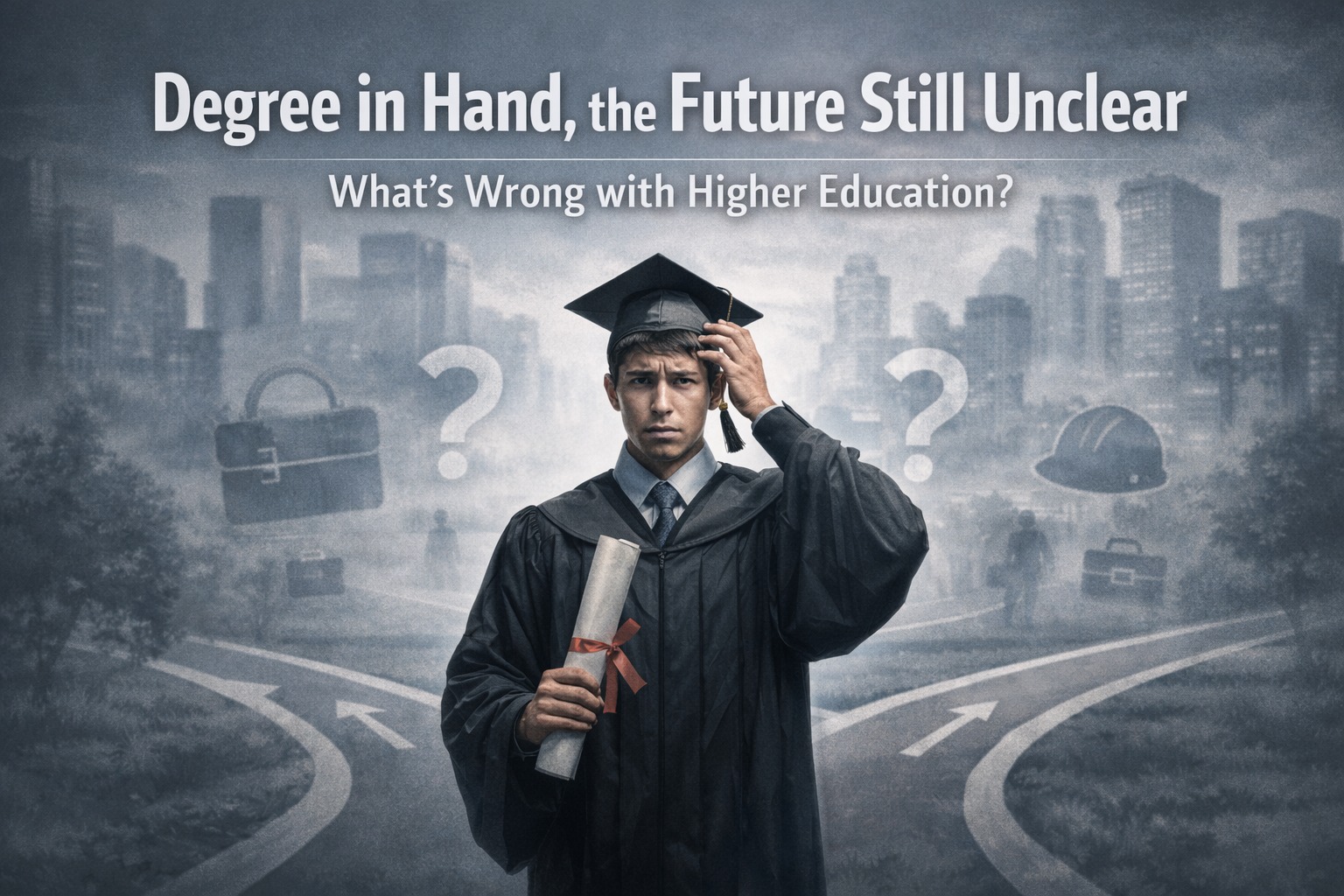
Academic degrees have long been perceived as symbols of future certainty. Graduating from university is often seen as proof of readiness to enter the workforce and adult life. However, reality shows otherwise. Many university graduates actually feel that their future is uncertain after graduation. The degree has been obtained, yet life direction and career paths remain vague. This condition raises a fundamental question: what is wrong with higher education today?
THE ILLUSION OF CERTAINTY IN ACADEMIC DEGREES
For years, higher education has been promoted as the safest path to success. This narrative has shaped expectations that a bachelor’s degree will automatically open career opportunities. Problems arise when this promise is not fully realized in the real world.
When graduates realize that a degree no longer guarantees job security, feelings of confusion and disappointment emerge. This illusion of certainty eventually collapses, leaving behind questions about the practical value of higher education.
HIGHER EDUCATION THAT IS TOO ACADEMIC-ORIENTED
One of the root problems lies in the dominant academic orientation of higher education. Universities tend to emphasize grades, publications, and on-time graduation rather than preparedness for life after college. Students are trained to meet institutional standards, not to understand the realities they will face beyond campus.
As a result, many graduates excel theoretically but feel uncertain when required to make independent life and career decisions.
THE GAP BETWEEN CAMPUS AND THE WORLD OF WORK
The job market evolves rapidly, while university curricula often lag behind. Many graduates find that the skills demanded in the workplace do not fully align with what they learned during their studies. This mismatch makes the transition from campus to professional life particularly challenging.
This condition reinforces feelings of unpreparedness and prolongs the period of uncertainty for higher education graduates.
LACK OF CAREER DIRECTION AND GUIDANCE
Career guidance in universities often exists only as a formality. While programs may be available, they are rarely integrated into the educational process as a whole. Students are seldom encouraged to explore their interests, potential, and career options from the beginning of their studies.
Without consistent guidance, students are forced to navigate their post-graduation lives on their own—often without adequate preparation.
SOCIAL PRESSURE AND MISLEADING STANDARDS OF SUCCESS
Social pressure after graduation also contributes to the uncertainty of the future. Society demands quick success, stable jobs, and financial security in a short time. Social media amplifies these expectations through narratives of instant success.
Rather than helping, such pressure narrows opportunities for exploration and deepens graduates’ confusion.
AN INDIVIDUAL PROBLEM OR A SYSTEMIC FAILURE?
If the phenomenon of an unclear future affected only a few graduates, it might be considered a personal issue. However, when it occurs on a wide scale, it clearly indicates structural problems within higher education that require evaluation.
This issue cannot be reduced to individual failure alone. There is a close relationship between the education system, social expectations, and the realities of the labor market that are not aligned.
REDEFINING THE MEANING OF HIGHER EDUCATION
Higher education needs to be redefined—not merely as a degree-producing machine, but as a space for shaping mature individuals who are prepared to face life’s uncertainties. Universities should help students understand themselves, not just master academic content.
As long as higher education continues to sell an illusion of certainty, graduates will remain confronted with an unclear future. The question now is no longer whether a degree is important, but whether the education system truly prepares people for life afterward.
**Keywords:**
About the Author
Gusti Ayu Tita
Author — STEKOM University
An active author focused on academic issues, educational technology, and human resource development in the campus environment.