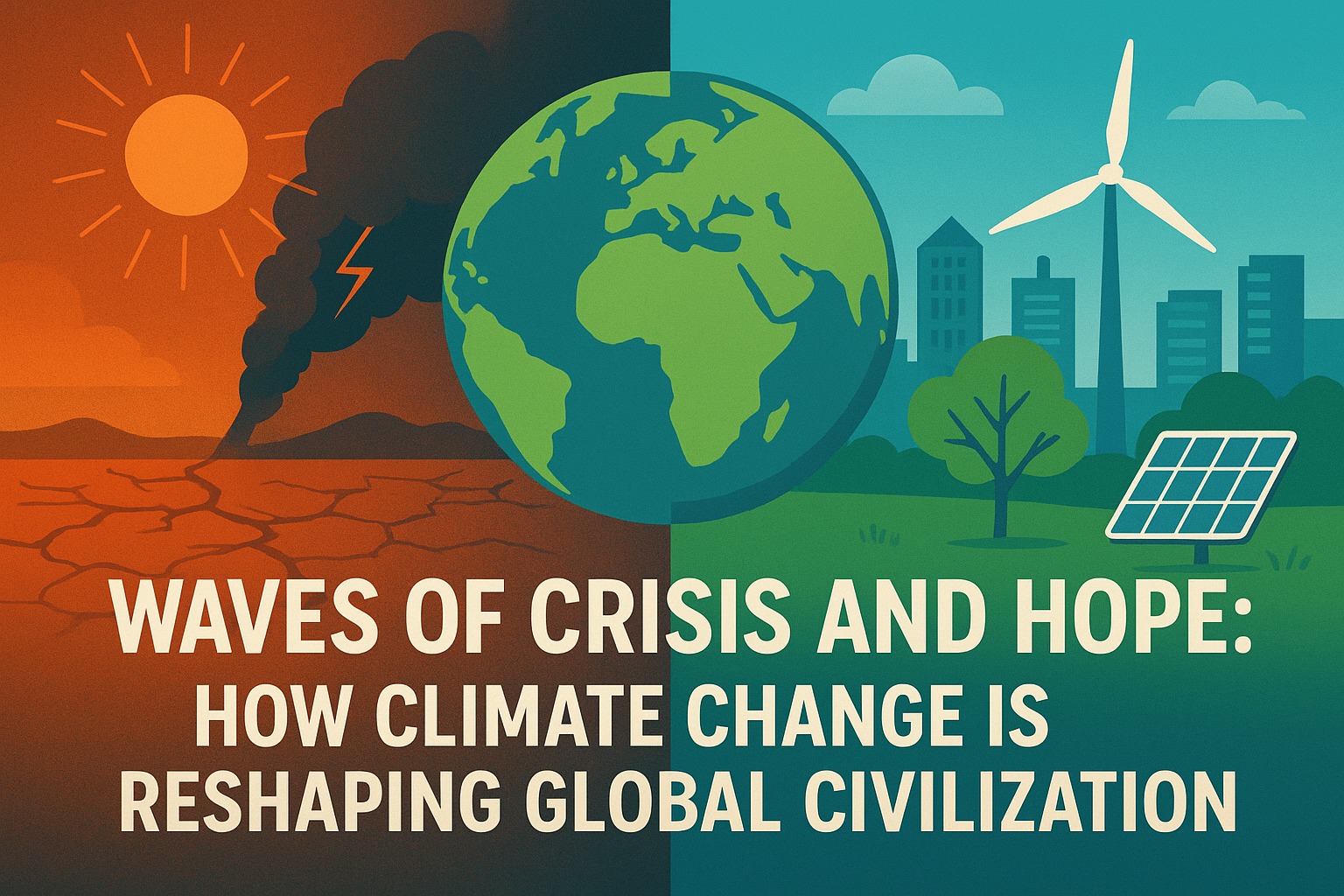
Human civilization has never been separated from nature’s influence, but today that relationship is entering its most fragile phase. Climate change is not merely a matter of temperatures rising by a few degrees — it is a massive shift affecting food security, health, the economy, and even political stability. Stronger storms, unpredictable seasons, and steadily rising sea levels are clear signs that the Earth is shifting course.
In this moment, humanity faces two great waves: the threat of crisis and the hope for survival. Climate change forces the world to redefine how we live, rebuild economic systems, and rethink our relationship with nature. At this point, the history of civilization is being rewritten.
A Warming Planet, A Shaken World
Global warming is disrupting ecosystems that have remained stable for thousands of years. Polar ice is melting, coral reefs are bleaching, and forests are losing their ability to recover. The natural world, once the foundation of civilization, is now becoming a source of threat.
Its impacts ripple into social life. Coastal regions face the risk of submersion, dry areas become more arid, and tropical diseases spread farther than ever before. As the environment becomes unstable, so do the societies that depend on it.
Civilization at a Turning Point
History shows that climate shifts have toppled kingdoms and triggered mass migrations. Today, similar threats are re-emerging — but on a global scale. The resilience of civilization is now tested not by economic strength alone, but by the ability to adapt.
Major cities are beginning to transform through green infrastructure, while rural areas adjust their farming patterns. The world is learning that development without environmental awareness is a recipe for collapse. Modern civilization is being pushed to rebuild itself on the foundation of sustainability.
A Chain of Unbroken Impacts
Climate change is not a single domino; it is a long, interconnected chain.
Here are the major impacts now being felt worldwide:
- Food Crisis
Extreme weather leads to crop failures, reduced yields, and rising food prices.
- Climate Migration
Millions are forced to abandon their homes due to floods, droughts, or rising sea levels.
- Health Threats
Climate-influenced diseases spread to new regions, increasing the risk of outbreaks.
- Economic Pressure
Natural disasters drain state budgets and slow economic growth.
When one sector collapses, others follow — revealing how deeply human life is connected to the environment.
In the Midst of Crisis, Hope Emerges
Behind the threats, global innovations are taking shape. Clean energy is replacing fossil fuels, electric transportation reduces pollution, and agricultural technologies help farmers survive extreme conditions.
Collective awareness is also rising. International green movements, climate campaigns, and sustainable lifestyles are becoming the new face of civilization. People and leaders alike are realizing that protecting the planet is not a choice, but a necessity.
Humanity’s Role in Shaping the Future
Humans are not only victims — they are also decision-makers. Every choice in consumption, policy, and innovation shapes the future of the climate. Civilizations do not collapse overnight; they fall through a series of small neglects.
Likewise, renewal begins with simple actions: saving energy, preserving forests, and supporting environmental policies. The future of Earth depends on the courage shown today.
Conclusion
Climate change has become a new sculptor of global civilization. It tears down old systems and demands the birth of new ones. The waves of crisis are immense, but hope has not yet drowned.
If humanity chooses to act, innovate, and unite, civilization will not end in destruction — it will evolve into something wiser and more sustainable. The future is not determined by disaster, but by how we respond to it.
About the Author
Gusti Ayu Tita
Author — STEKOM University
An active author focused on academic issues, educational technology, and human resource development in the campus environment.