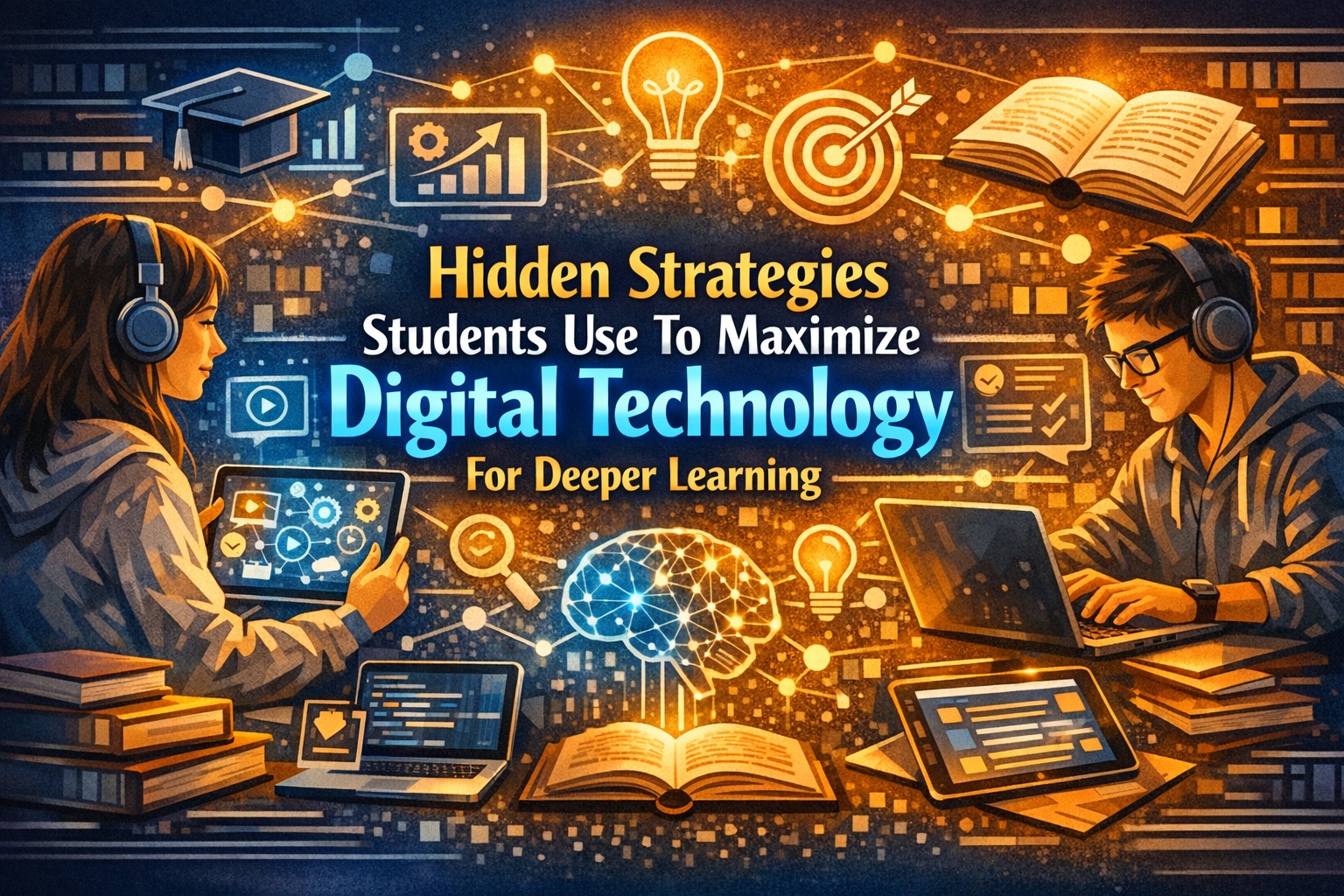
Digital technology has become an essential part of modern education, but not all students use it in the same way. While many rely on it only for basic tasks, some students quietly develop effective strategies to maximize its potential for deeper learning. These hidden strategies go beyond simply accessing information. They involve how students think, process, and apply knowledge in a more meaningful way.
INTRODUCTION
In higher education, digital technology is often seen as a tool for convenience. It helps students attend online classes, search for materials, and complete assignments more efficiently. However, its true power lies in how it can transform learning into a deeper and more engaging process.
Students who understand this do not just use technology passively. They actively explore ways to make their learning more effective, structured, and insightful. These strategies are rarely discussed, yet they play a crucial role in shaping successful learners.
This article uncovers the hidden strategies students use to maximize digital technology for deeper learning and how these approaches can be applied by others.
USING DIGITAL TOOLS FOR ACTIVE LEARNING
Active learning is one of the most effective ways to understand and retain information, and digital technology provides many opportunities to support it.
Instead of simply reading or watching content, students engage with materials through note taking apps, interactive quizzes, and digital mind maps. They ask questions, summarize ideas, and connect concepts while learning.
Some students also use features like playback control in video lectures to pause, rewind, and reflect on complex topics. This allows them to fully understand the material rather than just consume it.
By turning passive content into active engagement, students can significantly improve their comprehension and retention.
CURATING DIGITAL RESOURCES INTENTIONALLY
Not all information available online is useful or relevant. Successful students develop the ability to curate digital resources carefully.
They select high quality materials, organize them into categories, and revisit them when needed. This may include saving articles, bookmarking important pages, or creating structured digital notes.
By organizing information effectively, students reduce confusion and save time. They know exactly where to find what they need, which allows them to focus more on learning rather than searching.
This strategy transforms digital chaos into a structured knowledge system.
LEVERAGING AI FOR DEEPER UNDERSTANDING
Artificial intelligence has opened new possibilities for learning, but its effectiveness depends on how it is used.
Students who maximize AI do not just ask for answers. They use it to explore explanations, compare perspectives, and generate ideas. For example, they may ask AI to explain a concept in different ways or provide real life examples.
This approach helps them gain a deeper understanding rather than surface level knowledge. They use AI as a guide to expand their thinking, not as a shortcut to complete tasks.
By interacting critically with AI, students can turn it into a powerful learning partner.
BUILDING A PERSONALIZED LEARNING SYSTEM
Every student has a unique way of learning, and digital technology allows them to create systems that suit their needs.
Some students combine multiple tools such as digital planners, note taking apps, and learning platforms to create a structured routine. Others use reminders, progress trackers, and goal setting tools to stay consistent.
This personalized system helps students manage their time, monitor their progress, and maintain motivation. It also allows them to adapt their strategies based on what works best for them.
As a result, learning becomes more efficient and aligned with individual preferences.
USING DIGITAL COMMUNITIES FOR COLLABORATIVE LEARNING
Learning does not have to be done alone. Digital communities provide opportunities for collaboration and knowledge sharing.
Students join online forums, discussion groups, and study communities where they can exchange ideas and ask questions. These interactions expose them to different perspectives and deepen their understanding of topics.
In many cases, explaining concepts to others also strengthens their own knowledge. Teaching becomes a form of learning.
This collaborative approach transforms digital spaces into active learning environments.
PRACTICING REFLECTION THROUGH DIGITAL TOOLS
Reflection is an important part of deep learning, and digital tools make it easier to practice regularly.
Students can use journals, blogs, or note taking apps to reflect on what they have learned. They can write summaries, identify challenges, and evaluate their progress.
This process helps them become more aware of their learning patterns. They can identify strengths, address weaknesses, and improve their strategies over time.
Reflection turns learning into a continuous and evolving process.
MANAGING DISTRACTIONS IN DIGITAL ENVIRONMENTS
While digital technology offers many benefits, it also comes with distractions. Notifications, social media, and entertainment platforms can easily disrupt focus.
Successful students develop strategies to manage these distractions. They use focus apps, set time limits, or create dedicated study environments.
Some also apply techniques such as time blocking, where they allocate specific periods for focused learning and breaks.
By controlling distractions, students can maintain concentration and make better use of their study time.
TRANSFORMING INFORMATION INTO KNOWLEDGE
Access to information is not enough for deep learning. Students must learn how to transform information into knowledge.
This involves analyzing content, connecting ideas, and applying what they have learned to real situations. Digital tools can support this process through visualization, simulations, and interactive exercises.
Students who focus on understanding rather than memorizing are able to retain knowledge longer and use it more effectively.
This transformation is what truly defines deep learning.
CONCLUSION
Digital technology offers endless opportunities for learning, but its effectiveness depends on how it is used. Students who apply hidden strategies such as active learning, resource curation, AI utilization, and reflection are able to achieve deeper understanding.
These strategies show that technology is not just a tool for convenience. It is a powerful resource that can enhance thinking, creativity, and independence.
By adopting these approaches, students can move beyond surface level learning and unlock the full potential of digital technology in their educational journey.
About the Author
Gusti Ayu Tita
Author — STEKOM University
An active author focused on academic issues, educational technology, and human resource development in the campus environment.