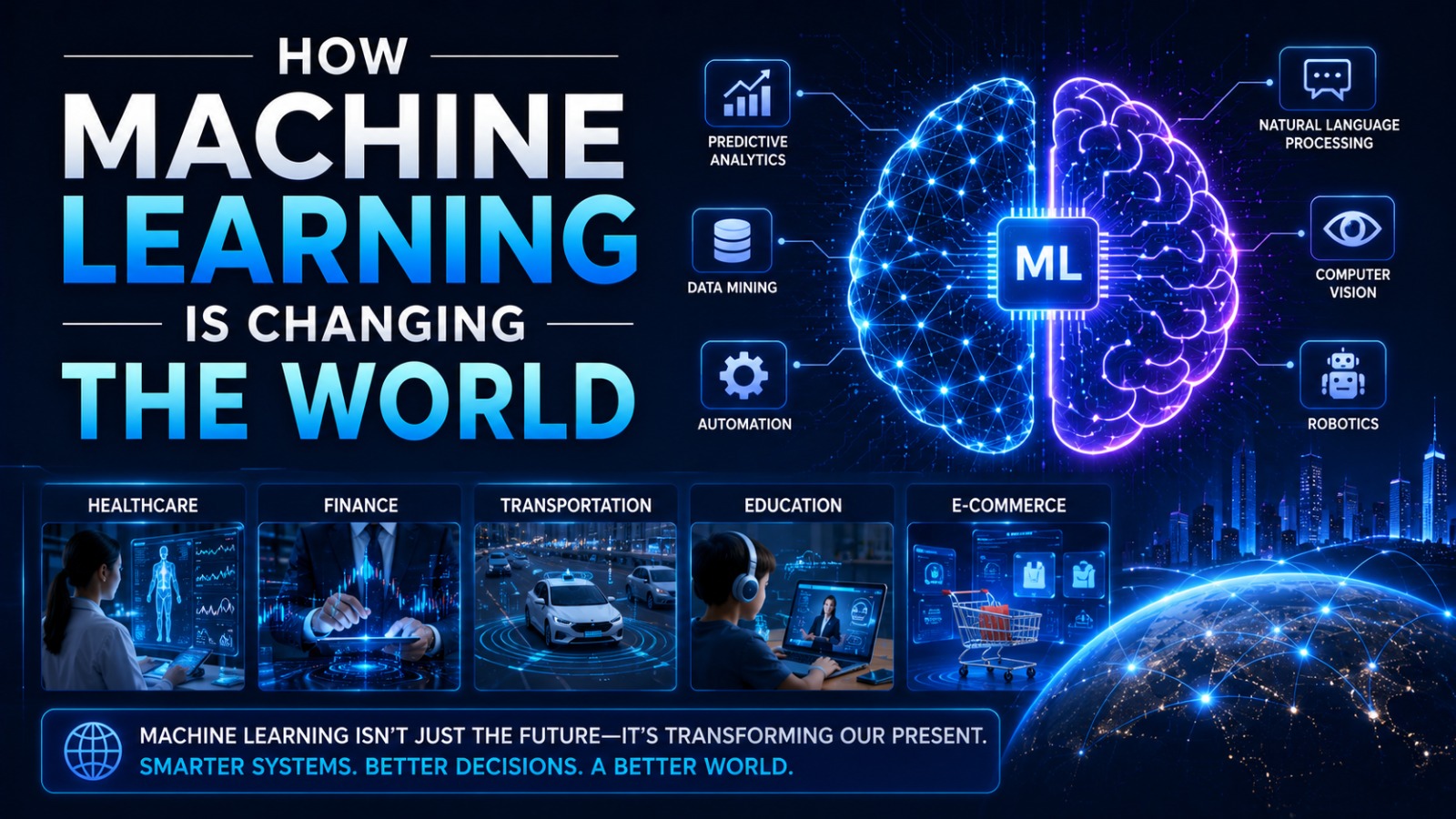
Machine learning has become one of the most influential technologies of the modern era. As a subset of artificial intelligence, it enables systems to learn from data, identify patterns, and make decisions with minimal human intervention. From personalized recommendations to advanced medical diagnostics, machine learning is transforming industries and reshaping everyday life.
WHAT IS MACHINE LEARNING?
Machine learning is a branch of artificial intelligence that focuses on building algorithms capable of learning from data. Instead of being explicitly programmed for every task, these systems improve their performance over time as they are exposed to more information.
There are several types of machine learning, including supervised learning, unsupervised learning, and reinforcement learning. Each approach serves different purposes, depending on the nature of the problem and the available data.
KEY BENEFITS OF MACHINE LEARNING
Machine learning offers numerous advantages that drive its widespread adoption:
- Automation: Reduces the need for manual processes and increases efficiency.
- Accuracy: Improves decision-making through data-driven insights.
- Scalability: Handles large volumes of data with ease.
- Adaptability: Continuously learns and evolves over time.
These benefits make machine learning a valuable tool for organizations seeking innovation and growth.
APPLICATIONS ACROSS INDUSTRIES
Machine learning is being applied in a wide range of sectors:
- Healthcare: Enhances disease detection and personalized treatment plans.
- Finance: Detects fraudulent activities and improves risk assessment.
- Retail: Powers recommendation systems and customer analytics.
- Transportation: Supports autonomous vehicles and route optimization.
These applications highlight the versatility and impact of machine learning in solving complex problems.
IMPACT ON DAILY LIFE
Machine learning has become an integral part of everyday experiences. From voice assistants to streaming platforms, users interact with machine learning systems more often than they realize.
For instance, recommendation algorithms suggest products, movies, or music based on user preferences. Navigation apps use machine learning to predict traffic patterns and suggest optimal routes. These conveniences enhance efficiency and user satisfaction.
ROLE IN BUSINESS TRANSFORMATION
Businesses leverage machine learning to gain a competitive edge. By analyzing large datasets, companies can uncover valuable insights, optimize operations, and improve customer experiences.
Machine learning also enables predictive analytics, allowing organizations to anticipate trends and make informed decisions. This capability is crucial in dynamic markets where adaptability is key to success.
CHALLENGES AND ETHICAL CONSIDERATIONS
Despite its advantages, machine learning presents several challenges. Data privacy concerns, algorithmic bias, and lack of transparency are significant issues that must be addressed.
Ensuring that machine learning systems are fair, accountable, and ethical is essential. Organizations must implement responsible practices to build trust and avoid unintended consequences.
FUTURE OF MACHINE LEARNING
The future of machine learning is filled with potential. Advancements in computing power, data availability, and algorithm design will continue to drive innovation.
Integration with other technologies, such as robotics and the Internet of Things, will expand its applications even further. As machine learning evolves, it will play a central role in shaping the future of technology and society.
CONCLUSION
Machine learning is revolutionizing the way the world operates. Its ability to learn from data and make intelligent decisions is transforming industries and improving daily life.
While challenges remain, the continued development of machine learning promises a future filled with innovation and opportunity. Embracing this technology will be essential for individuals and organizations aiming to thrive in the digital age.
About the Author
Gusti Ayu Tita
Author — STEKOM University
An active author focused on academic issues, educational technology, and human resource development in the campus environment.