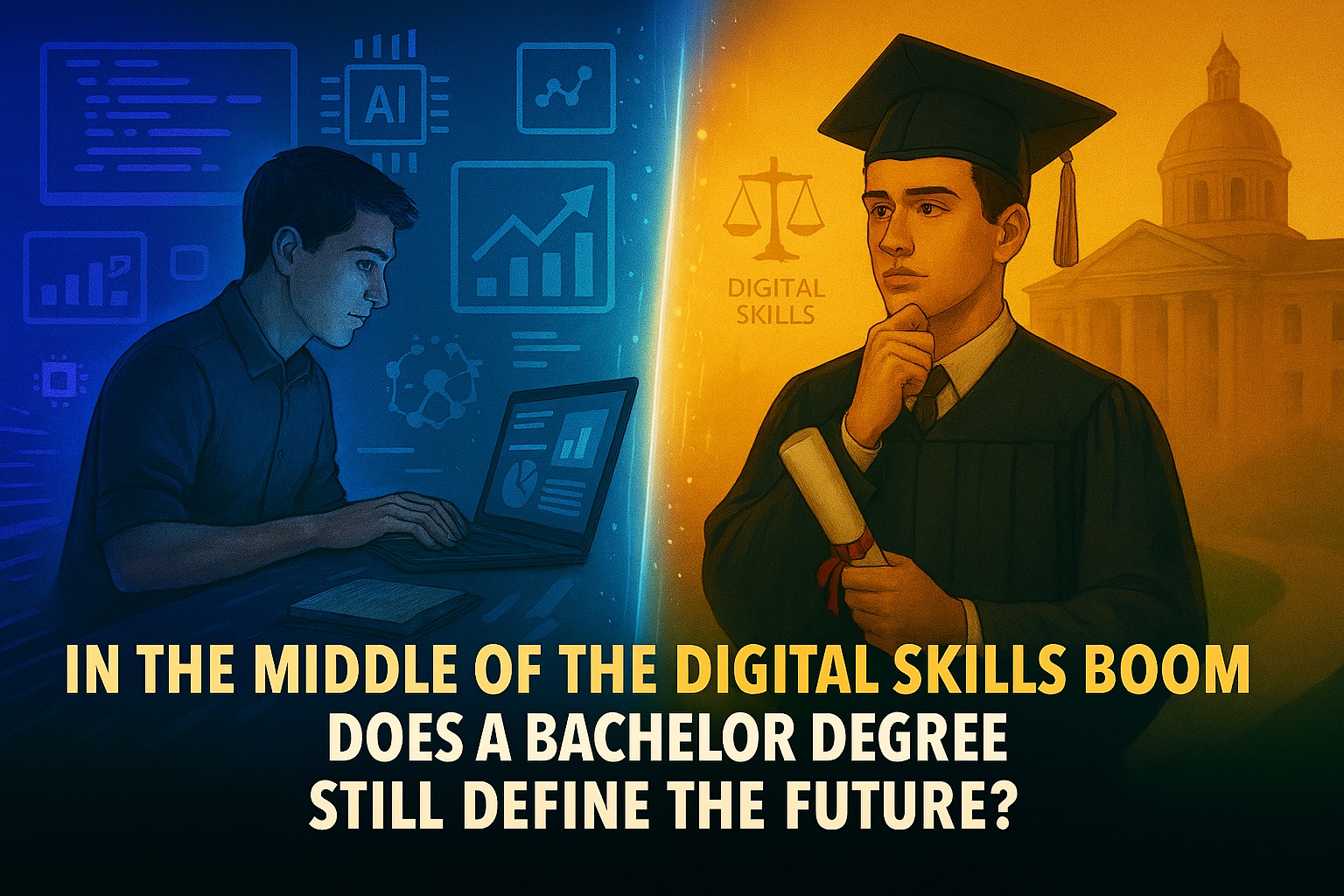
The world is experiencing a massive digital skills boom. From coding and data analytics to content creation and artificial intelligence, technical expertise is more accessible than ever. Online platforms, short courses, and industry certifications allow people to gain job-ready skills in months instead of years.
Amid this transformation, an important question arises: in the middle of the digital skills boom, does a bachelor degree still define the future? This article explores the evolving role of higher education and whether a bachelor degree remains a key factor in long-term career success.
THE RISE OF THE DIGITAL SKILLS ECONOMY
The digital economy has reshaped how businesses operate. Companies rely heavily on technology, automation, and global connectivity. As a result, digital skills have become some of the most in-demand competencies in the job market.
Today, employers often prioritize practical abilities such as programming, digital marketing, UX design, and cybersecurity. Many job descriptions emphasize proven skills and project experience over formal academic qualifications.
This shift has empowered individuals to pursue alternative learning paths. Bootcamps, micro-credentials, and self-paced courses provide targeted knowledge aligned with industry needs. For many, this route appears faster and more cost-effective than pursuing a traditional four-year degree.
WHAT A BACHELOR DEGREE STILL PROVIDES
Despite the surge in digital learning opportunities, a bachelor degree continues to offer distinct advantages. Higher education delivers more than technical training. It develops analytical thinking, research capabilities, communication skills, and intellectual discipline.
University programs are structured to provide depth and context. Students explore theories, historical developments, ethical considerations, and interdisciplinary perspectives. This broader understanding helps graduates adapt when technologies evolve or industries shift.
Additionally, certain professions still require formal qualifications. Fields such as healthcare, law, engineering, and public administration depend on accredited academic credentials. In these sectors, a bachelor degree remains a foundational requirement.
SHORT TERM SKILLS VERSUS LONG TERM GROWTH
Digital skills can open doors quickly, but long-term career growth often depends on more than technical expertise. Leadership, strategic planning, critical thinking, and problem-solving are competencies typically cultivated over extended academic experiences.
A bachelor degree signals persistence and the ability to complete a structured program. It often serves as a gateway to advanced education, managerial roles, and global opportunities.
The key distinction lies in time horizon. Short-term training may help secure an entry-level role, while higher education can support sustainable career advancement.
THE HYBRID APPROACH TO CAREER SUCCESS
Rather than viewing digital skills and higher education as opposing forces, many professionals are combining both. Students pursue a bachelor degree while earning certifications, completing internships, or building digital portfolios.
This hybrid approach reflects the modern reality of lifelong learning. The future workforce must remain adaptable, continuously upgrading skills to keep pace with technological change.
Employers increasingly value candidates who demonstrate both academic grounding and hands-on expertise. The integration of structured education and practical experience creates a competitive advantage.
DOES A BACHELOR DEGREE STILL DEFINE THE FUTURE
The answer is not absolute. A bachelor degree no longer single-handedly defines the future, but it remains a powerful component of professional development.
In the middle of the digital skills boom, success depends on adaptability, continuous learning, and the ability to apply knowledge effectively. A degree can provide a strong foundation, while digital skills ensure relevance in a rapidly changing market.
Ultimately, the future belongs to individuals who balance education with innovation, theory with practice, and long-term vision with immediate skill application.
About the Author
Gusti Ayu Tita
Author — STEKOM University
An active author focused on academic issues, educational technology, and human resource development in the campus environment.