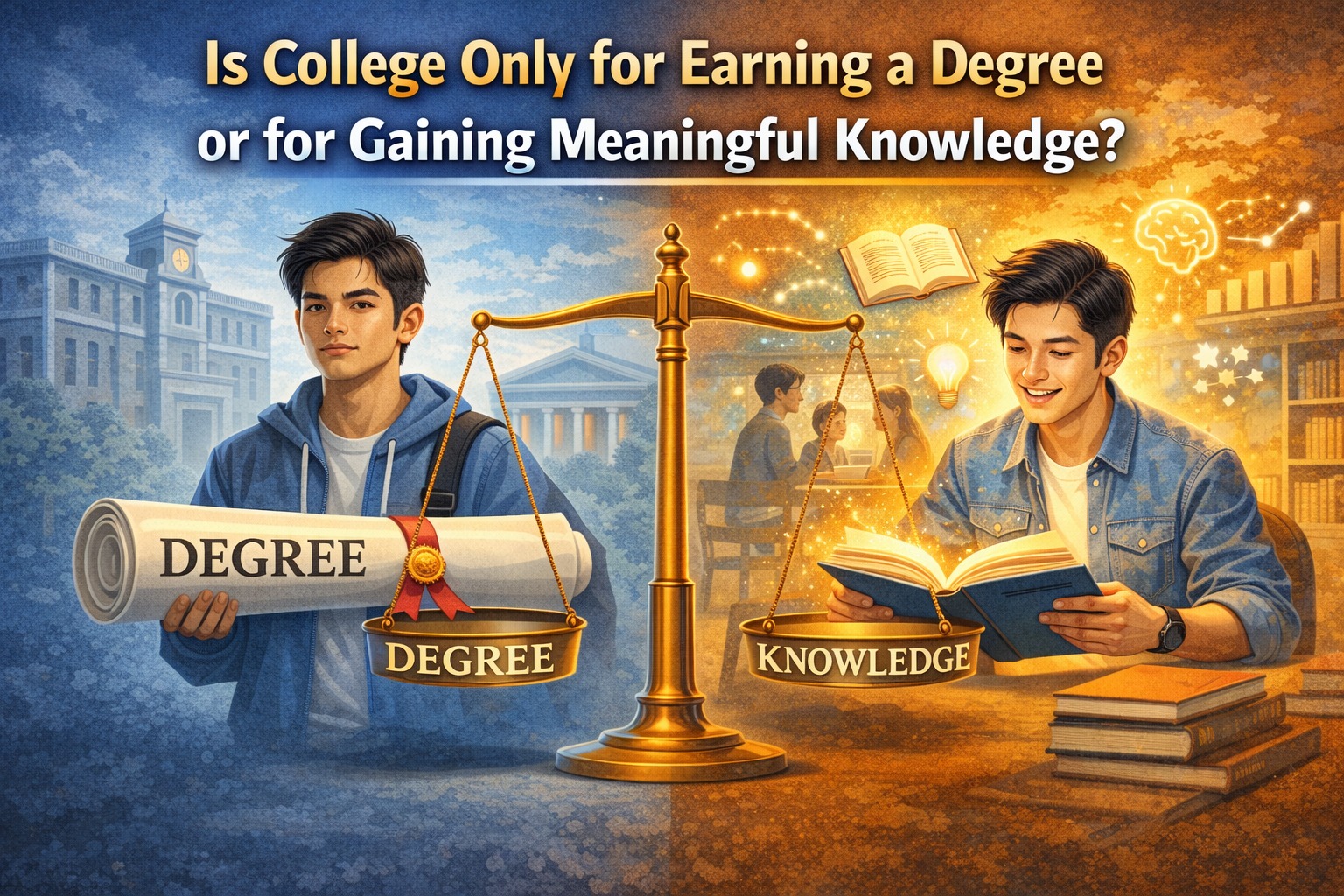
In today’s competitive world, many students pursue higher education with one primary goal: earning a degree. A diploma is often seen as the key to better job opportunities, higher salaries, and social recognition. However, an important question arises: Is college only for earning a degree, or is it truly about gaining meaningful knowledge?
This question reflects a broader debate about the real purpose of higher education. While a degree is important, the value of college extends far beyond a certificate.
THE DEGREE AS A FORMAL QUALIFICATION
There is no doubt that a college degree holds significant value. Employers often use it as a benchmark to assess a candidate’s academic background and commitment. In many industries, a degree is a minimum requirement for entering professional careers such as law, medicine, engineering, and education.
A degree represents:
- Completion of structured academic training
- Mastery of specific subject areas
- Discipline and perseverance
- A basic qualification for employment
From this perspective, college serves as a gateway to the job market. Without a degree, many career paths may remain inaccessible. Therefore, earning a degree is a practical and realistic goal for many students.
However, if students focus only on obtaining a diploma without truly understanding what they learn, they may miss the deeper purpose of education.
GAINING MEANINGFUL KNOWLEDGE AND CRITICAL THINKING
College is designed not only to provide information but also to develop intellectual abilities. Meaningful knowledge goes beyond memorizing theories or passing exams. It involves understanding concepts, applying them in real-life situations, and thinking critically about problems.
In college, students learn to:
- Analyze complex issues
- Conduct research
- Communicate ideas effectively
- Solve problems creatively
- Collaborate with others
These skills are essential in the modern workplace, where adaptability and critical thinking are highly valued. Knowledge gained through active learning helps students become independent thinkers rather than passive recipients of information.
Meaningful education shapes how students see the world, make decisions, and contribute to society.
PERSONAL GROWTH BEYOND THE CLASSROOM
Another important aspect of college is personal development. Higher education is often a transformative period in a person’s life. Students meet people from diverse backgrounds, engage in discussions, join organizations, and participate in extracurricular activities.
Through these experiences, they develop:
- Leadership skills
- Emotional intelligence
- Social awareness
- Time management abilities
- Confidence and independence
These qualities cannot be measured by grades alone. They are built through interaction, experience, and reflection. College, therefore, becomes a space for holistic growth, not just academic achievement.
THE RISK OF FOCUSING ONLY ON THE DIPLOMA
When students see college solely as a way to obtain a degree, learning may become superficial. They might prioritize grades over understanding, memorize information without comprehension, and choose easy paths instead of challenging themselves.
This mindset can lead to several consequences:
- Limited practical skills
- Lack of innovation
- Difficulty adapting to real-world challenges
- Reduced long-term career growth
Employers increasingly look for candidates who demonstrate competence, creativity, and initiative—not just academic credentials. A degree may open the door, but knowledge and skills determine long-term success.
FINDING THE BALANCE BETWEEN DEGREE AND KNOWLEDGE
The ideal approach is not choosing between a degree and meaningful knowledge but combining both. A degree provides formal recognition, while meaningful knowledge builds competence and character.
Students can maximize their college experience by:
- Actively participating in class discussions
- Seeking internships or practical experiences
- Engaging in research projects
- Building professional networks
- Continuously learning beyond the curriculum
By doing so, they transform college from a mere credentialing process into a powerful foundation for lifelong learning and career development.
CONCLUSION
So, is college only for earning a degree or for gaining meaningful knowledge? The answer is clear: it should be both—but with a stronger emphasis on meaningful learning. A degree may serve as proof of education, but knowledge, skills, and personal growth define true success.
Higher education is not just about collecting certificates. It is about shaping critical thinkers, responsible professionals, and lifelong learners. Students who understand this difference will gain far more than a diploma—they will gain the ability to thrive in an ever-changing world.
About the Author
Gusti Ayu Tita P
Author — STEKOM University
An active author focused on academic issues, educational technology, and human resource development in the campus environment.