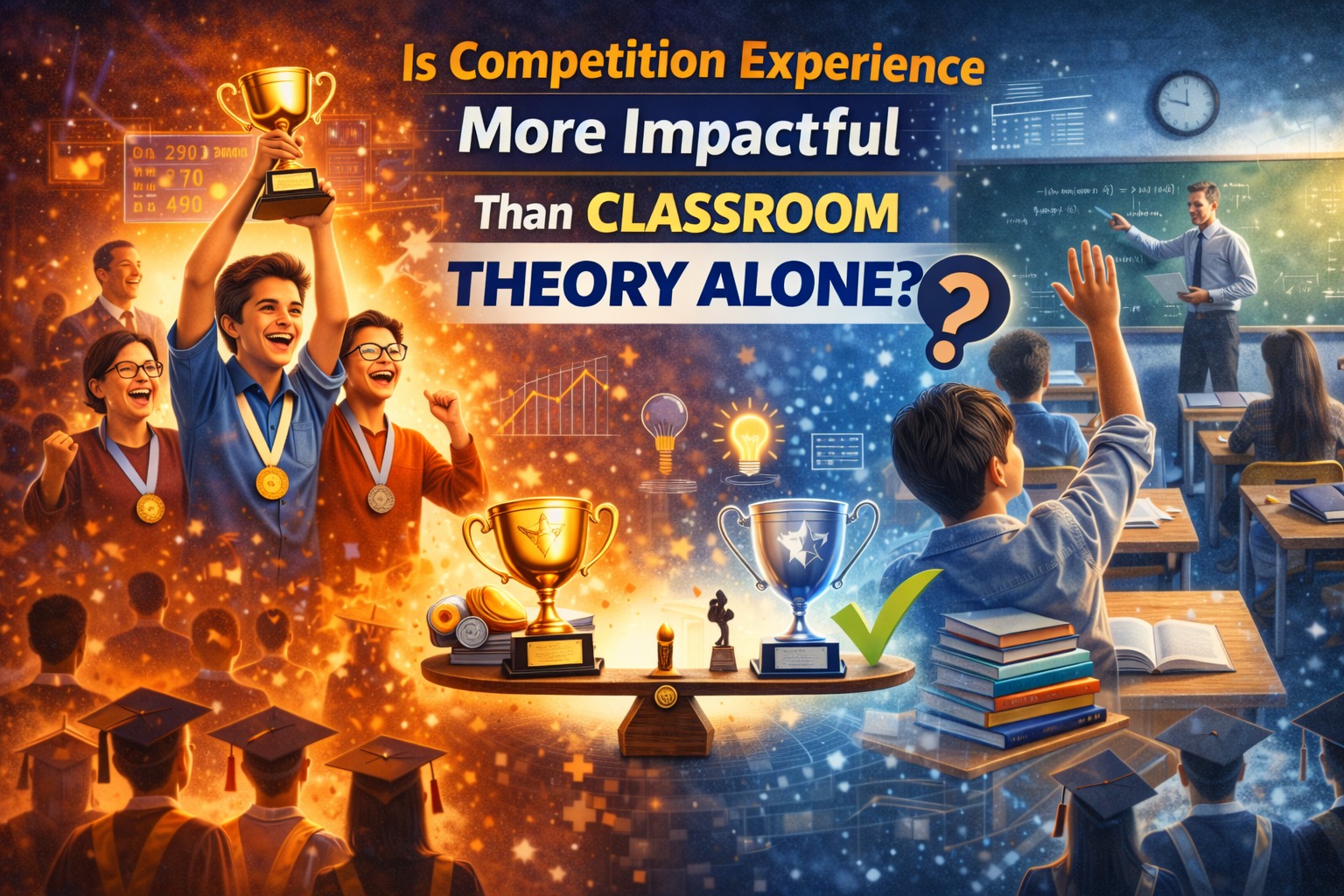
In higher education, students are not only expected to understand theories in the classroom but also to apply them in real-world contexts. One learning approach often considered effective is participation in competitions. However, an important question arises: is competition experience truly more impactful than theoretical learning alone?
THE ROLE OF THEORY IN BUILDING A KNOWLEDGE FOUNDATION
Classroom theory serves as the primary foundation of learning. Through theory, students understand concepts, principles, and frameworks that form the basis of a discipline. Without strong theoretical mastery, practical application may lack direction and rely heavily on trial and error.
Theoretical learning also develops analytical thinking, logic, and systematic understanding, which are essential for solving both academic and professional problems.
COMPETITION AS A FORM OF REAL-WORLD LEARNING
Unlike classroom settings, competitions place students in real, challenging situations. In competitions, students are required to think quickly, make strategic decisions, and work under time pressure and performance targets.
These experiences help students understand how theories are applied in real conditions while sharpening problem-solving and adaptability skills.
THE IMPACT OF COMPETITION ON SKILL DEVELOPMENT
Competitions do not only test knowledge but also foster the development of both soft skills and hard skills. Communication, teamwork, time management, and leadership skills are often cultivated through the preparation and execution of competitions.
Such skills are difficult to develop optimally if students rely solely on theoretical learning.
A COMPARISON OF LONG-TERM IMPACT
In the long run, students with competition experience tend to be better prepared to face workplace challenges. They become accustomed to handling pressure, receiving criticism, and evaluating their performance objectively.
However, these advantages are maximized only when supported by strong theoretical understanding. Without a solid academic foundation, competition experience may lose its reflective and educational value.
BALANCING THEORY AND EXPERIENCE
The question of which is more impactful does not need to be answered by choosing one over the other. Theory and competition experience complement each other. Theory provides direction, while competition offers context and real-world exposure.
Students who successfully combine both gain a more comprehensive understanding and stronger readiness to face academic and professional challenges.
THE ROLE OF UNIVERSITIES IN INTEGRATING BOTH APPROACHES
Universities play a strategic role in integrating theory and practical experience. Support for academic competitions, collaborative projects, and problem-based learning is essential in bridging the gap between concepts and practice.
With this approach, the learning process becomes more relevant and impactful.
CONCLUSION
Competition experience does have a significant impact on developing students’ skills and readiness, but it cannot stand alone without strong theoretical support. The two should not be compared, but integrated. When theory and competition experience are balanced, students gain more meaningful and sustainable learning outcomes.
About the Author
Gusti Ayu Tita
Author — STEKOM University
An active author focused on academic issues, educational technology, and human resource development in the campus environment.