
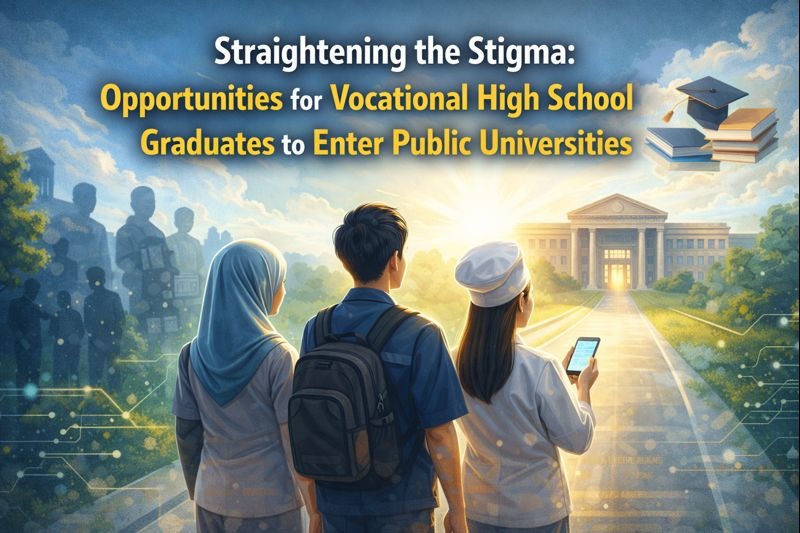
The stigma that graduates of Vocational High Schools (SMK) are only suited to enter the workforce immediately after graduation still persists strongly in society. This perception causes many SMK students to hesitate about continuing their education to Public Universities (PTN), even though such opportunities are actually open to them. Along with changes in the national education system, this long-standing assumption is gradually losing its relevance.
This article discusses the real facts about opportunities for SMK graduates to enter public universities, he available admission pathways, and ways to correct the stigma that has long limited their educational choices.
The Origins of the Stigma Against SMK Graduates
The stigma surrounding SMK originates from the initial purpose of vocational schools, which were designed to prepare students to be job-ready upon graduation. The strong focus on practical skills is often misinterpreted as a lack of academic ability. In reality, SMK students are also equipped with general knowledge, logical thinking skills, and basic academic competencies that are relevant to higher education.
This misunderstanding has shaped the assumption that SMK graduates have limited access to higher education.
Regulatory Facts: Equal Rights for All
From a regulatory perspective, SMK graduates have the same rights as graduates of general high schools (SMA) and Islamic senior high schools (MA) to pursue higher education. There are no regulations that prohibit SMK graduates from applying to public universities. The selection process is based on academic performance, test results, and suitability with the chosen study program.
This confirms that opportunities to enter public universities are open to everyone, regardless of their school background.
Public University Admission Pathways Open to SMK Graduates
SMK graduates can apply through several official admission pathways, including:
Merit-Based Selection
SMK students with consistent academic records and supporting achievements have the opportunity to be accepted through merit-based pathways, especially when choosing study programs aligned with their vocational competencies.
Test-Based Selection
Test-based admissions assess reasoning, literacy, and numeracy skills. With proper preparation, SMK graduates can compete fairly with applicants from other educational backgrounds.
Independent University Admission Pathways
Public universities also offer independent admission pathways with various selection mechanisms. These pathways serve as strategic alternatives to expand opportunities for entering higher education.
Advantages of SMK Graduates in Campus Life
SMK graduates possess strengths that often become added value in higher education, such as practical experience, teamwork skills, and readiness to handle project-based assignments. These advantages are highly relevant in applied, vocational, and engineering programs.
With learning approaches that are increasingly application-oriented, an SMK background can become a strong asset.
Changing Perspectives, Opening Futures
Correcting the stigma surrounding SMK graduates is not only the responsibility of students but also of educational institutions and society. Accurate information and the courage to try are key to ensuring that SMK graduates do not hesitate to pursue public universities.
Higher education does not belong to a single educational track. With proper strategies and preparation, SMK graduates have real opportunities to enter public universities and achieve broader future prospects.
**Keywords:**
About the Author
Gusti Ayu Tita
Author — STEKOM University
An active author focused on academic issues, educational technology, and human resource development in the campus environment.



