INTRODUCTION
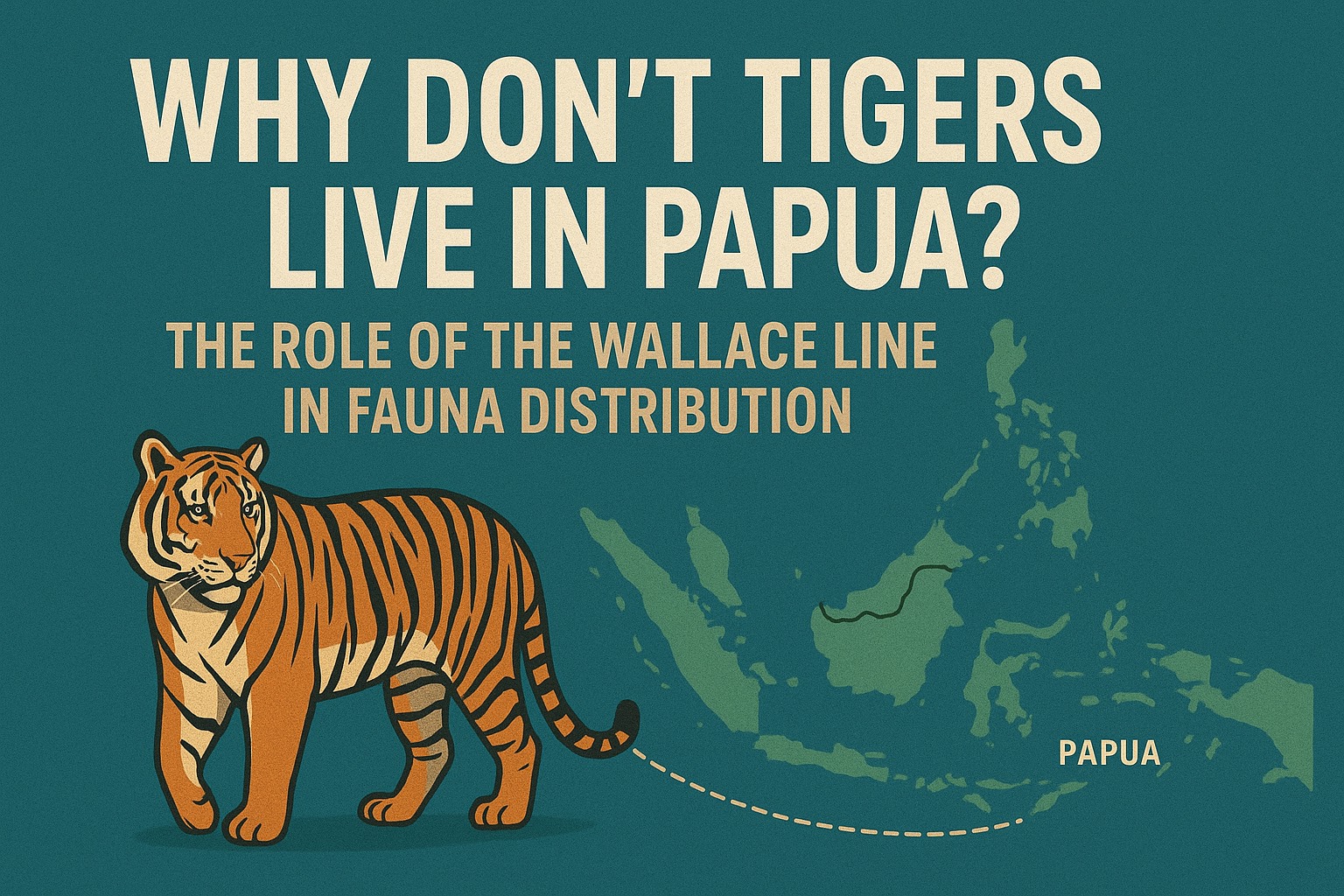
Indonesia is home to an extraordinary diversity of wildlife, ranging from tigers in Sumatra to birds of paradise in Papua. However, a common question often arises: why are tigers not found in Papua? After all, these regions are part of the same country and both have vast forest areas. The answer to this phenomenon is closely related to a scientific concept known as the Wallace Line—an invisible natural boundary that influences the distribution of animal species.
TIGERS AS ASIAN FAUNA
Tigers are large mammals that belong to the Asian fauna group. They naturally inhabit regions that were once connected to the Asian continent, such as Sumatra, Java, Kalimantan, and mainland Southeast Asia. Tigers require large and stable land habitats to survive, reproduce, and migrate.
From an evolutionary perspective, tigers developed in Asia and spread by following land routes. When geographical conditions changed, their distribution was halted by certain natural boundaries.
PAPUA’S POSITION IN THE AUSTRALIAN FAUNAL ZONE
Papua is part of the Australian faunal region. Millions of years ago, this area was separated from the Asian landmass and became geologically closer to the Australian continent. As a result, the fauna in Papua evolved differently, with a dominance of bird species and marsupials.
Iconic Papuan animals such as tree kangaroos and birds of paradise have no evolutionary relationship with tigers. This fundamental difference explains why tigers never naturally occurred in Papua.
THE ROLE OF THE WALLACE LINE IN FAUNAL DISTRIBUTION
The Wallace Line serves as a natural boundary between Asian and Australian fauna. It runs through deep ocean waters that have historically been difficult for land animals to cross, including large mammals like tigers.
Although the distances between islands may appear relatively short, the deep seas act as a natural barrier. Consequently, Asian fauna could not spread eastward to regions like Papua, and Australian fauna did not migrate westward into western Indonesia.
GEOLOGICAL AND EVOLUTIONARY FACTORS
During the ice ages, sea levels did drop significantly. However, the seas around the Wallace Line remained deep and never formed land bridges. This prevented permanent animal migration across the boundary.
Over long periods, this geographical isolation led to distinct evolutionary paths in each region. As a result, each zone developed unique species that are not found elsewhere.
CONCLUSION
The absence of tigers in Papua is not a coincidence. It is the result of long-term natural processes shaped by geological history and the role of the Wallace Line as a faunal boundary. Understanding this concept helps us appreciate that Indonesia’s biodiversity was formed through complex and interconnected scientific processes.
About the Author
Gusti Ayu Tita
Author — STEKOM University
An active author focused on academic issues, educational technology, and human resource development in the campus environment.