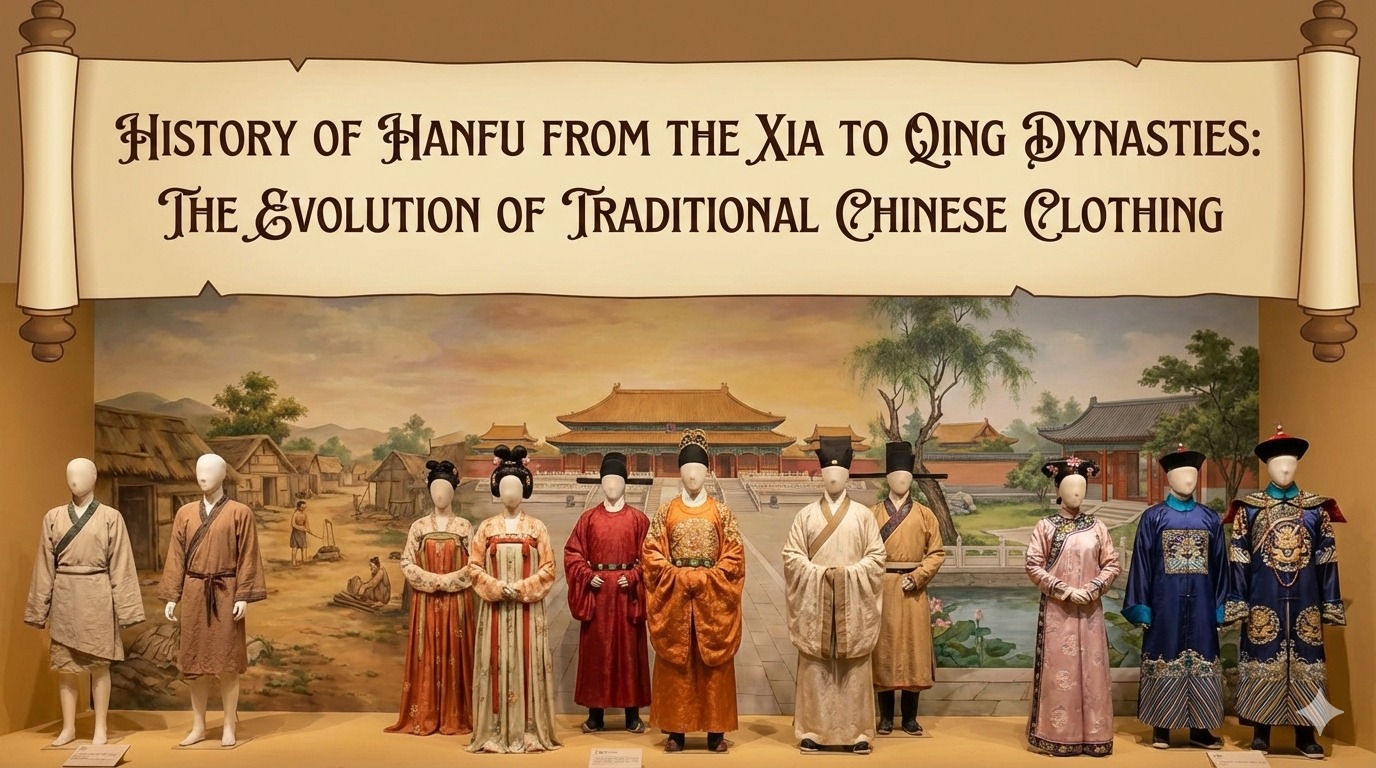
The History of Hanfu from the Xia to the Qing Dynasty: The Evolution of Traditional Chinese Clothing
Hanfu is the traditional attire of the Han ethnic group that developed alongside the long journey of Chinese civilization. This clothing not only functioned as body covering, but also represented cultural values, life philosophy, and the social structure of society in each dynastic period. This paper discusses the history and evolution of Hanfu from the Xia Dynasty to the Qing Dynasty, emphasizing changes in form, function, and cultural meaning. This study is expected to serve as cultural literacy material that enriches readers’ understanding of China’s cultural heritage.
Traditional clothing is an important part of a nation’s cultural identity. In China, Hanfu has become a symbol of civilization and the identity of the Han people, evolving over thousands of years. The history of Hanfu cannot be separated from the social, political, and cultural dynamics that occurred during each dynasty.
The development of Hanfu reflects changes in values and worldviews within Chinese society. From simple forms in the early stages of civilization to more complex designs during major dynasties, Hanfu records the historical journey of the Han people. Therefore, the study of Hanfu is important as an effort to preserve culture and strengthen historical literacy.
This paper aims to describe the history of Hanfu from the Xia Dynasty to the Qing Dynasty and to explain how the evolution of this clothing reflects the development of Chinese civilization.
A. Hanfu during the Xia, Shang, and Zhou Dynasties
During the Xia Dynasty (approximately 2100–1600 BCE), clothing was still simple and functional. Garments were made from natural fibers such as ramie and early silk. Nevertheless, the basic concept of Hanfu—separating upper and lower garments—began to emerge.
In the Shang and Zhou Dynasties, Hanfu developed alongside the rise of ritual systems and belief structures. Clothing functioned as a symbol of social status and as attire for religious ceremonies. Colors and patterns were strictly regulated to reflect a person’s position in society.
B. The Standardization of Hanfu in the Qin and Han Dynasties
The Qin and Han Dynasties marked an important period in the history of Hanfu. The government officially established dress regulations to strengthen national identity and social order. The *yi-shang* (separate upper and lower garments) and *shenyi* (one-piece robe) models became the main forms of Hanfu.
During the Han Dynasty, Hanfu was worn by all levels of society. This made Hanfu a symbol of the collective identity of the Han people and strengthened cultural unity.
C. The Development of Hanfu in the Tang, Song, and Ming Dynasties
In the Tang Dynasty, Hanfu experienced rapid development with more colorful and layered designs. Foreign cultural influences from the Silk Road enriched the forms and motifs of Hanfu, reflecting the cultural openness of Tang society.
In contrast, the Song Dynasty presented Hanfu in a simpler and more elegant style. Slimmer cuts and softer colors reflected intellectual values and a philosophy of modest living.
During the Ming Dynasty, Hanfu once again emphasized Han cultural identity. Clothing designs became more formal and conservative, reflecting social order and values of propriety.
D. Hanfu during the Qing Dynasty
During the Qing Dynasty, Manchu clothing became politically dominant. However, Hanfu did not completely disappear. The values and philosophy of Hanfu continued to survive in traditions, ceremonial practices, and the daily lives of Han communities.
Hanfu is a form of traditional clothing that records the long historical and cultural journey of China. The evolution of Hanfu from the Xia Dynasty to the Qing Dynasty reflects changes in social values, politics, and life philosophy among the Han people. Therefore, Hanfu is not only important as a cultural heritage, but also as a valuable source of historical literacy.
About the Author
Gusti Ayu Tita
Author — STEKOM University
An active author focused on academic issues, educational technology, and human resource development in the campus environment.