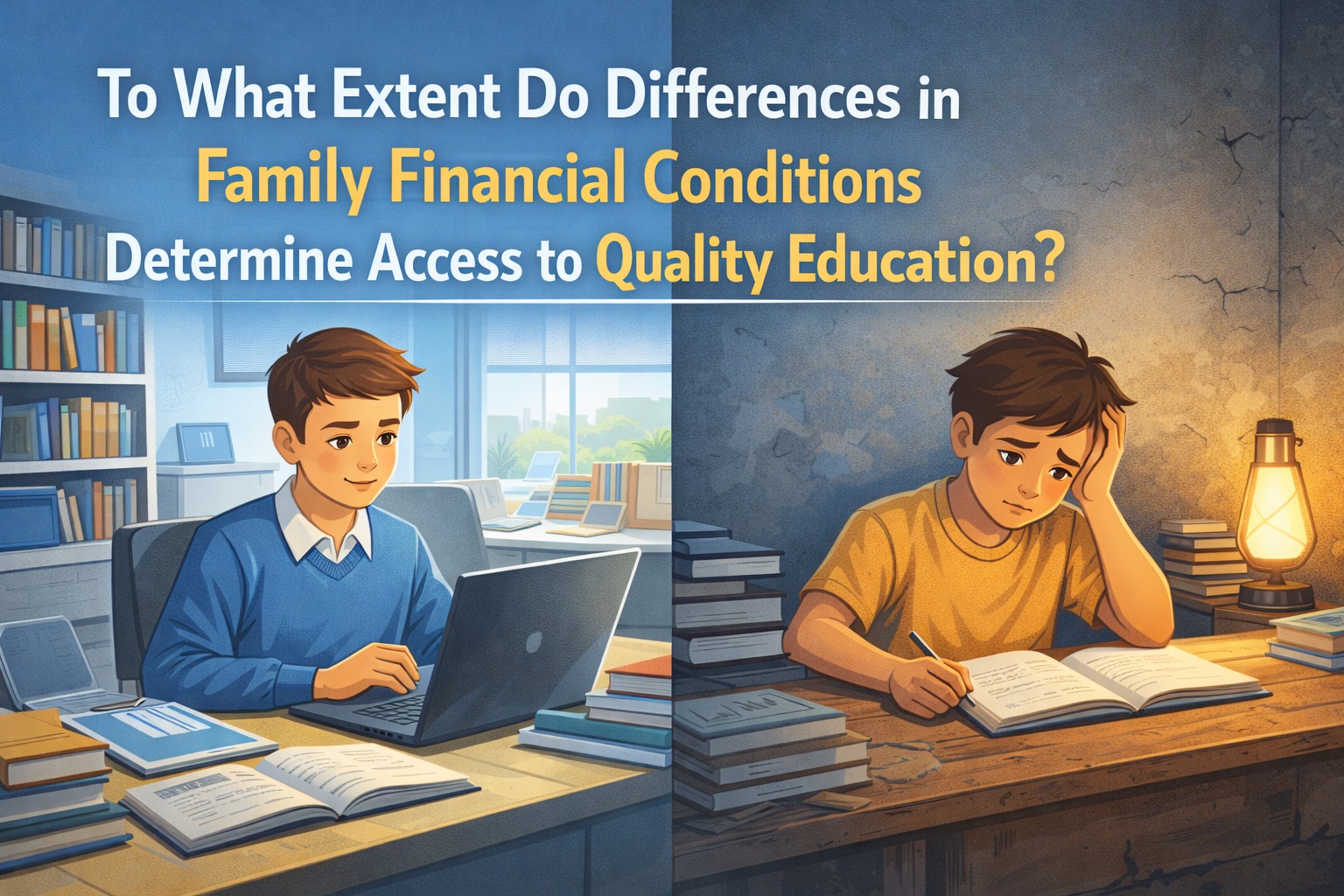
Access to quality education remains a major challenge in many regions. Although education is often described as “a right for every citizen,” in reality, not all children have equal opportunities. One of the most influential factors is a family’s financial condition. The question is: to what extent do economic differences determine the quality of education a child receives? This article examines the issue comprehensively.
The Role of Financial Conditions in School Choice
Families with stronger economic conditions tend to have more options. They can enroll their children in well-known schools with complete facilities or private institutions offering high-quality instruction.
In contrast, low-income families often have no choice but to send their children to nearby schools with limited facilities, insufficient teaching staff, or high teacher–student ratios.
Direct Impacts of These Conditions:
- Differences in learning quality
- Differences in the availability of educational facilities
- Variations in access to additional curricula such as foreign languages, technology, or the arts
Inequality in Access to Learning Resources
Financial conditions also affect a family’s ability to provide supplementary learning resources. Children from well-off families usually have access to:
- Complete books and stationery
- Laptops, tablets, or digital learning devices
- Stable internet access
- Private tutoring or extra lessons
Meanwhile, students from disadvantaged families may rely solely on school facilities—sometimes having to share devices or lacking internet access altogether. These disparities directly affect comprehension, learning speed, and academic performance.
The Home Learning Environment
Beyond facilities, financial conditions shape different home learning environments.
Well-established families can typically provide quiet and dedicated study spaces. In contrast, students from low-income households may live in crowded or noisy environments or be required to help their parents work, limiting their study time.
Impacts of the Home Learning Environment:
- Reduced concentration
- Irregular study schedules
- Higher stress levels
These factors indirectly lower academic achievement.
Gaps in Opportunities for Personal Development Activities
Quality education goes beyond academic instruction and includes non-academic activities such as:
- Academic competitions and Olympiads
- Student exchange programs
- Science, arts, or language clubs
- Leadership training
Unfortunately, registration fees, transportation costs, and equipment expenses often become barriers for students from low-income families. Yet these activities can open significant future opportunities, including scholarships and academic networks.
Long-Term Effects on Academic and Career Futures
Inequality in access to education from an early age has long-term consequences for:
- Admission to prestigious schools or universities
- Choice of academic majors
- Opportunities to obtain scholarships
- Readiness to enter the workforce
Children from economically disadvantaged families must work much harder to access the same opportunities.
Efforts to Reduce Inequality
To mitigate the impact of financial disparities on access to education, several measures can be taken:
1. Strengthening educational assistance programs such as KIP, regional scholarships, and school supply support.
2. Improving the quality of public schools, especially in underdeveloped areas.
3. Providing affordable or free internet access for students.
4. Encouraging collaboration between governments, schools, and communities to offer additional learning facilities.
Conclusion
Differences in family financial conditions play a major role in determining access to quality education. From learning facilities and school choices to opportunities for personal development, all are influenced by economic capacity. This inequality creates achievement gaps that can persist into a child’s future.
Quality education should be accessible to all children, not only those from financially advantaged backgrounds. Therefore, collective efforts are essential to reduce inequality and ensure that every child has an equal opportunity to achieve their full potential.
About the Author
Gusti Ayu Tita
Author — STEKOM University
An active author focused on academic issues, educational technology, and human resource development in the campus environment.