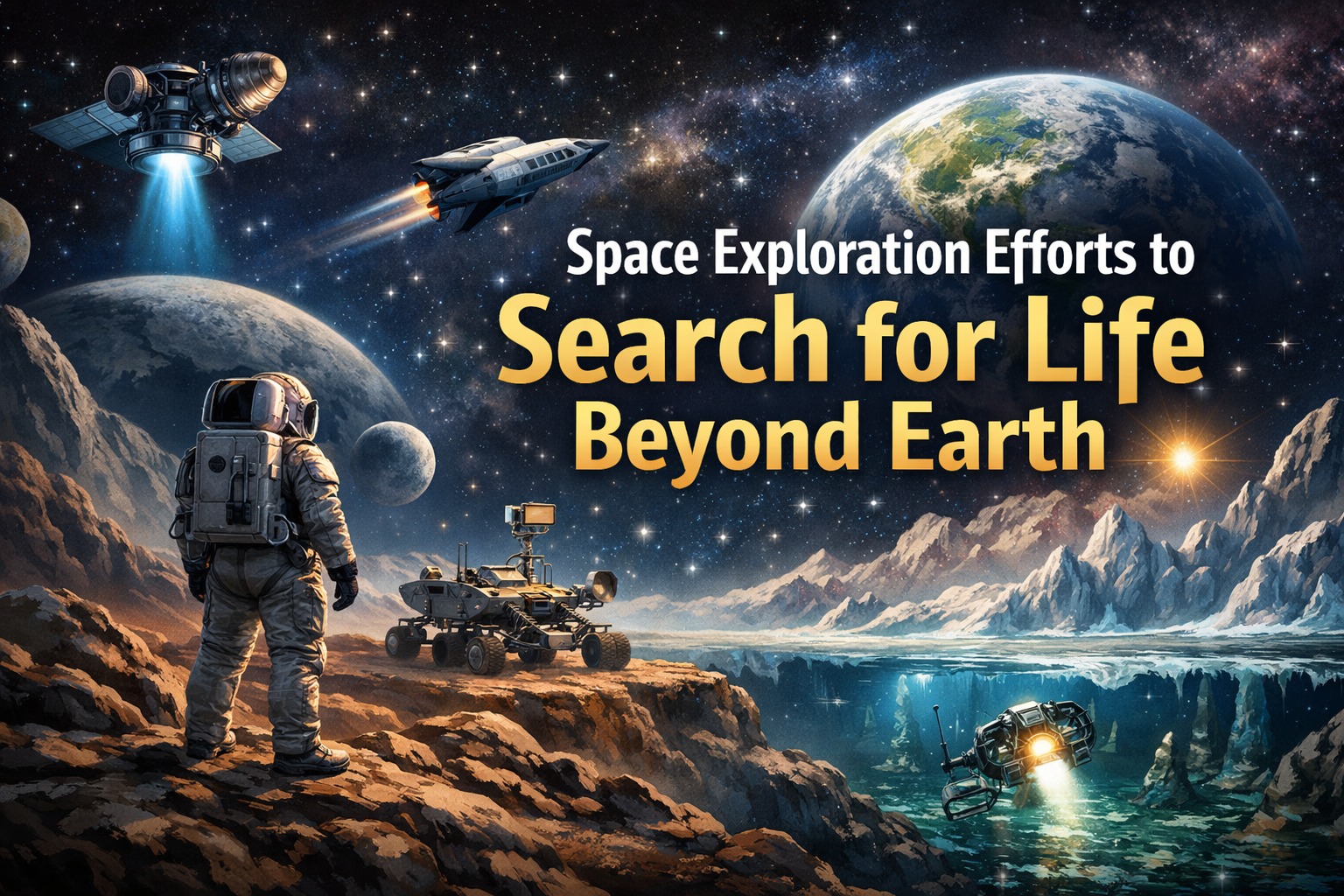
The question of whether humanity is alone in the universe has fascinated scientists and dreamers for centuries. Today, advances in technology and astronomy have transformed this curiosity into a serious scientific pursuit. Space exploration efforts to search for life beyond Earth are now at the forefront of modern science, combining innovation, collaboration, and cutting-edge discoveries.
THE IMPORTANCE OF SEARCHING FOR LIFE BEYOND EARTH
Understanding whether life exists elsewhere is not just about curiosity—it has profound implications for science, philosophy, and humanity’s future. Discovering extraterrestrial life could reshape our understanding of biology, evolution, and the conditions necessary for life.
Scientists focus on identifying environments that could support life, particularly those with water, energy sources, and suitable chemical elements. These efforts help us better understand how life originated on Earth and whether similar processes could occur elsewhere in the universe.
ADVANCED TECHNOLOGIES IN SPACE EXPLORATION
Modern space missions rely on highly sophisticated technologies. Telescopes, satellites, and robotic probes allow scientists to observe distant planets and analyze their atmospheres.
Space telescopes such as the James Webb Space Telescope have revolutionized the search by detecting chemical signatures in exoplanet atmospheres. These instruments can identify gases like oxygen, methane, and carbon dioxide, which may indicate biological activity.
Meanwhile, robotic missions to planets and moons within our solar system provide direct data. Rovers and landers collect samples, analyze soil composition, and search for microbial life in extreme environments.
KEY TARGETS IN THE SEARCH FOR LIFE
Several locations in our solar system and beyond are considered promising candidates in the search for extraterrestrial life.
Mars remains a primary target due to evidence of ancient water flows and the presence of organic molecules. Moons such as Europa (orbiting Jupiter) and Enceladus (orbiting Saturn) are also of great interest because they are believed to have subsurface oceans beneath their icy crusts.
Beyond our solar system, scientists study exoplanets located in the “habitable zone”—the region around a star where conditions may allow liquid water to exist. These planets are among the most exciting prospects for finding life.
CHALLENGES IN FINDING EXTRATERRESTRIAL LIFE
Despite significant progress, the search for life beyond Earth faces numerous challenges. The vast distances between stars make exploration difficult and time-consuming. Additionally, detecting life—especially microbial life—requires highly sensitive instruments and precise measurements.
Another challenge lies in defining what life actually is. Life elsewhere may not resemble life on Earth, making it harder to identify using current scientific methods. Researchers must remain open to unexpected forms of biology.
THE ROLE OF INTERNATIONAL COLLABORATION
Space exploration is no longer the effort of a single nation. International collaboration plays a crucial role in advancing research and sharing knowledge.
Organizations like NASA, ESA, and other global space agencies work together on joint missions, data sharing, and technological development. This cooperation accelerates discoveries and reduces the costs associated with complex space missions.
FUTURE PROSPECTS AND HUMAN INVOLVEMENT
The future of space exploration looks promising, with plans for more advanced missions and even human exploration beyond Earth orbit. Upcoming missions aim to return samples from Mars, explore icy moons, and deploy more powerful telescopes.
Private space companies are also contributing to innovation, making space more accessible and opening new possibilities for exploration. In the coming decades, humans may play a more direct role in searching for life beyond Earth.
CONCLUSION
The search for life beyond Earth represents one of the most exciting scientific endeavors of our time. Through advanced technology, global collaboration, and persistent curiosity, humanity continues to push the boundaries of what is possible.
While definitive evidence of extraterrestrial life has yet to be found, each mission brings us closer to answering one of the most fundamental questions: Are we alone in the universe?
About the Author
Gusti Ayu Tita
Author — STEKOM University
An active author focused on academic issues, educational technology, and human resource development in the campus environment.