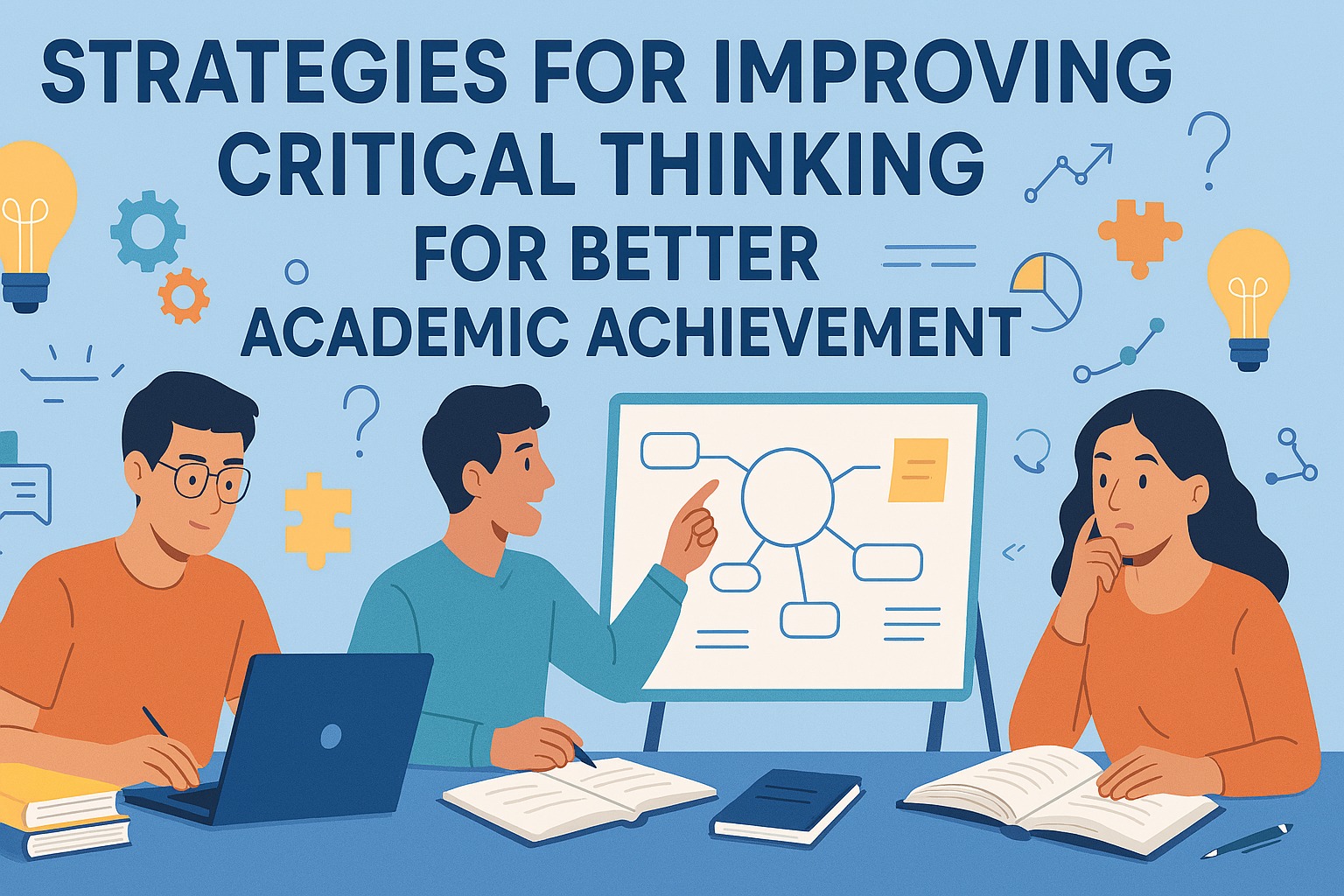
Critical thinking has become one of the most essential academic skills in modern education. In an era where information is easily accessible through digital platforms, students must be able to analyze, evaluate, and interpret information wisely. Without strong critical thinking abilities, learners may struggle to distinguish between reliable knowledge and misleading information.
Academic success is not only determined by memorizing theories or completing assignments. Students who are able to question ideas, evaluate arguments, and connect concepts from different disciplines tend to perform better in their studies. Critical thinking encourages deeper understanding, allowing learners to engage with academic materials more meaningfully.
Improving critical thinking does not happen instantly. It requires continuous practice, intellectual curiosity, and the willingness to explore different perspectives. Through the right strategies, students can gradually develop this skill and apply it effectively in their academic journey.
Developing critical thinking ultimately supports better academic achievement. When students learn to approach problems logically and thoughtfully, they are more capable of producing high-quality academic work, participating in meaningful discussions, and making informed decisions in their educational pursuits.
UNDERSTANDING THE CONCEPT OF CRITICAL THINKING
Critical thinking refers to the ability to analyze information objectively and make reasoned judgments. It involves questioning assumptions, identifying biases, and evaluating evidence before reaching conclusions. This skill allows students to move beyond surface-level understanding toward deeper intellectual engagement.
In academic environments, critical thinking helps students interpret complex theories and research findings. Instead of simply accepting information presented in textbooks or lectures, students learn to examine the reasoning behind ideas. This process strengthens their understanding of academic subjects.
Another important aspect of critical thinking is the ability to connect different ideas. Students who develop this skill can relate concepts from multiple disciplines, creating broader perspectives in their learning. This ability supports creativity and innovation in academic work.
Understanding the concept of critical thinking is the first step toward improving it. When students recognize how critical thinking functions in the learning process, they become more aware of the importance of questioning, analyzing, and reflecting on the information they encounter.
DEVELOPING A HABIT OF ASKING QUESTIONS
One effective strategy to improve critical thinking is cultivating the habit of asking questions. Curiosity encourages students to explore topics more deeply and avoid passive learning. Instead of accepting information as it is, they begin to examine the reasons behind it.
Questioning allows students to identify gaps in knowledge and clarify complex concepts. By asking meaningful questions during lectures or discussions, students actively engage with the learning process. This engagement helps them develop stronger analytical abilities.
Asking questions also encourages independent thinking. Students who question ideas are more likely to evaluate evidence and consider alternative explanations. This process helps them form balanced and logical conclusions in academic contexts.
Furthermore, the habit of questioning strengthens intellectual confidence. When students feel comfortable expressing curiosity and doubt, they develop a more active role in their education. Over time, this mindset enhances both learning outcomes and academic performance.
ENGAGING IN DISCUSSIONS AND ACADEMIC DEBATES
Academic discussions provide an excellent environment for developing critical thinking skills. When students exchange ideas with peers, they are exposed to diverse viewpoints that challenge their assumptions. This interaction encourages deeper reflection on the topics being discussed.
Debates are particularly effective in sharpening analytical abilities. In a debate setting, students must construct logical arguments, evaluate opposing perspectives, and support their claims with evidence. This process trains them to think systematically and communicate their ideas clearly.
Participating in discussions also improves listening skills. Critical thinkers do not only express their opinions but also analyze the arguments presented by others. This ability allows students to identify strengths and weaknesses in different viewpoints.
Through regular participation in academic conversations, students gradually develop intellectual maturity. They become more open to different perspectives while maintaining the ability to defend their ideas with sound reasoning.
STRENGTHENING RESEARCH AND INFORMATION LITERACY
Research activities play a crucial role in developing critical thinking. When students conduct academic research, they must evaluate sources, compare information, and identify credible references. This process trains them to analyze information carefully before using it in their work.
Information literacy is particularly important in the digital era. Students are constantly exposed to vast amounts of online content, but not all of it is reliable. Critical thinking helps them determine which sources are trustworthy and academically valuable.
Academic research also encourages students to explore complex problems systematically. By reviewing scholarly articles, analyzing data, and interpreting findings, learners gain a deeper understanding of academic subjects. This experience strengthens their analytical abilities.
Over time, strong research skills help students produce higher-quality academic papers. Their arguments become more evidence-based, structured, and convincing, contributing significantly to better academic achievement.
PRACTICING ANALYTICAL READING AND WRITING
Reading academic texts critically is another effective way to enhance thinking skills. Instead of reading passively, students should analyze the arguments presented by authors. They need to examine the purpose, evidence, and logic behind each claim.
Analytical reading encourages students to identify the strengths and weaknesses of an argument. By doing so, they develop the ability to evaluate academic materials more objectively. This skill is especially useful when studying complex theoretical frameworks.
Writing also plays a significant role in strengthening critical thinking. When students write essays or research papers, they must organize ideas logically and support their arguments with evidence. This process requires careful analysis and thoughtful reasoning.
Through consistent practice in analytical reading and writing, students gradually develop stronger intellectual discipline. These habits improve both comprehension and academic expression, which are essential for academic success.
APPLYING PROBLEM-SOLVING APPROACHES IN LEARNING
Problem-solving activities provide practical opportunities for applying critical thinking. When students face academic challenges, they must identify the problem, analyze possible solutions, and evaluate the most effective approach. This process encourages systematic reasoning.
Many academic disciplines rely on problem-solving as a core learning method. Whether in science, social studies, or humanities, students are often required to interpret data, analyze case studies, or develop solutions to theoretical problems.
By engaging in problem-based learning, students become more active participants in their education. They learn to approach challenges logically rather than relying solely on memorized information. This shift in mindset significantly improves learning quality.
Regular exposure to problem-solving tasks also increases intellectual resilience. Students become more comfortable dealing with complex questions and uncertain situations, which are common in higher education.
BUILDING A REFLECTIVE LEARNING MINDSET
Reflection is an important element of critical thinking development. After completing academic tasks, students should evaluate their learning process and identify areas for improvement. This habit helps them understand how they think and learn.
Reflective learning encourages students to analyze both successes and mistakes. Instead of viewing errors as failures, they treat them as opportunities to improve their reasoning and strategies. This perspective promotes continuous intellectual growth.
Keeping a learning journal or reflecting after discussions can help students develop deeper awareness of their thought processes. Over time, this practice strengthens their ability to evaluate ideas critically and independently.
A reflective mindset ultimately supports long-term academic success. Students who regularly reflect on their learning experiences become more adaptable, thoughtful, and capable of handling complex academic challenges.
About the Author
Gusti Ayu Tita
Author — STEKOM University
An active author focused on academic issues, educational technology, and human resource development in the campus environment.