
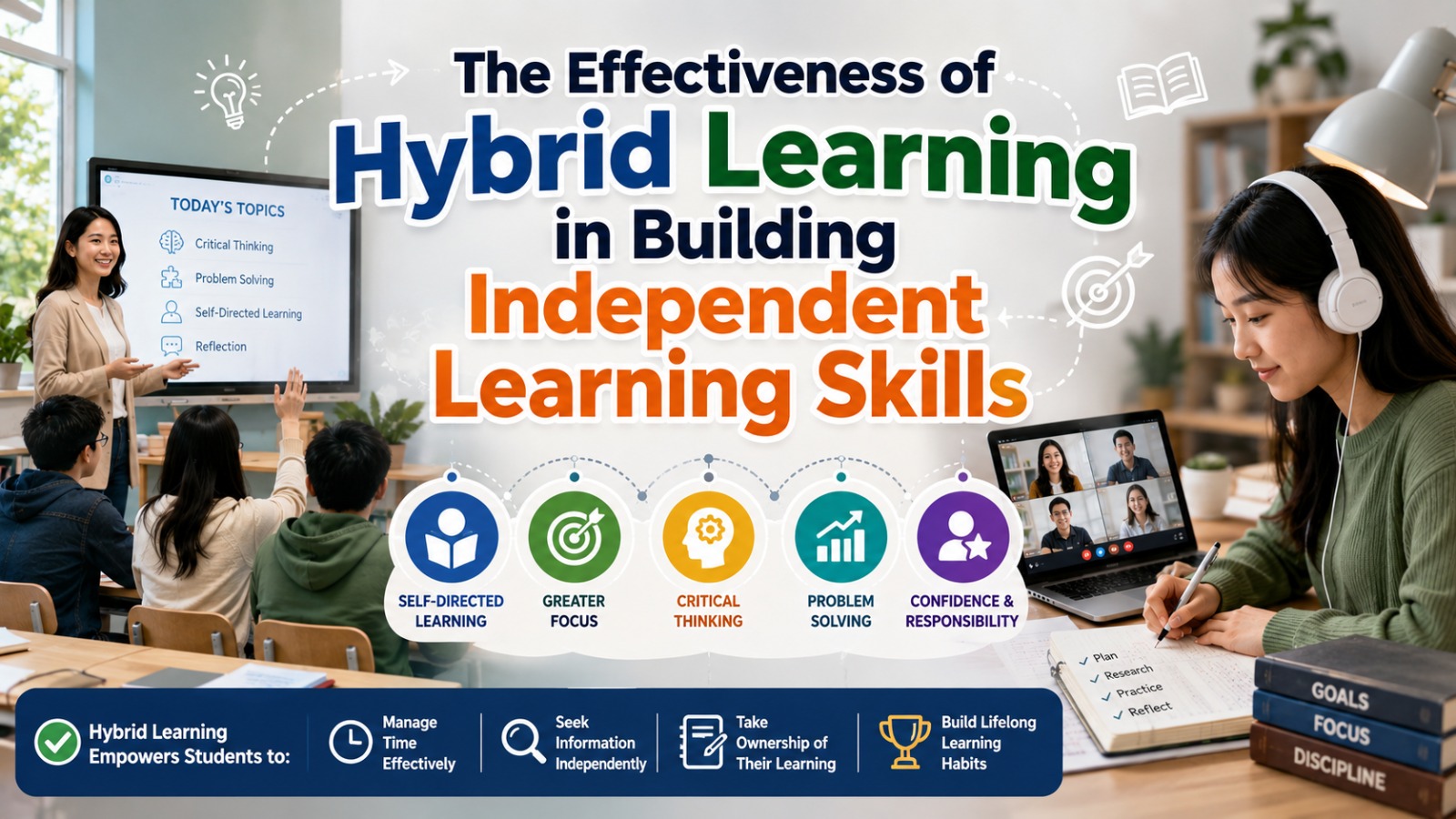
Education continues to evolve as technology reshapes the way students learn. One of the most significant developments in recent years is hybrid learning, a model that combines face-to-face instruction with online learning activities. This approach has become increasingly popular because it offers flexibility while maintaining direct interaction between teachers and learners.
Beyond convenience, hybrid learning has shown strong potential in developing one of the most valuable academic abilities: independent learning skills. In today’s fast-changing world, students need more than subject knowledge. They also need the ability to manage their own learning process, think critically, and take responsibility for their progress.
UNDERSTANDING HYBRID LEARNING
Hybrid learning refers to an educational model where students learn through a combination of classroom sessions and digital learning experiences. Lessons may include in-person discussions, online assignments, recorded lectures, virtual collaboration, and self-paced study.
Unlike traditional classroom models, hybrid learning gives students greater control over when and how they engage with learning materials. This shift creates opportunities for learners to become more active participants rather than passive receivers of information.
WHY INDEPENDENT LEARNING SKILLS MATTER
Independent learning is the ability of students to manage their own educational journey. It includes setting goals, organizing study time, seeking resources, evaluating understanding, and solving problems without constant supervision.
These skills are essential not only for academic success but also for future careers. Students who learn independently tend to adapt more easily to new challenges, absorb knowledge more effectively, and become more confident in decision-making.
As education becomes increasingly flexible and digital, independent learning is no longer optional. It has become a core skill for lifelong learning.
HOW HYBRID LEARNING ENCOURAGES SELF-DISCIPLINE
One of the clearest benefits of hybrid learning is the development of self-discipline. Since part of the learning process takes place outside the physical classroom, students must manage their own schedules and complete tasks without immediate supervision.
Online assignments, recorded lessons, and flexible deadlines encourage students to plan their study time carefully. Over time, this regular practice helps learners develop stronger habits of responsibility and consistency.
Students gradually learn that academic progress depends not only on teacher guidance but also on their own commitment.
IMPROVING TIME MANAGEMENT AND ORGANIZATION
Hybrid learning often requires students to balance classroom participation with digital tasks. This structure naturally strengthens time-management skills.
Students must organize deadlines, review learning materials, and decide when to study independently. These routines help them become more aware of how they use their time.
As learners become more organized, they also become more efficient in handling academic responsibilities.
ENCOURAGING ACTIVE LEARNING BEHAVIOR
Traditional learning environments can sometimes encourage passivity, where students simply listen and follow instructions. Hybrid learning often changes this pattern.
When students access digital resources independently, they are encouraged to explore materials, revisit lessons, search for additional references, and clarify concepts on their own. This process promotes active learning rather than simple content consumption.
The result is a deeper understanding of topics and stronger confidence in solving academic challenges.
DEVELOPING PROBLEM-SOLVING AND CRITICAL THINKING
Independent learning often involves encountering difficulties without immediate teacher assistance. In hybrid learning environments, students frequently need to find solutions by reviewing materials, using online resources, or discussing ideas with classmates.
This experience strengthens problem-solving abilities and critical thinking. Instead of waiting for answers, students learn how to identify problems, analyze information, and make decisions independently.
These abilities are valuable far beyond the classroom.
CHALLENGES OF HYBRID LEARNING
Although hybrid learning can strengthen independent learning skills, it is not without challenges.
Some students may initially struggle with motivation, self-control, or digital distractions. Others may have limited access to stable internet or appropriate learning devices.
Without proper guidance, flexibility can sometimes lead to procrastination rather than independence. For this reason, teachers still play an important role in providing structure, feedback, and encouragement.
CONCLUSION
Hybrid learning has proven to be more than a flexible educational model. It also serves as an effective approach for building independent learning skills.
By encouraging self-discipline, improving time management, promoting active learning, and strengthening problem-solving abilities, hybrid learning helps students become more responsible and confident learners.
As education continues to adapt to modern needs, hybrid learning offers a practical path toward developing the independent learners needed for the future.
About the Author
Gusti Ayu Tita
Author — STEKOM University
An active author focused on academic issues, educational technology, and human resource development in the campus environment.



