The rapid advancement of communication technologies has significantly transformed how people connect, communicate, and access information. Among these innovations, 5G networks represent a major leap forward in wireless connectivity. With faster speeds, lower latency, and greater capacity, 5G is set to revolutionize industries and redefine digital experiences worldwide.
WHAT IS 5G TECHNOLOGY?
5G, or the fifth generation of mobile networks, is the latest standard in wireless communication. It succeeds 4G LTE and is designed to provide significantly improved performance in terms of speed, responsiveness, and connectivity.
Unlike previous generations, 5G is built to support a wide range of devices, from smartphones to smart cities. It enables seamless communication between machines, devices, and users, making it a key enabler of the digital ecosystem.
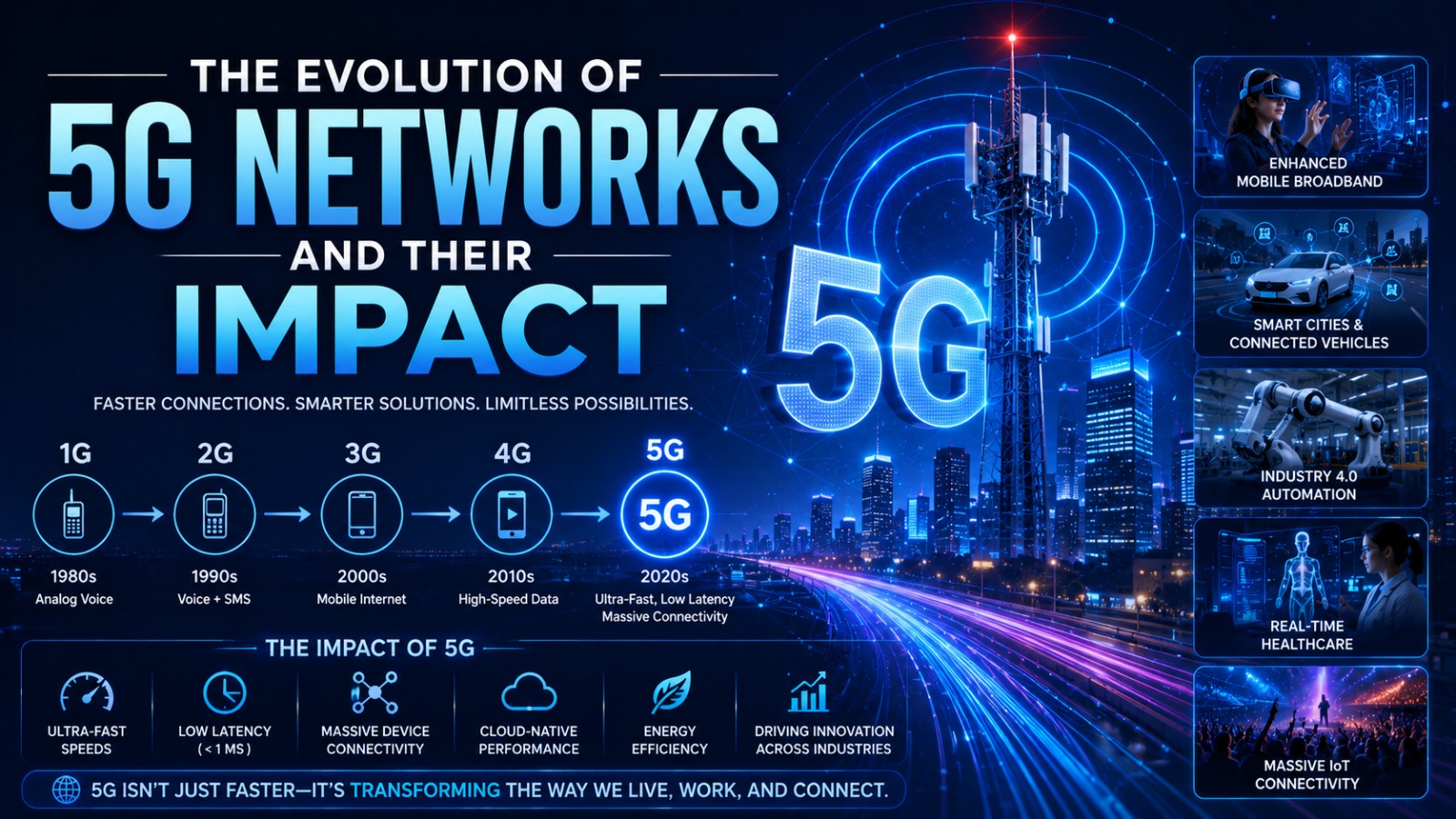
THE EVOLUTION FROM 1G TO 5G
The journey to 5G has been marked by continuous innovation:
- 1G: Introduced analog voice communication.
- 2G: Enabled digital voice and SMS messaging.
- 3G: Brought mobile internet and multimedia services.
- 4G LTE: Delivered high-speed internet and streaming capabilities.
- 5G: Offers ultra-fast speeds, low latency, and massive device connectivity.
Each generation has built upon the previous one, improving the way people interact with technology.
KEY FEATURES OF 5G NETWORKS
5G technology introduces several groundbreaking features:
- High Speed: Data transfer rates significantly faster than 4G.
- Low Latency: Near-instant communication with minimal delay.
- Massive Connectivity: Supports billions of connected devices.
- Enhanced Reliability: Provides stable and consistent network performance.
These features enable new applications that were previously not possible.
IMPACT ON VARIOUS INDUSTRIES
5G is expected to transform multiple industries:
- Healthcare: Enables remote surgeries and real-time patient monitoring.
- Transportation: Supports autonomous vehicles and smart traffic systems.
- Manufacturing: Enhances automation and smart factory operations.
- Entertainment: Improves streaming quality and immersive experiences.
The increased connectivity and speed open up new possibilities for innovation and efficiency.
ROLE IN THE INTERNET OF THINGS (IOT)
5G plays a crucial role in the expansion of the Internet of Things (IoT). With its ability to handle a massive number of connected devices, 5G enables seamless communication between sensors, machines, and systems.
This capability supports smart homes, smart cities, and industrial IoT applications, improving efficiency and resource management.
CHALLENGES AND LIMITATIONS
Despite its advantages, 5G deployment faces several challenges. High infrastructure costs, limited coverage in rural areas, and regulatory hurdles can slow down adoption.
Additionally, concerns about data security and privacy must be addressed to ensure safe and reliable usage.
FUTURE OF 5G NETWORKS
The future of 5G is closely linked to ongoing technological advancements. As infrastructure expands and devices become more compatible, 5G adoption will continue to grow.
Integration with emerging technologies such as artificial intelligence and augmented reality will further enhance its impact. These developments will create more connected and intelligent digital environments.
CONCLUSION
The evolution of 5G networks marks a significant milestone in the development of communication technology. Its ability to deliver faster speeds, lower latency, and greater connectivity is transforming industries and everyday life.
As 5G continues to expand, it will play a vital role in shaping the future of digital innovation. Embracing this technology will be essential for unlocking new opportunities in an increasingly connected world.
About the Author
Gusti Ayu Tita
Author — STEKOM University
An active author focused on academic issues, educational technology, and human resource development in the campus environment.