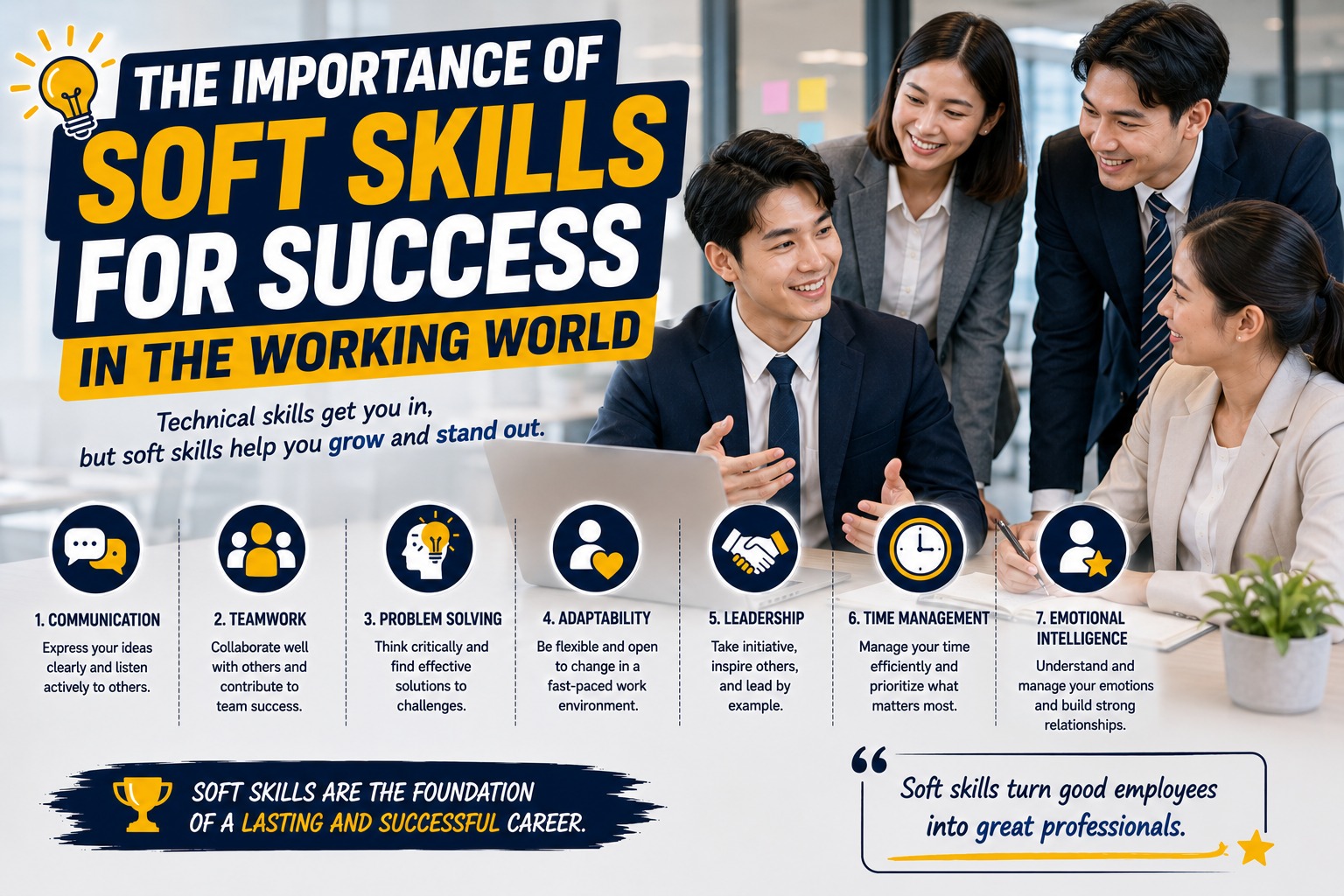
In today’s competitive professional environment, technical abilities alone are no longer enough to achieve career success. Companies increasingly value employees who also possess strong soft skills because these abilities influence communication, teamwork, leadership, and adaptability in the workplace. Soft skills help individuals work effectively with others, solve problems efficiently, and maintain professionalism in different situations. Employees who master both technical knowledge and interpersonal abilities usually have greater opportunities for long-term career growth.
UNDERSTANDING SOFT SKILLS
Soft skills are personal and interpersonal abilities that affect how individuals interact, communicate, and work with others. Unlike hard skills, which are technical and measurable, soft skills are related to behavior, attitude, and emotional intelligence.
Examples of important soft skills include communication, teamwork, leadership, problem-solving, adaptability, creativity, and time management. These skills are valuable in almost every profession and industry.
COMMUNICATION SKILLS IMPROVE PROFESSIONAL RELATIONSHIPS
Communication is one of the most essential soft skills in the working world. Employees need to express ideas clearly, listen actively, and understand instructions properly.
Good communication helps reduce misunderstandings, improve teamwork, and create stronger relationships with coworkers, clients, and supervisors. Professionals with excellent communication skills often perform better in meetings, presentations, and collaborative projects.
TEAMWORK INCREASES WORKPLACE PRODUCTIVITY
Most companies rely heavily on teamwork to achieve business goals. Employees who can cooperate effectively with different personalities and backgrounds contribute positively to workplace productivity.
Strong teamwork skills include respecting opinions, sharing responsibilities, supporting colleagues, and solving conflicts professionally. Individuals who work well in teams are often considered valuable assets by employers.
PROBLEM-SOLVING HELPS HANDLE CHALLENGES
Workplace challenges and unexpected situations are common in professional environments. Employees with strong problem-solving skills can analyze situations calmly and find effective solutions.
This ability helps companies overcome difficulties more efficiently and supports better decision-making processes. Employers appreciate individuals who can remain productive under pressure and think critically during challenging situations.
ADAPTABILITY IS IMPORTANT IN MODERN WORKPLACES
Technology and industry trends continue to change rapidly. Employees must be able to adapt to new systems, work environments, and responsibilities.
Adaptable employees are usually more open to learning and willing to embrace change. This flexibility allows professionals to remain competitive and relevant in modern workplaces.
LEADERSHIP SKILLS SUPPORT CAREER GROWTH
Leadership is not limited to management positions. Employees at every level can demonstrate leadership by taking initiative, motivating teammates, and handling responsibilities confidently.
Strong leadership skills help individuals gain trust from coworkers and supervisors. Companies often promote employees who show responsibility, decision-making abilities, and a positive influence on teams.
TIME MANAGEMENT IMPROVES EFFICIENCY
Effective time management is essential for maintaining productivity and meeting deadlines. Employees who organize tasks properly can handle responsibilities more efficiently and reduce unnecessary stress.
Good time management also reflects discipline and professionalism, which are highly valued in the workplace.
EMOTIONAL INTELLIGENCE STRENGTHENS PROFESSIONALISM
Emotional intelligence is the ability to understand and manage emotions effectively. This skill helps employees communicate better, control stress, and build healthy workplace relationships.
Professionals with strong emotional intelligence usually handle criticism maturely, resolve conflicts peacefully, and maintain positive attitudes during difficult situations.
SOFT SKILLS SUPPORT LONG-TERM CAREER SUCCESS
Technical knowledge may help someone get a job, but soft skills often determine long-term career growth. Employees with excellent interpersonal abilities usually adapt faster, build stronger professional networks, and create better workplace reputations.
Soft skills also increase opportunities for leadership positions and career advancement because they influence how individuals work with others and contribute to organizational success.
CONCLUSION
Soft skills play a crucial role in achieving success in the working world. Communication, teamwork, adaptability, leadership, and emotional intelligence all contribute to professional performance and career development. Employees who continuously improve their soft skills alongside technical abilities will have stronger opportunities to succeed and grow in today’s competitive professional environment.
About the Author
Gusti Ayu Tita
Author — STEKOM University
An active author focused on academic issues, educational technology, and human resource development in the campus environment.