
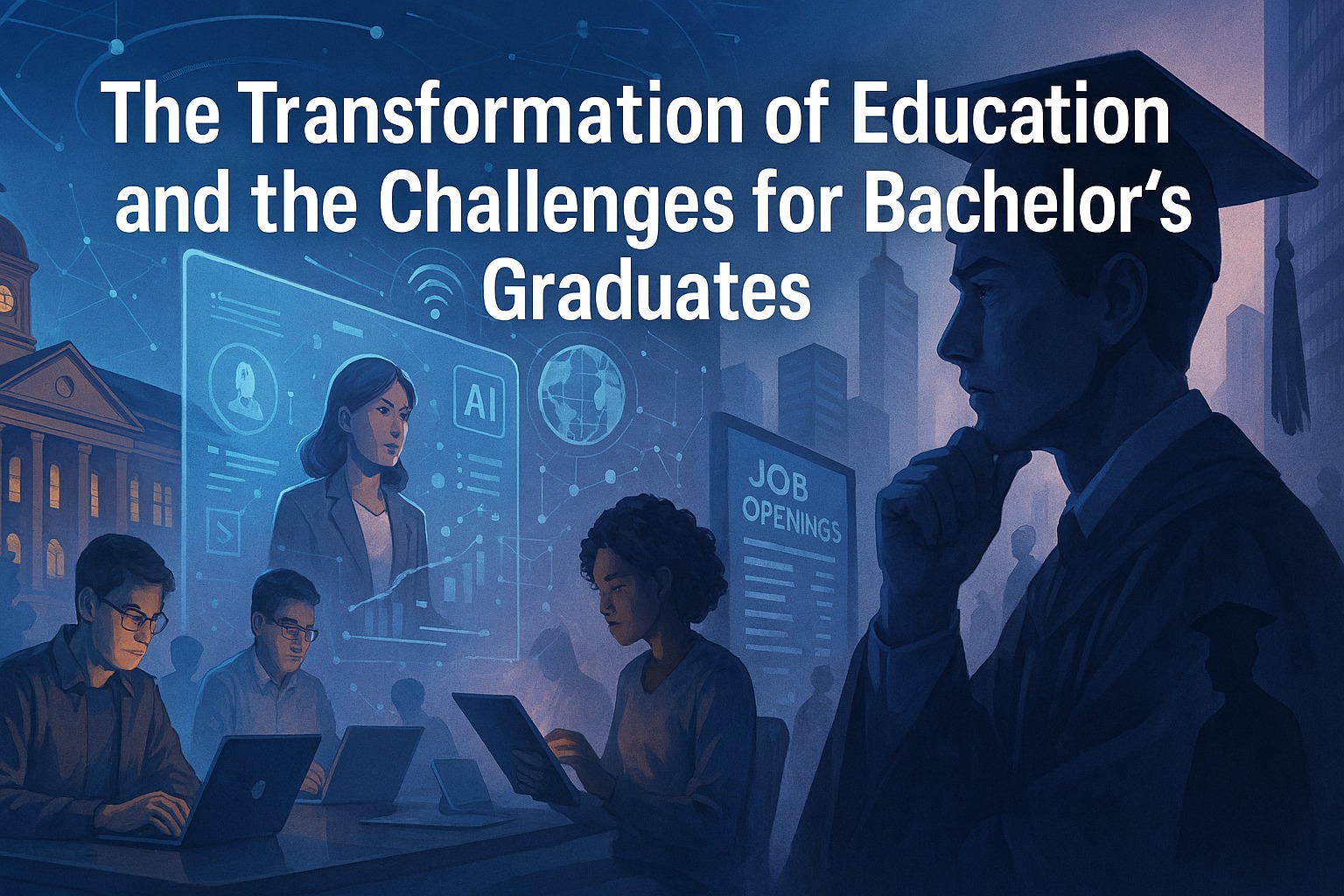
Higher education is undergoing a profound transformation. Rapid technological innovation, shifting industry demands, and changing student expectations are reshaping the way universities operate. As a result, the value and meaning of a bachelor’s degree are being redefined in the modern era.
For decades, earning a bachelor’s degree was considered a clear pathway to stable employment and upward mobility. Today, however, graduates face a more competitive and unpredictable job market. Employers are not only looking for academic credentials but also practical skills, adaptability, and real-world experience.
Understanding the transformation of education and the challenges for bachelor’s graduates is essential for students who want to remain relevant. The issue is no longer whether higher education matters, but how graduates can align their academic journey with evolving global demands.
DIGITALIZATION AND THE SHIFT IN LEARNING MODELS
Technology has dramatically changed how education is delivered. Online learning platforms, hybrid classrooms, and digital collaboration tools have expanded access to knowledge. Students are no longer limited to physical lecture halls to gain expertise.
This shift has created more flexible learning pathways. Many students now combine formal university education with online certifications, short courses, and self-paced programs. As a result, the traditional monopoly of universities over knowledge distribution has weakened.
However, digitalization also increases competition. Graduates are no longer competing only with peers from their campus, but with candidates worldwide who may have acquired similar skills through alternative routes.
For bachelor’s graduates, this means a degree alone may not be enough. They must demonstrate digital literacy, independent learning ability, and the capacity to continuously update their skills in a rapidly changing environment.
CHANGING INDUSTRY EXPECTATIONS
Industries today prioritize practical competence alongside academic knowledge. Employers seek graduates who can immediately contribute to organizational goals without requiring extensive retraining.
This expectation has led to a growing emphasis on internships, project-based learning, and experiential education. Companies value candidates who can showcase portfolios, problem-solving abilities, and teamwork experience.
The gap between theory and practice often becomes a challenge. Some graduates struggle to translate classroom concepts into real-world solutions, especially in highly dynamic sectors such as technology, marketing, and entrepreneurship.
To address this issue, universities are gradually redesigning curricula to be more industry-oriented. Nevertheless, graduates still carry the responsibility of actively seeking hands-on experience during their studies.
THE RISE OF SKILL-BASED COMPETITION
The global workforce is increasingly skill-driven. Certifications in coding, data analysis, digital marketing, and other technical areas sometimes hold comparable weight to a traditional degree.
This shift has intensified competition for bachelor’s graduates. Candidates without formal degrees but with strong technical portfolios can compete for similar roles, especially in digital industries.
As a result, graduates must differentiate themselves beyond academic achievement. Soft skills such as communication, leadership, adaptability, and critical thinking are becoming decisive factors.
A bachelor’s degree still provides foundational knowledge, but graduates must complement it with specialized and transferable skills to remain competitive in a skill-based economy.
ECONOMIC PRESSURE AND EMPLOYABILITY CONCERNS
The cost of higher education continues to rise in many parts of the world. Students and families increasingly view a bachelor’s degree as a financial investment that must generate tangible returns.
When graduates face underemployment or prolonged job searches, doubts about the value of their degree naturally emerge. This economic pressure adds psychological stress to new entrants in the workforce.
Furthermore, automation and artificial intelligence are transforming job structures. Some entry-level positions traditionally filled by bachelor’s graduates are being replaced or redefined.
In response, graduates must adopt a long-term perspective. Continuous learning, career flexibility, and strategic networking are essential to navigate economic uncertainty successfully.
GLOBALIZATION AND INCREASED TALENT MOBILITY
Globalization has expanded career opportunities but also intensified competition. Employers can recruit talent from different countries, often seeking the most cost-effective and skilled candidates.
For bachelor’s graduates, this means competing in a broader talent pool. Language proficiency, cross-cultural communication, and global awareness are increasingly valuable assets.
International exposure through exchange programs, internships, or collaborative projects can enhance employability. Graduates who understand global trends are better positioned to adapt to multinational work environments.
In this interconnected world, a bachelor’s degree remains relevant, but it must be supported by global competencies and a willingness to engage beyond local boundaries.
ADAPTABILITY AS THE NEW EDUCATIONAL OUTCOME
One of the most significant transformations in education is the shift from knowledge accumulation to adaptability development. Information is easily accessible, but the ability to analyze and apply it effectively is what distinguishes professionals.
Bachelor’s graduates must be prepared for careers that may not even exist at the time of their enrollment. This uncertainty requires resilience, creativity, and a mindset of lifelong learning.
Universities are increasingly integrating interdisciplinary approaches to prepare students for complex challenges. Graduates who can connect ideas across fields often have a competitive advantage.
Ultimately, the transformation of education highlights a central reality: a bachelor’s degree is no longer a guaranteed ticket to success, but it remains a valuable foundation. Its true worth depends on how graduates leverage their education, expand their skills, and adapt to the evolving world of work.
About the Author
Gusti Ayu Tita
Author — STEKOM University
An active author focused on academic issues, educational technology, and human resource development in the campus environment.



