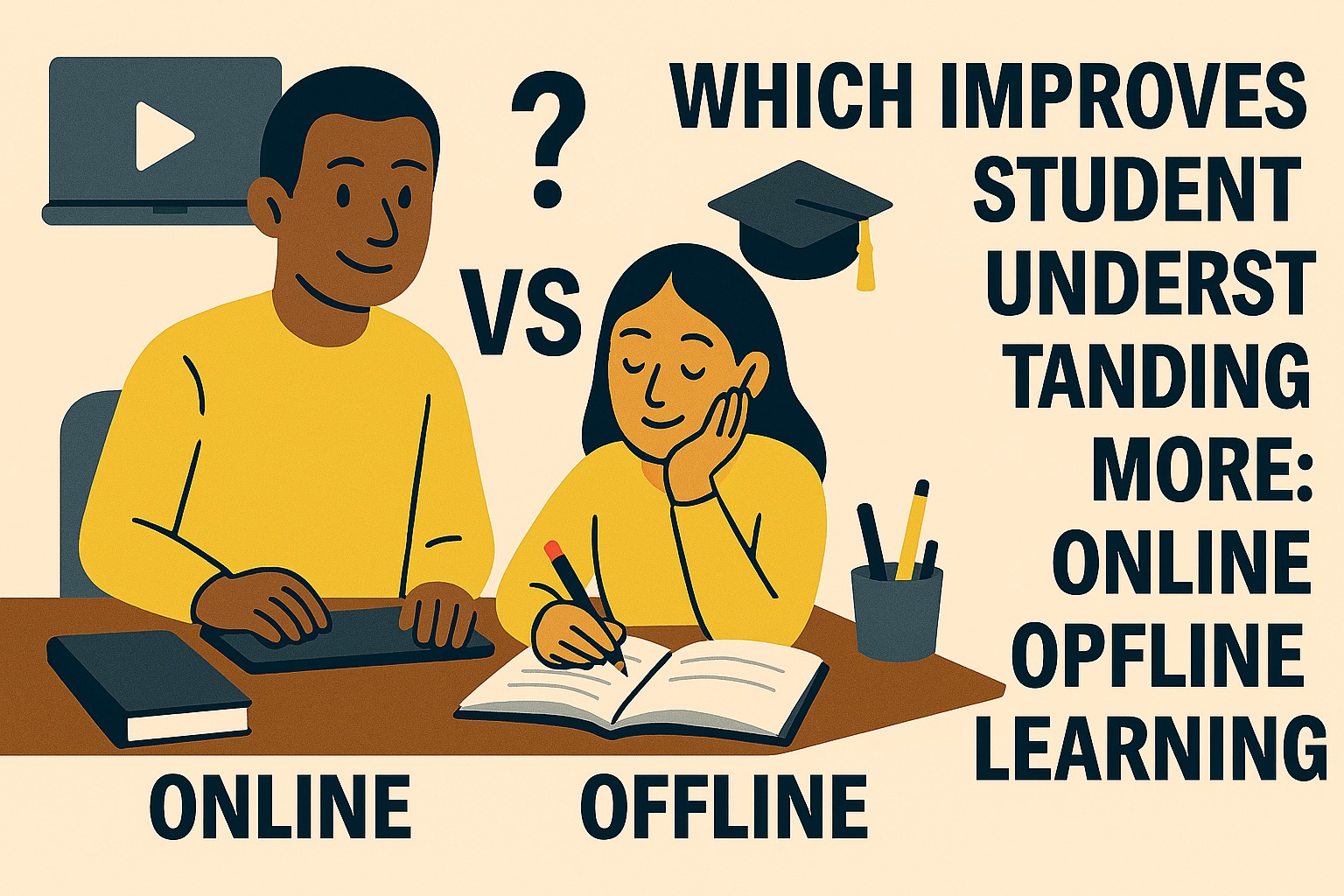
Education continues to evolve alongside technological advancement. In recent years, the debate over online and offline learning has become increasingly relevant. Schools, universities, and training institutions now integrate digital platforms into their teaching systems. This shift raises a critical question: which improves student understanding more, online or offline learning?
To answer this question, it is important to examine how each method influences comprehension, engagement, and knowledge retention.
LEARNING ENVIRONMENT AND FOCUS
Offline learning provides a structured classroom environment where students interact directly with teachers and peers. The physical presence of an instructor often helps students stay focused and disciplined. Classroom discussions, group work, and immediate clarification of doubts can strengthen understanding of complex topics.
On the other hand, online learning offers a flexible environment. Students can access lessons from anywhere and often review recorded materials multiple times. This ability to revisit explanations can significantly improve comprehension, especially for learners who need extra time to process information.
However, online settings may also present distractions. Without proper self-discipline, students may struggle to maintain concentration, which can reduce the effectiveness of learning.
INTERACTION AND COMMUNICATION
Face-to-face interaction in offline learning allows teachers to observe students’ expressions and body language. This helps instructors adjust their teaching methods in real time. Students can ask spontaneous questions and receive immediate responses, which often enhances understanding.
Online learning platforms also provide interactive tools such as live video sessions, discussion forums, and chat features. These tools encourage communication, but the interaction may feel less personal. Technical issues or limited internet access can further disrupt the learning experience.
While both methods offer communication channels, offline learning may provide a more natural and emotionally engaging experience for many students.
ACCESS TO RESOURCES AND TECHNOLOGY
Online learning excels in providing vast digital resources. Students can access e-books, videos, simulations, and online quizzes with just a few clicks. This variety of learning materials can support different learning styles, making it easier for visual or auditory learners to grasp concepts.
Offline learning, meanwhile, often provides hands-on experiences through laboratories, workshops, and physical demonstrations. For subjects that require practical skills, such as science or engineering, direct practice can significantly improve understanding.
Therefore, the effectiveness of each method depends on the type of subject being studied and the resources available.
STUDENT RESPONSIBILITY AND MOTIVATION
Online learning requires strong self-motivation and time management skills. Students must take responsibility for completing tasks and managing deadlines independently. For highly motivated learners, this independence can enhance deeper understanding and critical thinking.
In contrast, offline learning offers a routine schedule that encourages accountability. The presence of teachers and classmates can motivate students to participate actively and stay consistent in their studies.
Ultimately, student understanding is closely linked to personal learning habits rather than the method itself.
CONCLUSION
Both online and offline learning have the potential to improve student understanding. Online learning provides flexibility, diverse digital resources, and opportunities for independent study. Offline learning offers structured environments, direct interaction, and hands-on experiences that can strengthen comprehension.
Instead of determining which method is universally better, educators and students should consider individual needs, subject requirements, and available resources. A balanced combination of both approaches may deliver the most effective results in enhancing student understanding in today’s digital age.
About the Author
Gusti Ayu Tita P
Author — STEKOM University
An active author focused on academic issues, educational technology, and human resource development in the campus environment.