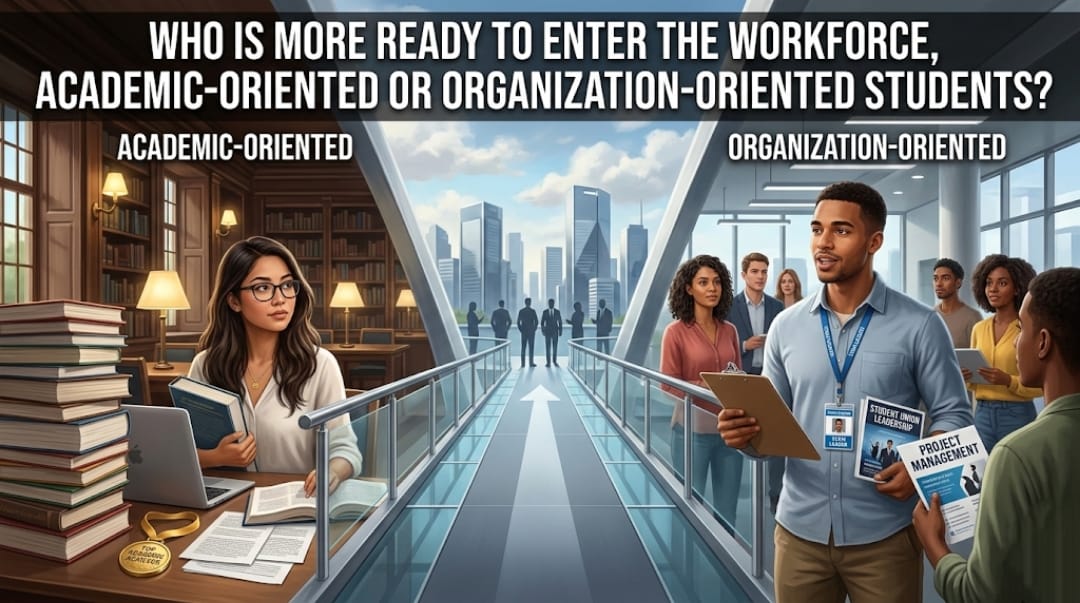
Preparing for the workforce is a major milestone for university students. As graduation approaches, a common debate emerges: who is more ready to enter the workforce, academic-oriented students or organization-oriented students?
Both profiles offer unique strengths. Academic-oriented students focus on grades and theoretical mastery, while organization-oriented students prioritize leadership, teamwork, and practical involvement. Understanding how each contributes to career readiness can help students plan their development more strategically.
UNDERSTANDING ACADEMIC-ORIENTED STUDENTS
Academic-oriented students dedicate most of their time to coursework, research, and examinations. They often maintain high GPAs and demonstrate strong analytical capabilities.
Key characteristics include:
- Strong theoretical foundation
- Advanced problem-solving skills
- High discipline and consistency
- Ability to work independently
In fields such as engineering, accounting, medicine, and data science, academic strength is highly valued. Employers in technical sectors often seek candidates who can understand complex systems and apply structured reasoning.
However, professional environments also demand collaboration and adaptability.
UNDERSTANDING ORGANIZATION-ORIENTED STUDENTS
Organization-oriented students actively participate in campus clubs, student councils, event committees, and volunteer programs. Through these experiences, they develop skills that extend beyond textbooks.
Common strengths include:
- Communication and public speaking skills
- Leadership and team management experience
- Time management under multiple responsibilities
- Conflict resolution and negotiation abilities
These competencies are essential in roles that require coordination, client interaction, and cross-functional teamwork. Many employers assess these qualities during behavioral interviews.
While organizational involvement enhances interpersonal competence, it should ideally be supported by adequate academic knowledge.
WHAT DEFINES WORKFORCE READINESS?
Workforce readiness involves a combination of hard skills and soft skills. Hard skills relate to technical knowledge and job-specific expertise, while soft skills include communication, adaptability, and collaboration.
Recruiters typically evaluate:
- Academic qualifications
- Internship or project experience
- Leadership exposure
- Problem-solving ability in real situations
In many hiring processes, academic performance serves as an entry requirement. Meanwhile, organizational experience often influences final selection decisions, especially when candidates have similar academic backgrounds.
INDUSTRY EXPECTATIONS AND CAREER PATHS
Different industries prioritize different competencies. Technical and research-based careers may emphasize academic achievement. On the other hand, careers in marketing, management, public relations, and entrepreneurship often value leadership and networking skills developed through organizational activities.
Students should align their efforts with their intended career path. Those targeting analytical roles may focus more on academic excellence, while those aiming for managerial roles may benefit from active organizational participation.
CONCLUSION
Who is more ready to enter the workforce, academic-oriented or organization-oriented students? The answer depends on the role, industry, and individual strengths. Academic-oriented students bring structured knowledge and analytical depth. Organization-oriented students contribute leadership, adaptability, and teamwork skills.
In today’s evolving job market, candidates who combine academic competence with organizational experience are generally better equipped to navigate professional challenges and achieve sustainable career growth.
About the Author
Gusti Ayu Tita
Author — STEKOM University
An active author focused on academic issues, educational technology, and human resource development in the campus environment.