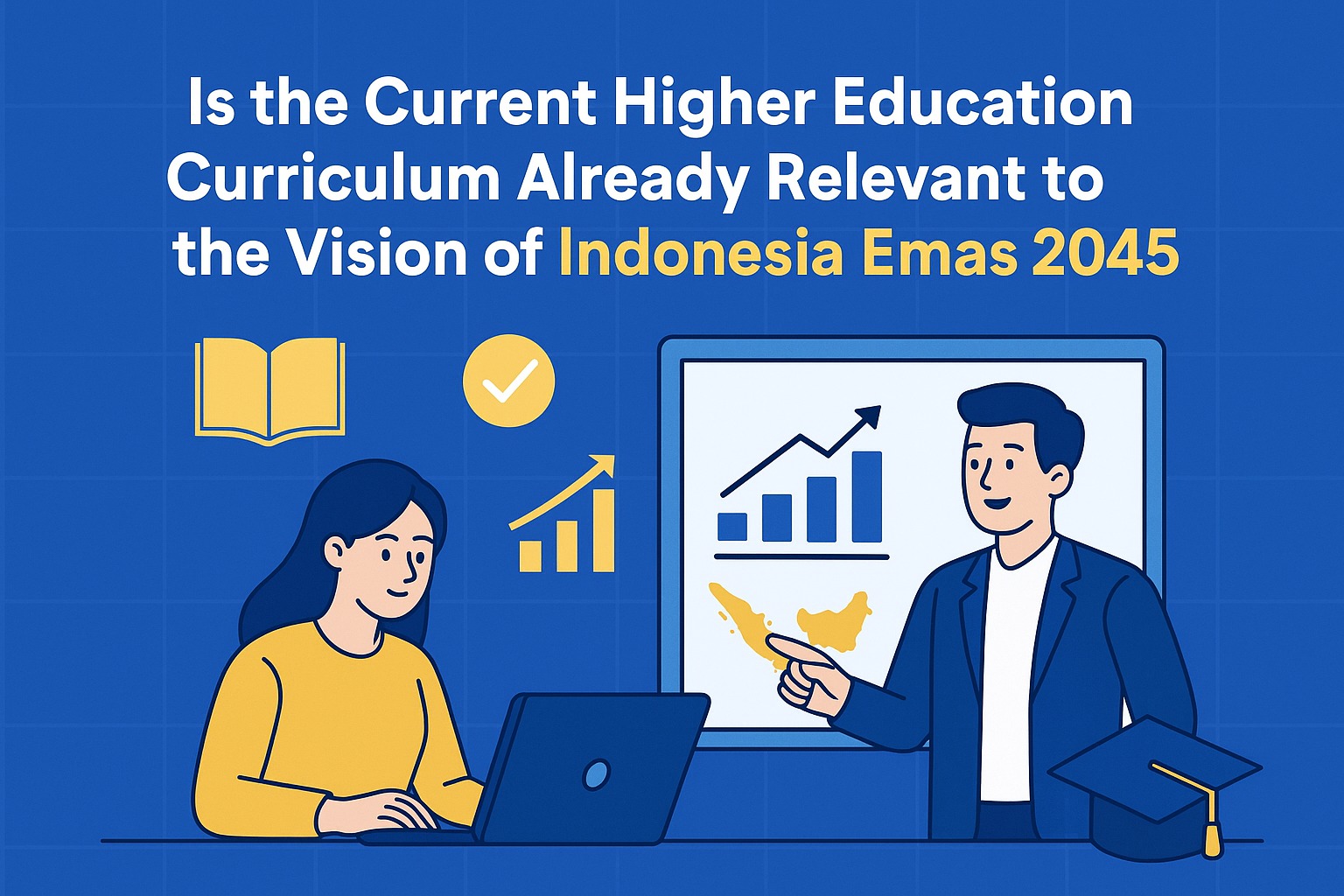
Higher education is one of the key factors that will determine Indonesia’s future, especially in achieving its long-term national goal: the Golden Indonesia 2045 vision. However, to what extent is the current higher education curriculum capable of supporting this vision? This article discusses the relevance of Indonesia’s higher education curriculum to the needs of the future, as well as the challenges the nation faces in realizing the Golden Indonesia 2045 mission.
1. THE VISION OF GOLDEN INDONESIA 2045 AND ITS CHALLENGES
Golden Indonesia 2045 is a major national vision set to commemorate a century of Indonesian independence. Its primary goal is to transform Indonesia into a developed nation with strong global competitiveness. To achieve this, Indonesia requires excellent human resources (HR) who not only master science and technology but also possess innovative thinking, critical reasoning, and adaptability to rapid changes.
However, one of the biggest challenges is the uneven and insufficient quality of education—particularly higher education. This raises an important question: is the current higher education curriculum adequate to support Indonesia’s aspirations toward 2045?
2. INDONESIA’S HIGHER EDUCATION CURRICULUM: RELEVANT OR OUTDATED?
Indonesia’s higher education curriculum has undergone numerous changes since independence, yet several issues remain unresolved. Key aspects that require attention include:
Alignment with Industry and Workforce Needs
One major criticism of Indonesia's higher education system is the gap between university teaching materials and actual industry demands. Many university graduates struggle to find jobs that match their competencies. Numerous study programs remain overly theoretical and insufficiently prepare students for real-world challenges.
Development of Soft Skills
Beyond technical knowledge, soft skills—such as communication, leadership, creativity, and teamwork—are increasingly crucial in the modern workplace. However, not all higher education programs in Indonesia emphasize soft skill development. Curricula that focus solely on academic content, without cultivating character and interpersonal competence, leave graduates less prepared for workplace dynamics.
To support Golden Indonesia 2045, the curriculum must respond more effectively to industrial developments, especially those driven by advanced technologies such as AI, robotics, and biotechnology. A more applied, competency-based curriculum that integrates both theory and practice will better prepare students to contribute meaningfully to national development.
Project-based learning and internship programs are also effective strategies to enhance soft skills and ensure students gain real-world experience.
3. A FLEXIBLE AND TECHNOLOGY-ORIENTED CURRICULUM
The Fourth Industrial Revolution has drastically transformed how we work and learn. Digital technology, automation, and big data have become key drivers of progress across sectors. Consequently, higher education institutions must incorporate cutting-edge technological content into their curricula.
Yet, many Indonesian universities still lag behind global technological advancements. Some programs have not integrated new technologies, or only teach outdated ones—hindering graduates’ ability to adapt to rapidly evolving industry needs.
To support Golden Indonesia 2045, higher education must implement flexible and technology-responsive curricula, including courses in digital literacy, coding, data science, artificial intelligence, and other emerging fields crucial for the future economy.
4. STRENGTHENING COLLABORATION AMONG UNIVERSITIES, GOVERNMENT, AND INDUSTRY
To ensure curricula remain relevant to workforce needs, stronger collaboration between universities, the government, and industry is essential. Such partnerships help ensure that the curriculum reflects the latest developments in the job market.
Government policies can support this alignment by providing funding, research incentives, and frameworks that encourage industry-based curriculum development. Meanwhile, industries must actively participate in curriculum design, training initiatives, and internship opportunities for students.
5. INTEGRATING ENTREPRENEURIAL VALUES INTO THE CURRICULUM
Entrepreneurship is a vital component of economic growth and job creation. As Indonesia moves toward its 2045 vision, universities must place greater emphasis on entrepreneurship and innovation. This can be achieved through specialized courses, business incubators, or entrepreneurship competitions that encourage students to develop their own ventures.
Collaboration with financial institutions and business organizations can further enhance entrepreneurship programs by offering practical, hands-on training. A curriculum that nurtures creativity and innovative problem-solving will be invaluable in developing human resources capable of driving Indonesia’s economic advancement.
CONCLUSION: BUILDING A FUTURE-ORIENTED CURRICULUM FOR GOLDEN INDONESIA 2045
Indonesia’s current higher education curriculum requires significant improvement to align more closely with the Golden Indonesia 2045 vision. Key steps include strengthening connections between education and industry, integrating modern technologies into learning, enhancing students’ soft skills, and fostering collaboration among universities, government, and industry. Through these efforts, a more adaptive and responsive curriculum can produce excellent human resources who are ready to lead the nation into the future.
High-quality and relevant higher education will serve as a strong foundation for creating a generation that is not only knowledgeable but also creative, innovative, and capable of meeting global challenges. Continuous curriculum reform—guided by technological developments, industry needs, and national aspirations—is essential to ensure Indonesia remains competitive on the world stage in 2045.
Tentang Penulis
Gusti Ayu Tita
Penulis — Universitas STEKOM
Penulis aktif yang berfokus pada isu-isu akademik, teknologi pendidikan, dan pengembangan sumber daya manusia di lingkungan kampus.