The Impact of Technology on Students’ Learning Patterns and Time Management
In today’s digital era, technology is no longer just a supporting tool—it has become an essential part of students’ daily lives. From searching for academic references to submitting assignments, almost all learning activities now rely heavily on technology. However, to what extent does technology actually influence students’ learning patterns and time management? Does technology truly make everything easier, or does it instead make students more prone to losing focus?
Students’ Learning Patterns in the Digital Era
Technology has significantly changed how students access and process information.
In the past, studying often meant reading books in the library. Today, students can learn through video lectures, e-books, and even educational podcasts. Platforms such as YouTube, Coursera, and Google Scholar have made learning more flexible and interactive. However, this convenience also comes with challenges. The abundance of information can make it difficult for students to identify what is truly relevant. As a result, learning may become faster, but not always deeper, especially when it is not supported by strong discipline and critical thinking skills.
Technology and Students’ Time Management
Technology plays a major role in helping students manage their time more efficiently.
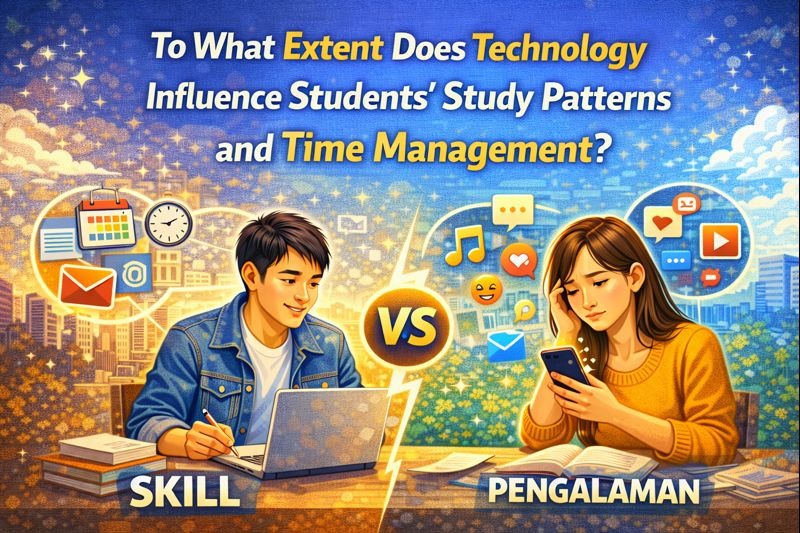
Applications like Notion, Google Calendar, and Trello assist students in organizing schedules, tracking assignments, and managing priorities. With the help of these tools, students can improve productivity and study more efficiently. Unfortunately, technology can also become a double-edged sword. Social media notifications and endless scrolling can consume hours without students realizing it. This is why digital literacy is essential—not only the ability to use technology, but also the wisdom to control how and when it is used.
The Key to Success: Balancing Technology and Self-Discipline
The effectiveness of technology depends on how wisely students use it.
Students who utilize technology strategically—such as using to-do list applications, joining online courses, or leveraging AI tools for research—tend to have better time management and higher learning quality. However, without self-discipline, technology easily turns into a distraction. Maintaining a balance between digital convenience and personal focus is the key to succeeding in the modern academic environment.
Conclusion
Technology has a significant impact on students’ learning patterns and time management, depending on how it is used.
Technology can become a powerful ally for disciplined and mindful students, but it can also be a major obstacle for those who are easily distracted by digital temptations. Therefore, students should start using technology not only to simplify tasks, but also to improve their learning strategies and time management in order to become more productive.
Tentang Penulis
Gusti Ayu Tita
Penulis — Universitas STEKOM
Penulis aktif yang berfokus pada isu-isu akademik, teknologi pendidikan, dan pengembangan sumber daya manusia di lingkungan kampus.