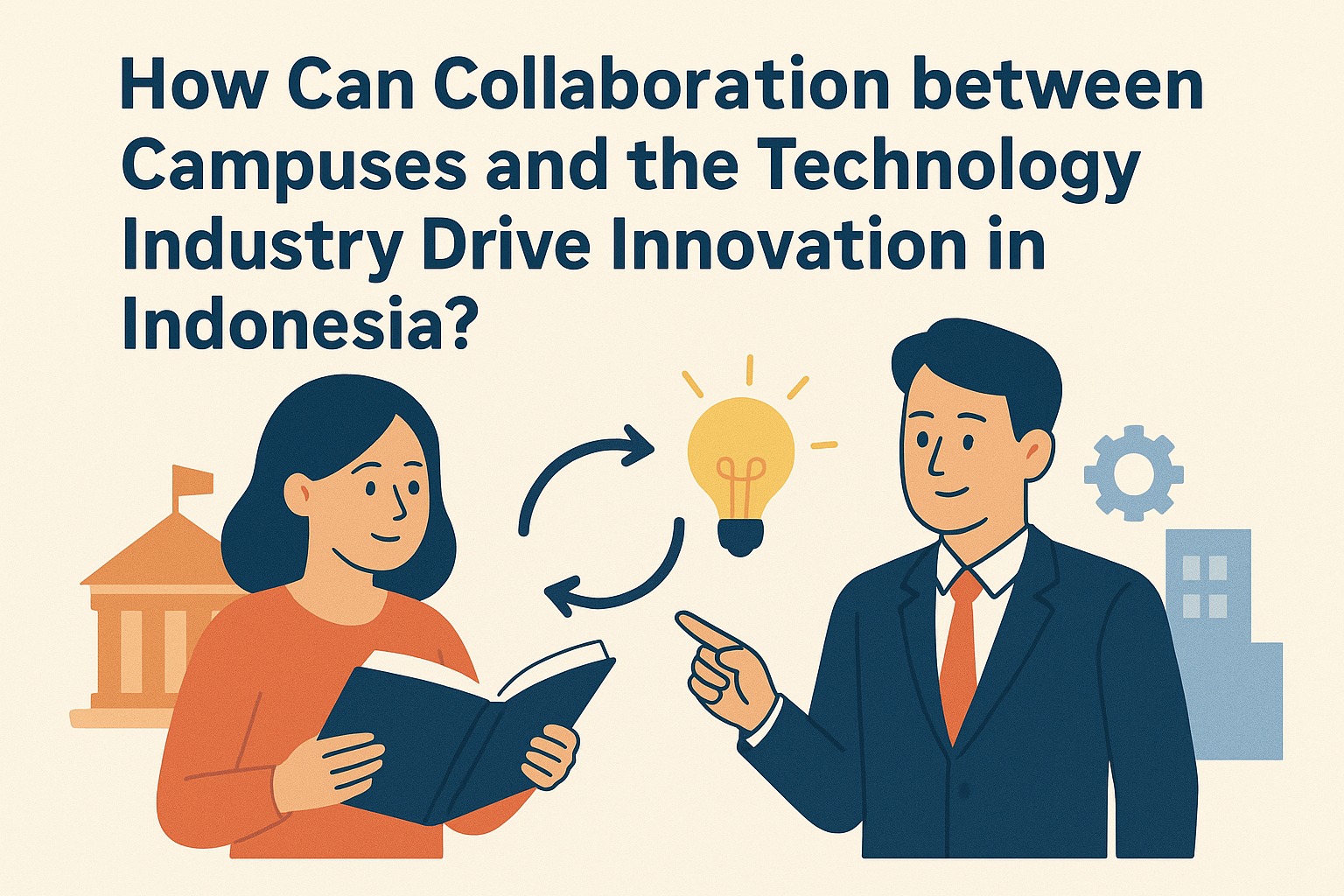
In today’s digital era, technology is advancing rapidly, and Indonesia—as a developing nation—must be able to seize these opportunities to accelerate economic growth and innovation. One effective way to achieve this is by building collaboration between universities and the technology industry. This collaboration not only benefits both sides but also creates a positive impact on society as a whole. But how exactly can collaboration between academia and the tech industry drive innovation in Indonesia?
1. IMPROVING THE QUALITY OF HUMAN RESOURCES (HR)
One of the main impacts of collaboration between universities and the technology industry is the improvement of human resource quality in Indonesia. The industry needs workers who not only possess theoretical knowledge but also practical skills relevant to the latest technological developments. Through this collaboration, universities can align their curricula with industry needs, ensuring that students not only learn theory but also participate in real-world projects related to the workforce.
For example, through internships, joint study programs, or collaborative projects involving students and industry practitioners, students gain hands-on experience that enriches their learning. In addition, lecturers can obtain updated insights into emerging technological trends, making teaching in universities more relevant and up-to-date.
2. DRIVING JOINT RESEARCH AND INNOVATION
Collaboration between academia and industry goes beyond education—it also includes research and technological innovation. Many tech companies require research to develop new products or solutions. Universities, with their research facilities, can serve as ideal partners.
For instance, tech companies developing artificial intelligence (AI) or the Internet of Things (IoT) can collaborate with universities for deeper research. Students and lecturers can participate in research aimed at solving real industry problems, which can eventually produce innovations beneficial to society. Such collaborations can also lead to patents or new technological products that strengthen Indonesia’s competitiveness in the global market.
3. CREATING A SUSTAINABLE INNOVATION ECOSYSTEM
One of the biggest challenges in Indonesia’s technological development is the limited ecosystem that supports innovation. Without collaboration between academia and industry, achieving sustainable technological progress becomes difficult. However, by building strong relationships between the two, Indonesia can create a more dynamic innovation ecosystem.
This ecosystem does not only involve developing new products or technologies but also includes the formation of supportive networks. Universities can act as centers of knowledge and research, while the industry serves as the driving force that implements research findings into marketable products or services. Through this collaboration, a mutually beneficial relationship emerges—one that accelerates innovation and digital transformation in Indonesia.
4. BOOSTING INDONESIA’S GLOBAL COMPETITIVENESS
Collaboration between universities and the technology industry also contributes positively to Indonesia’s global competitiveness. In many developed countries, such collaborations are already well established and have produced significant technological advancements. If Indonesia can strengthen similar collaborations, the country will be able to generate innovations that are not only beneficial domestically but also competitive internationally.
The presence of innovative technology can open new opportunities for Indonesian companies to grow and compete globally. For example, technology companies collaborating with universities in fields like artificial intelligence or blockchain may produce highly competitive products for international markets. At the same time, graduates trained in advanced technology and research skills will be more likely to be recruited by global companies seeking skilled professionals.
5. ADDRESSING TECHNOLOGICAL CHALLENGES ACROSS SECTORS
University–industry collaboration can also help address technological challenges faced by various sectors in Indonesia. Sectors such as agriculture, healthcare, education, and transportation require appropriate technological solutions to improve efficiency and productivity. Universities, equipped with experts in various fields, together with the technology industry, can develop solutions tailored to each sector’s needs.
In agriculture, for example, such collaboration could produce IoT-based agricultural technologies to monitor crop and weather conditions. In healthcare, collaboration could support the development of health applications or AI-based medical tools that improve healthcare services in Indonesia. In the education sector, digital technology can be used to enhance teaching quality through innovative online learning platforms.
CONCLUSION
Collaboration between universities and the technology industry holds great potential to drive innovation in Indonesia. By improving human resource quality, supporting research and innovation, creating a sustainable innovation ecosystem, and enhancing global competitiveness, such collaboration can accelerate Indonesia’s digital transformation. Moreover, it provides solutions for challenges across various sectors of the country. Therefore, it is crucial for the government, universities, and the technology industry to strengthen these partnerships so Indonesia can maximize technological and innovation potential for the nation’s advancement.
Tentang Penulis
Gusti Ayu Tita
Penulis — Universitas STEKOM
Penulis aktif yang berfokus pada isu-isu akademik, teknologi pendidikan, dan pengembangan sumber daya manusia di lingkungan kampus.