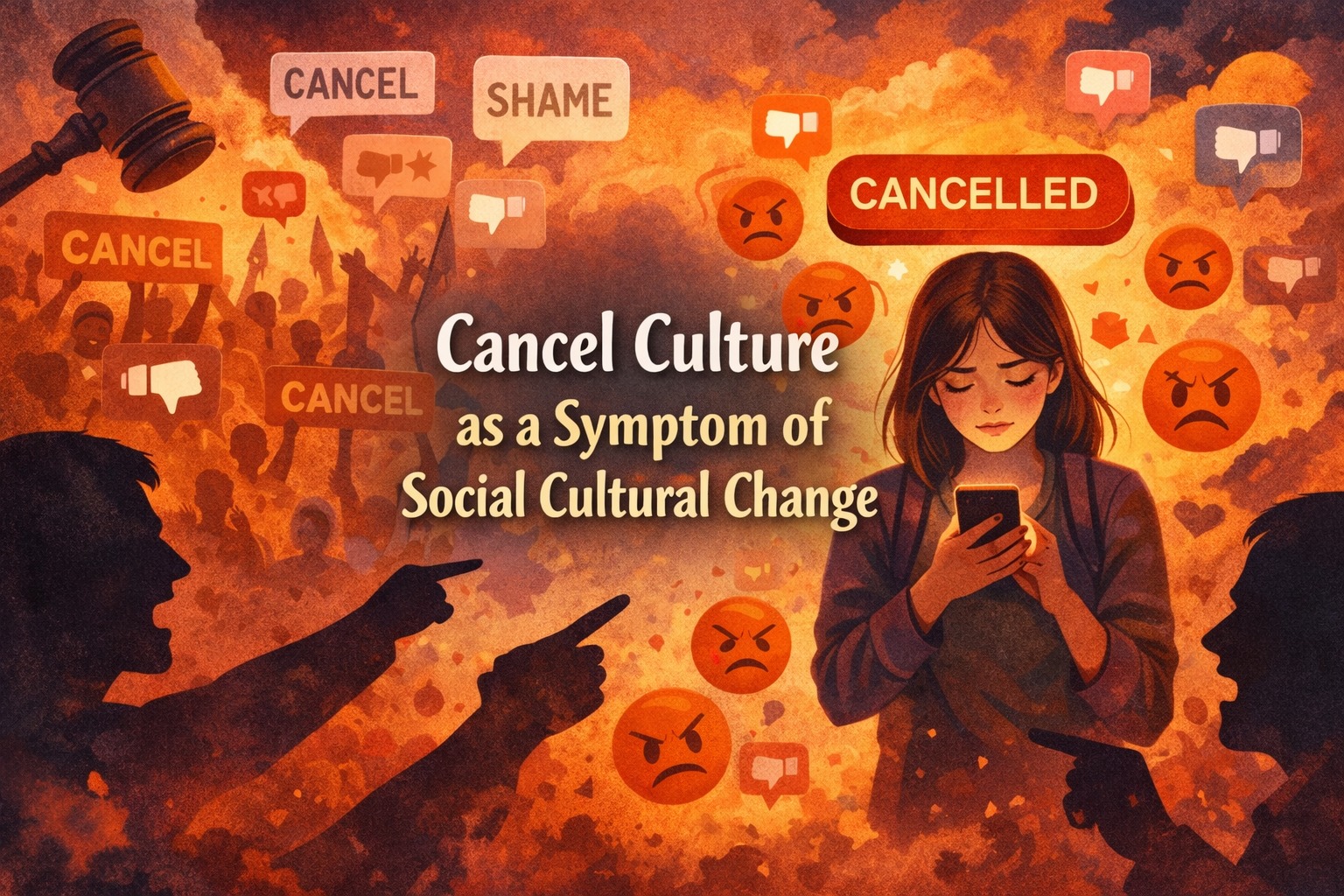
The development of digital technology has transformed the way society interacts, evaluates, and corrects social behavior. One phenomenon that reflects this shift is cancel culture. This practice is not only related to social media but also signals changes in values, norms, and mechanisms of control within contemporary social culture.
CANCEL CULTURE IN THE CONTEXT OF SOCIAL CHANGE
Cancel culture has emerged alongside the growing role of the public in monitoring the behavior of individuals and institutions. In the past, social judgment was largely shaped by formal authorities. Today, society has broader space to express criticism directly. This phenomenon indicates a shift in the distribution of symbolic power within the public sphere.
However, this expansion of public involvement is not always accompanied by collective maturity in responding to differences and mistakes.
SOCIAL MEDIA AND THE TRANSFORMATION OF CULTURAL NORMS
Social media plays a major role in shaping new norms of right and wrong. Values that were once local have now become global consumption. In this context, cancel culture functions as an unwritten mechanism of norm enforcement.
Unfortunately, these norms are often fluid and contextual. What is considered acceptable today may be viewed as problematic in the future. This instability makes cancel culture vulnerable to misuse.
BETWEEN ACCOUNTABILITY AND SOCIAL JUDGMENT
Supporters of cancel culture view it as a form of social accountability that aligns with the times. Public pressure is believed to encourage more ethical attitudes and behavior. In some cases, this approach has indeed been effective.
Criticism arises, however, when accountability shifts into mass judgment. This process often ignores context, intention, and opportunities for growth and self-correction. As a result, cancel culture risks creating new forms of social injustice that contradict its original purpose.
THE IMPACT OF CANCEL CULTURE ON DIALOGUE CULTURE
One significant impact of cancel culture is the transformation of public communication patterns. Discussions that should serve as spaces for exchanging ideas turn into arenas of moral validation. Fear of making mistakes leads many individuals to remain silent rather than participate openly.
If this trend continues, a healthy culture of dialogue may be replaced by a culture of surveillance and punishment. This challenges the principle of openness that should form the foundation of a democratic society.
CONCLUSION
Cancel culture, as a symptom of cultural change, reflects complex dynamics between technology, values, and symbolic power. It can function as a relevant tool for social correction, yet it also carries the risk of disproportionate judgment. The future challenge lies in building a social culture that balances moral accountability with empathy, rationality, and fair spaces for dialogue.
Tentang Penulis
Gusti Ayu Tita
Penulis — Universitas STEKOM
Penulis aktif yang berfokus pada isu-isu akademik, teknologi pendidikan, dan pengembangan sumber daya manusia di lingkungan kampus.