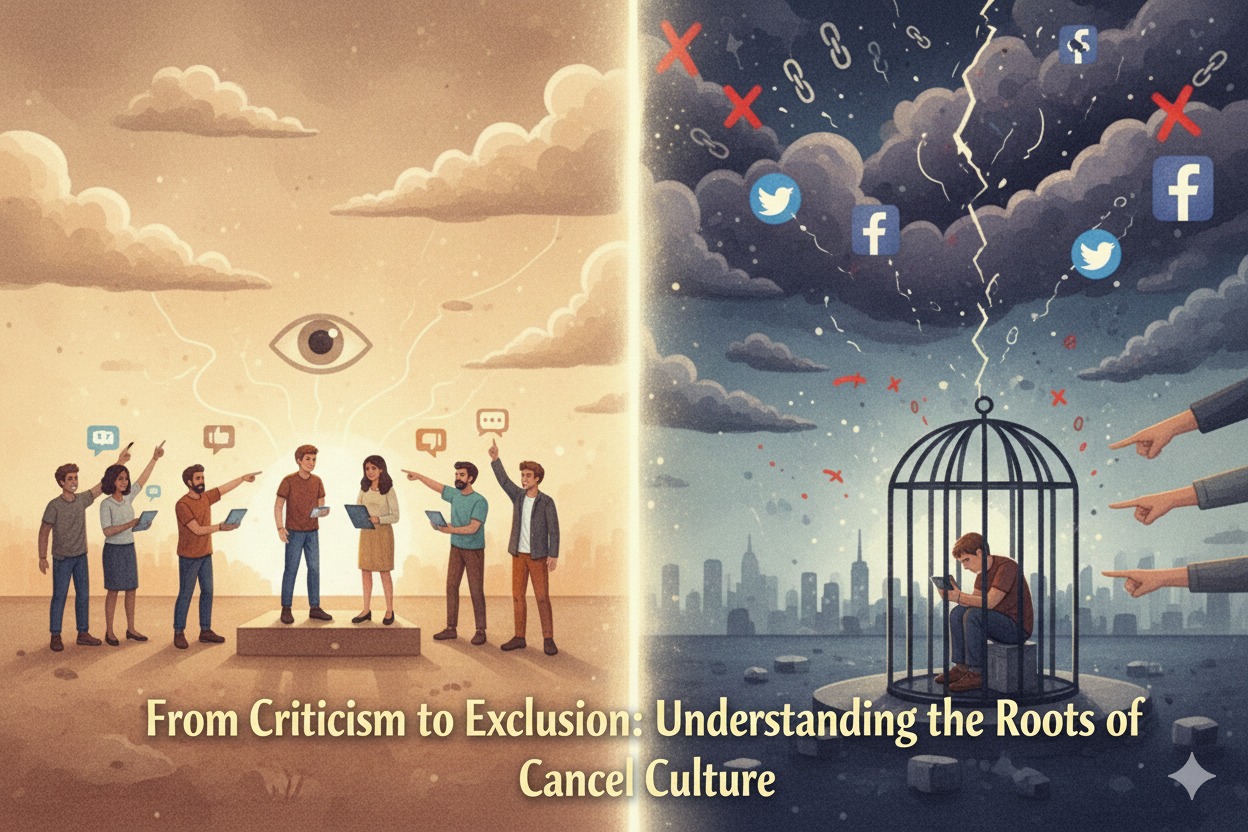
In the era of social media, public criticism can spread at an unprecedented speed. What initially begins as a warning or a difference of opinion often escalates into mass exclusion known as cancel culture. This phenomenon raises an important question: how does legitimate criticism transform into collective social pressure, and what lies at the root of this shift?
Criticism as Part of the Public Sphere
Criticism is a fundamental element of a democratic society. It functions as a tool of social control, behavioral correction, and a means of maintaining accountability. In the digital context, social media expands the space for criticism by allowing anyone to voice opinions without going through formal channels.
However, not all criticism carries the same weight. Criticism grounded in facts, context, and a desire for improvement differs fundamentally from emotionally driven condemnation aimed at punishment. This is where the early signs of a shift toward cancel culture begin to emerge.
The Transformation of Criticism into Social Exclusion
The shift from criticism to exclusion is often triggered by the dynamics of virality. When an issue touches collective emotions, public responses tend to become reactive. The individual being criticized is no longer seen as a subject capable of learning, but as a symbol of wrongdoing that must be removed.
Social media amplifies this process through algorithmic logic that prioritizes high engagement. The harsher the condemnation, the wider its reach. As a result, criticism that was once limited evolves into massive and uncontrollable social pressure.
Social and Psychological Factors Behind Cancel Culture
The rise of cancel culture is closely linked to psychological factors such as the need for social affiliation and moral validation. Joining waves of condemnation often provides a sense of moral righteousness and group recognition.
In addition, power imbalances play a role in shaping this practice. Cancel culture is frequently perceived as an alternative tool for groups who feel unheard by formal systems. However, when used without ethical boundaries, it risks creating new forms of injustice.
Long-Term Impacts on Digital Culture
If left unchecked by critical reflection, cancel culture can turn digital spaces into environments that are hostile to dialogue. Fear of past mistakes or misinterpretation may lead individuals to remain silent. In the long term, this threatens the exchange of ideas and social learning.
Moreover, the normalization of digital exclusion can erode public empathy. Mistakes are treated as permanent identities rather than as human processes that can be corrected and understood within context.
Conclusion
Understanding the roots of cancel culture requires reexamining how society interprets criticism, responsibility, and justice in digital spaces. Healthy criticism should encourage change, not exclusion. The key challenge ahead is building a social media culture that balances moral firmness with empathy and rationality.
Tentang Penulis
Gusti Ayu Tita
Penulis — Universitas STEKOM
Penulis aktif yang berfokus pada isu-isu akademik, teknologi pendidikan, dan pengembangan sumber daya manusia di lingkungan kampus.