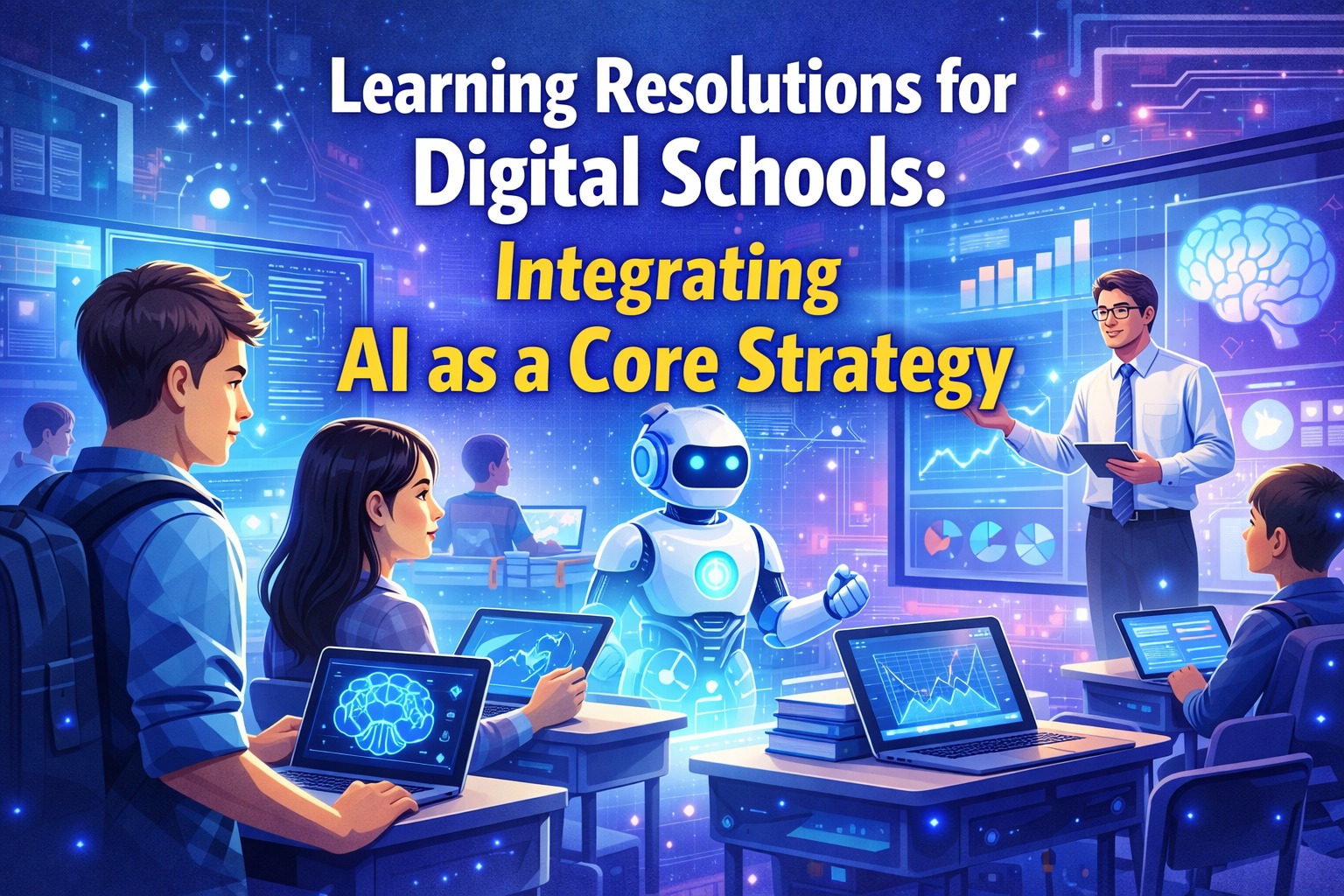
The transformation of education toward digital schools has accelerated significantly in recent years. This shift not only encourages the use of digital devices but also demands new strategies to make learning processes more effective. The coming years will be a crucial moment for educational institutions to establish more visionary learning resolutions, with one of the core strategies being the integration of artificial intelligence (AI).
AI introduces a smarter, more adaptive, and student-centered approach to learning. Digital schools that can utilize this technology effectively not only improve learning quality but also create more personalized and meaningful learning experiences.
WHY AI HAS BECOME A CORE STRATEGY IN DIGITAL SCHOOLS
Digital schools are no longer merely classrooms equipped with technology, but learning ecosystems that leverage data, automation, and intelligent algorithmic support.
Several reasons explain why AI has become a core strategy:
1. Accurately Identifying Individual Student Needs
AI adapts learning materials and exercises based on students’ abilities, learning pace, and learning styles.
2. More Efficient Classroom Management
Teachers can focus more on teaching, while systems assist with assessment, grading, and progress analysis.
3. Improved Accuracy in Academic Decision-Making
AI-processed data provides clear insights into students’ strengths and weaknesses, enabling early intervention.
4. More Flexible and Continuous Learning
Students can learn at home, at school, or anywhere through digital platforms with consistent quality
AI enables digital schools to function not only as content providers but also as learning companions that deeply understand students’ needs.
KEY PILLARS OF AI INTEGRATION IN DIGITAL LEARNING
To ensure effective AI integration, schools must understand the main pillars of applying this technology within modern learning systems.
1. Personalized Learning Materials
AI allows each student to receive customized learning content based on their progress.
The system can provide advanced challenges for fast learners and remedial exercises for those who need deeper understanding.
As a result, students do not feel left behind or overwhelmed by material that is too easy.
2. Real-Time Student Performance Analysis
Digital schools use AI to process student data within seconds.
Teachers receive accurate reports on progress, comprehension levels, and learning difficulty patterns, enabling more targeted instructional strategies.
3. 24/7 Automated Learning Assistants
AI-based chatbots or digital assistants provide instant responses when students need help.
Students do not need to wait for class hours to ask questions, making learning more independent and continuous throughout the day.
4. Interactive Learning Through Simulations
AI enhances learning experiences through simulations, educational games, and visual modules.
Learning is no longer limited to text and verbal explanations but involves interaction that strengthens comprehension.
POSITIVE IMPACTS OF AI INTEGRATION ON THE SCHOOL ENVIRONMENT
AI integration benefits not only students but also improves the overall quality of the educational ecosystem.
Key benefits include:
- Teachers can focus more on character development and human interaction
- Students gain confidence as learning pace matches their abilities
- Parents can monitor children’s progress more clearly through digital reports
- Schools become more efficient in administration, data management, and evaluation
AI creates a learning environment that is more structured, meaningful, and relevant to future needs.
CHALLENGES OF AI IMPLEMENTATION IN DIGITAL SCHOOLS
Despite its great potential, AI integration presents challenges that require careful preparation.
Key challenges include:
1. Unequal Access to Devices and Internet Connectivity
Schools must ensure equal access to prevent widening educational gaps.
2. Limited Teacher Training
Teachers need adequate training to use AI platforms effectively.
3. Data Security and Privacy
Student data must be securely managed to prevent misuse by unauthorized parties.
4. Technology Dependence
Learning must remain balanced so students continue developing critical thinking skills without excessive reliance on automated systems.
SETTING LEARNING RESOLUTIONS FOR THE FUTURE OF DIGITAL SCHOOLS
For sustainable development, AI integration must be part of a school’s strategic learning resolution.
Recommended steps include:
- Developing a digital curriculum integrated with AI-based modules
- Conducting regular teacher training programs
- Selecting secure and user-friendly AI platforms
- Establishing clear data protection policies
- Creating learning environments that support creativity and technological exploration
- Ensuring equal access to devices for all students
Through these measures, digital schools can position AI as a key partner in building innovative educational systems.
CONCLUSION
AI integration is no longer merely an additional technology but a core strategy shaping the future of digital education. Through personalized learning, real-time data analysis, and interactive learning experiences, AI helps students and teachers engage in more effective and human-centered learning processes.
Learning resolutions for digital schools must encompass technological reinforcement, human resource readiness, and robust security systems. With strong synergy between humans and AI, digital schools can evolve into inclusive, innovative, and meaningful learning centers for the future.
**Keywords:**
Tentang Penulis
Gusti Ayu Tita
Penulis — Universitas STEKOM
Penulis aktif yang berfokus pada isu-isu akademik, teknologi pendidikan, dan pengembangan sumber daya manusia di lingkungan kampus.