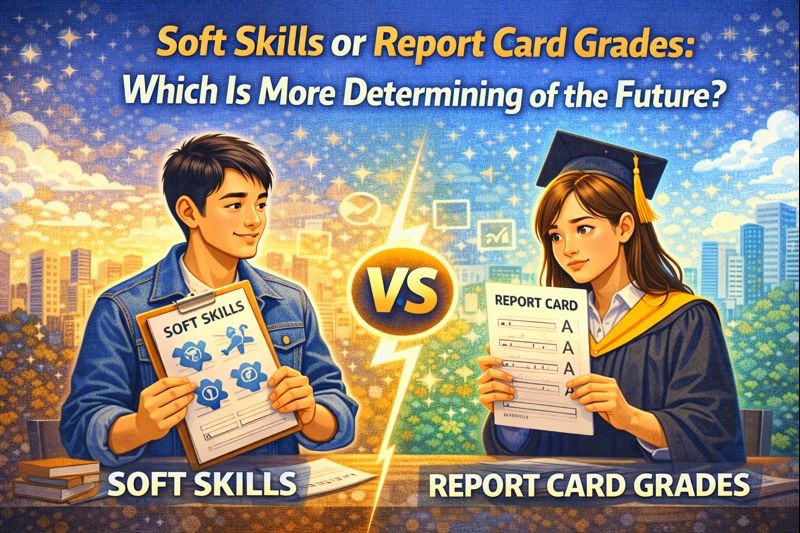
Soft Skills vs. Academic Grades: Which One Matters More for the Future?
In the world of education and careers, there is an ongoing debate about what plays a more important role in shaping a person’s future: soft skills or academic grades. Academic grades have long been considered the primary indicator of academic success, while soft skills are gaining increasing attention due to their importance in daily life and the professional world.
This article discusses the comparison between soft skills and academic grades, and which one has a greater influence on future success.
Understanding Soft Skills and Academic Grades
Knowing the definition of both concepts is essential before comparing them.
* Academic Grades are numerical scores that reflect a student’s academic performance across various subjects. These grades represent a student’s understanding and mastery of school materials.
* Soft Skills are non-technical abilities related to attitude, behavior, and social competence, such as communication, teamwork, time management, leadership, and adaptability.
The Role of Academic Grades in Shaping the Future
Academic grades often serve as the initial gateway to educational and career opportunities.
Academic grades are commonly used as the main criteria for university admissions, scholarships, and entry-level job opportunities. Some reasons why academic grades are still considered important include:
* Demonstrating strong academic ability.
* Reflecting learning discipline and consistency.
* Serving as a basic requirement for pursuing higher education.
However, academic grades alone are not enough to guarantee long-term success, especially in the workplace, which demands more than theoretical knowledge.
The Importance of Soft Skills for Future Success
Soft skills are increasingly recognized as a critical factor for success in both academic and professional settings.
Soft skills play a major role for several reasons:
* Supporting effective communication and teamwork.
* Enhancing problem-solving and critical thinking abilities.
* Enabling individuals to adapt to change and new challenges.
* Strengthening leadership and decision-making skills.
Today, many companies prioritize candidates with strong soft skills because they are better equipped to collaborate, communicate, and handle workplace pressure.
Soft Skills and Academic Grades: Which Is More Important?
There is no absolute answer, as both complement each other.
1. Academic Grades as an Academic Foundation
Academic grades provide essential knowledge and technical skills required for specific educational paths and professions.
2. Soft Skills as a Competitive Advantage
Soft skills often become the key differentiator when candidates have similar academic qualifications.
3. A Balanced Combination Is the Key
Long-term success is usually achieved by individuals who balance strong academic performance with well-developed soft skills.
Case Study: Education and the Workplace
Both education institutions and employers value academic performance and soft skills.
Many large companies, such as Google and IBM, emphasize soft skills in their recruitment processes. While academic qualifications are still considered, they prioritize employees who can adapt, communicate effectively, and work well in teams. Similarly, leading universities use academic grades to select prospective students but increasingly assess soft skills through interviews and extracurricular involvement.
How to Develop Soft Skills and Academic Grades Simultaneously
Both aspects can be improved together with the right approach.
* Maintain a disciplined study schedule to keep academic grades high.
* Participate in extracurricular activities that develop leadership and teamwork skills.
* Practice active communication with teachers and peers.
* Manage time effectively to balance academic and non-academic activities.
* Be open to feedback to improve both academic performance and personal skills.
Conclusion
Soft skills and academic grades are equally important in determining future success.
Academic grades build a strong academic foundation, while soft skills develop interpersonal abilities and adaptability needed in real-life situations. Therefore, the combination of both is the ultimate key to achieving a successful and opportunity-filled future.
Tentang Penulis
Gusti Ayu Tita P
Penulis — Universitas STEKOM
Penulis aktif yang berfokus pada isu-isu akademik, teknologi pendidikan, dan pengembangan sumber daya manusia di lingkungan kampus.