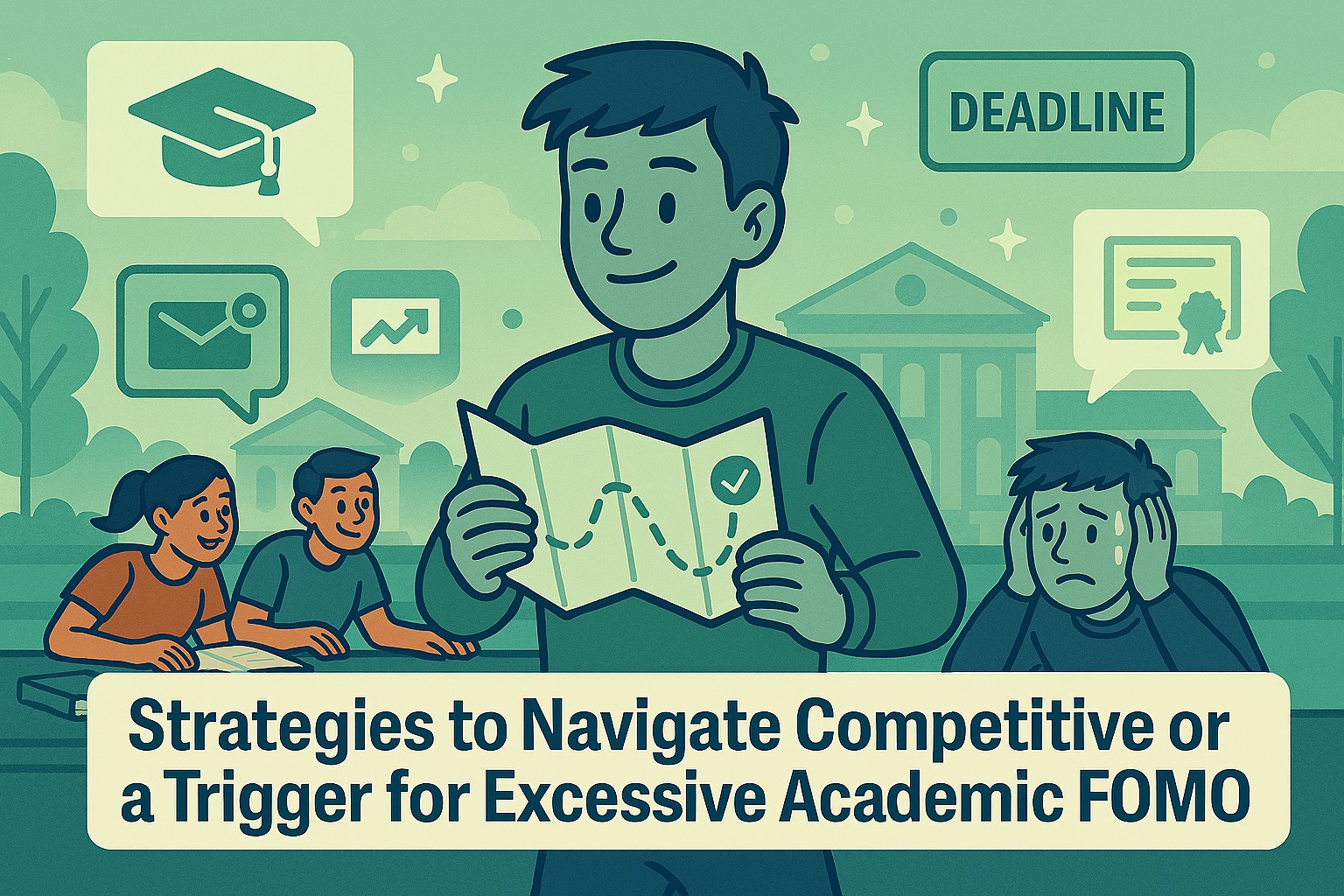
Modern academic environments are filled with opportunity, ambition, and visible achievement. Scholarships, internships, research programs, leadership roles, and certifications are constantly promoted as stepping stones toward future success. While these opportunities can accelerate growth, they also exist within a culture of intense competition that can unintentionally trigger academic FOMO — the fear of missing out on experiences that seem essential for staying ahead. Students today are not only competing academically; they are navigating a social ecosystem where achievements are constantly visible. This environment can blur the line between healthy motivation and fear-driven decision-making. Learning how to move through competitive culture intentionally — without falling into academic FOMO — is crucial for maintaining both performance and mental well-being.
UNDERSTANDING THE ROOT OF ACADEMIC FOMO IN COMPETITIVE SETTINGS
Academic FOMO often begins with comparison. Students see peers accumulating experiences and feel pressure to match or exceed those milestones. Competitive culture amplifies this pressure by framing opportunities as limited and high stakes.
When competition becomes identity-driven rather than growth-driven, students start equating self-worth with productivity. Every missed seminar or internship appears like a personal setback. This mindset can transform learning into a race, where participation is motivated by fear rather than curiosity.
Recognizing that FOMO stems from perception — not actual scarcity — is the first step toward navigating competition with clarity. Students who understand this dynamic gain emotional distance from urgency and begin making decisions aligned with personal priorities.
SHIFTING FROM REACTIVE TO INTENTIONAL DECISION-MAKING
One of the most effective strategies against academic FOMO is intentional participation. Instead of chasing every visible opportunity, students benefit from evaluating relevance, timing, and personal capacity.
Intentional decision-making requires asking reflective questions: Does this opportunity align with my goals? Will it enhance my understanding or skills? Do I realistically have the energy to commit? These reflections transform choices from impulse reactions into purposeful investments.
By focusing on alignment rather than accumulation, students protect cognitive resources. This approach reduces overload and strengthens engagement with selected activities, resulting in deeper learning and sustainable progress.
REDEFINING SUCCESS BEYOND COMPARISON
Competitive culture often promotes external benchmarks — awards, rankings, and visible achievements — as primary indicators of success. While these markers have value, relying solely on them narrows perspective.
Redefining success involves shifting attention to personal growth, mastery, and long-term development. When students measure progress against their own starting point, competition becomes a reference rather than a threat.
This mindset fosters resilience. Students celebrate improvement instead of chasing constant validation. As comparison loses emotional dominance, academic FOMO weakens, making room for confidence and autonomy.
BUILDING EMOTIONAL RESILIENCE IN HIGH-PRESSURE ENVIRONMENTS
Navigating competition requires emotional regulation as much as academic skill. Resilience enables students to process disappointment, uncertainty, and peer comparison without internalizing them as failure.
Developing resilience involves cultivating self-awareness, realistic expectations, and recovery habits. Adequate rest, reflection, and boundaries prevent burnout. Emotional resilience also encourages perspective — understanding that no single opportunity defines a career or identity.
When students strengthen emotional flexibility, competitive environments become spaces for challenge rather than sources of chronic stress.
CREATING SUPPORTIVE PEER AND LEARNING NETWORKS
Isolation intensifies academic FOMO. Students who perceive peers solely as competitors are more vulnerable to anxiety and comparison. Collaborative environments, by contrast, normalize shared growth.
Supportive networks encourage open conversations about pressure, workload, and priorities. Peer mentorship and cooperation shift the narrative from rivalry to collective progress. When students see others navigating challenges honestly, unrealistic expectations diminish.
A collaborative culture reminds students that success is not zero-sum. Opportunities for growth multiply when learning becomes communal.
BALANCING AMBITION WITH WELL-BEING
Ambition drives innovation and excellence, but without balance it risks exhaustion. Sustainable achievement requires pacing, reflection, and boundaries.
Students benefit from scheduling intentional downtime and evaluating commitments regularly. This balance reinforces the understanding that productivity is not constant motion, but strategic effort paired with recovery.
Maintaining well-being ensures that competition enhances development rather than undermines health. A balanced approach allows students to pursue opportunities with energy and clarity instead of fear.
CONCLUSION
Competitive academic culture can either sharpen growth or trigger academic FOMO depending on how students interpret and respond to it. The key lies in intentional participation, emotional resilience, and redefining success beyond comparison.
By shifting focus from accumulation to alignment, students transform competition into a tool for meaningful progress. Rather than chasing every opportunity, they engage selectively and sustainably. In doing so, academic life becomes a journey of purposeful development — one where ambition and well-being coexist.
Tentang Penulis
Gusti Ayu Tita P
Penulis — Universitas STEKOM
Penulis aktif yang berfokus pada isu-isu akademik, teknologi pendidikan, dan pengembangan sumber daya manusia di lingkungan kampus.