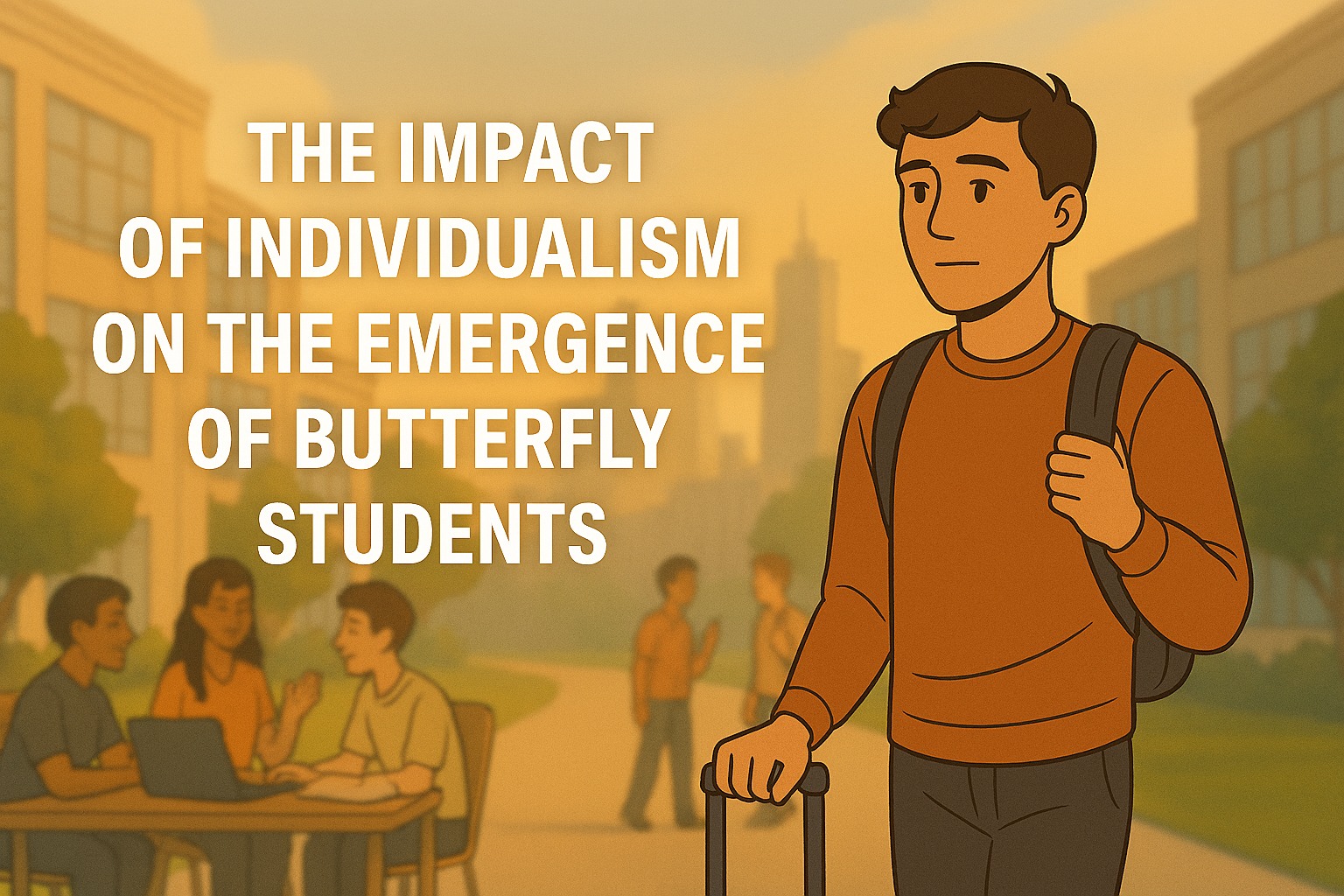
In contemporary higher education, student behavior reflects broader social values and cultural shifts. One of the most influential trends shaping student lifestyles today is individualism. As societies increasingly emphasize personal autonomy, self-achievement, and independence, university students adapt their academic and social behaviors accordingly. Among the patterns emerging from this cultural transformation is the rise of “butterfly students” — individuals who attend classes and return home immediately afterward, limiting participation in campus organizations and collective activities. The impact of individualism on the emergence of butterfly students is significant and complex. Individualistic values influence how students prioritize time, define success, build relationships, and engage with their academic environment. Understanding this connection provides insight into modern campus dynamics and evolving student identities.
UNDERSTANDING INDIVIDUALISM IN MODERN SOCIETY
Individualism emphasizes personal freedom, self-reliance, and independent decision-making. In highly individualistic cultures, success is often measured by personal achievements rather than collective contributions. Students raised within this value system are encouraged to pursue their own goals, protect their personal time, and focus on self-development.
Within university settings, this mindset translates into academic strategies centered on individual performance. Students prioritize grades, certifications, and personal skill mastery. While collaboration still exists in academic contexts, the ultimate objective frequently revolves around personal accomplishment rather than communal engagement.
This cultural orientation lays the foundation for the butterfly student pattern. When personal efficiency and self-focus dominate, involvement in campus organizations may appear optional rather than essential.
PRIORITIZATION OF PERSONAL GOALS OVER COLLECTIVE ENGAGEMENT
One of the clearest ways individualism contributes to the emergence of butterfly students is through goal prioritization. Students guided by individualistic values often create structured schedules that maximize productivity. They attend lectures, complete assignments, and return home to focus on personal projects, internships, or online courses.
Extracurricular involvement may be perceived as time-consuming or unrelated to immediate academic goals. As a result, students consciously limit their engagement in group-based activities. This decision is not necessarily driven by apathy but by strategic self-management.
The butterfly lifestyle aligns with a belief in efficiency. Students calculate opportunity costs and may conclude that investing time in organizations does not directly contribute to measurable academic or career outcomes. Over time, this mindset normalizes minimal campus participation.
SELF-RELIANCE AND INDEPENDENT LEARNING PATTERNS
Individualism also strengthens self-reliance. Students become comfortable studying independently, solving problems alone, and managing responsibilities without external support. Digital resources further enhance this independence, enabling access to academic materials without collaborative interaction.
Butterfly students often demonstrate strong self-discipline and internal motivation. They do not rely heavily on peer groups for academic success. Instead, they develop personalized learning systems that fit their preferences and routines.
While self-reliance promotes responsibility and accountability, it may reduce opportunities to practice teamwork and shared decision-making. Leadership and interpersonal skills often develop through collective engagement. When individual autonomy dominates, collaborative exposure may decrease.
CHANGING PERCEPTIONS OF COMMUNITY AND BELONGING
The rise of individualism has also transformed how students define community. In previous generations, campus life often centered around strong collective identities built through student organizations, cultural clubs, and physical gatherings. Today, belonging can be shaped by digital communities, niche interest groups, and remote networks.
Butterfly students may feel socially connected without physically participating in campus activities. Online forums, social media groups, and virtual collaboration spaces provide alternative forms of interaction. This shift reduces the perceived necessity of in-person engagement.
As a result, the traditional campus model emphasizing physical presence and group participation competes with individualized and digitally mediated experiences. Individualism encourages students to choose social interactions selectively, based on personal relevance rather than institutional expectations.
PSYCHOLOGICAL COMFORT AND PERSONAL BOUNDARIES
Individualistic values often emphasize maintaining personal boundaries and protecting mental well-being. Students may intentionally limit social obligations to avoid burnout, stress, or unnecessary commitments. The butterfly student pattern supports this protective approach.
By minimizing organizational involvement, students gain greater control over their schedules and emotional energy. They can allocate time to rest, hobbies, freelance work, or self-improvement activities without the pressure of collective responsibilities.
This boundary-setting behavior reflects a growing awareness of mental health and work-life balance. However, excessive withdrawal from campus engagement may reduce exposure to experiences that foster adaptability, empathy, and collaborative resilience.
LONG-TERM IMPLICATIONS FOR CAMPUS CULTURE
The impact of individualism on the emergence of butterfly students extends beyond individual behavior. It influences campus culture as a whole. Universities may observe declining participation in student organizations, reduced attendance at campus events, and a shift toward academic minimalism.
While individualistic students often excel in personal academic achievements, institutions must consider how to preserve vibrant community life. Collective engagement contributes to leadership development, networking opportunities, and interpersonal skill growth.
Balancing individual autonomy with community participation becomes a central challenge. Encouraging flexible engagement models, project-based collaboration, and purpose-driven organizations may attract students who value efficiency while still benefiting from collective experiences.
BALANCING INDIVIDUALISM AND COLLABORATION
Individualism is not inherently detrimental. It fosters independence, critical thinking, and strong personal accountability. The key lies in moderation. Students who combine self-directed focus with selective collaborative involvement often achieve well-rounded development.
Butterfly students can gradually integrate teamwork experiences without sacrificing personal efficiency. Participating in short-term projects, academic research teams, or professional networking events allows exposure to collective dynamics while maintaining autonomy.
By recognizing the influence of individualism, students can consciously expand their engagement in ways that support both personal growth and social development.
CONCLUSION
The impact of individualism on the emergence of butterfly students reflects a broader cultural transformation within modern society. Emphasis on personal achievement, self-reliance, and efficiency encourages students to prioritize individual goals over collective participation. This mindset contributes significantly to the butterfly student pattern observed in contemporary campuses.
While individualism strengthens independence and academic focus, it may also reduce opportunities for leadership, collaboration, and interpersonal growth. Achieving balance between autonomy and engagement is essential for comprehensive student development.
Understanding this relationship allows universities and students to adapt to evolving social values without sacrificing the benefits of community-based learning. In a world that increasingly values both independence and collaboration, integrating these elements remains the key to sustainable academic and professional success.
Tentang Penulis
Gusti Ayu Tita P
Penulis — Universitas STEKOM
Penulis aktif yang berfokus pada isu-isu akademik, teknologi pendidikan, dan pengembangan sumber daya manusia di lingkungan kampus.