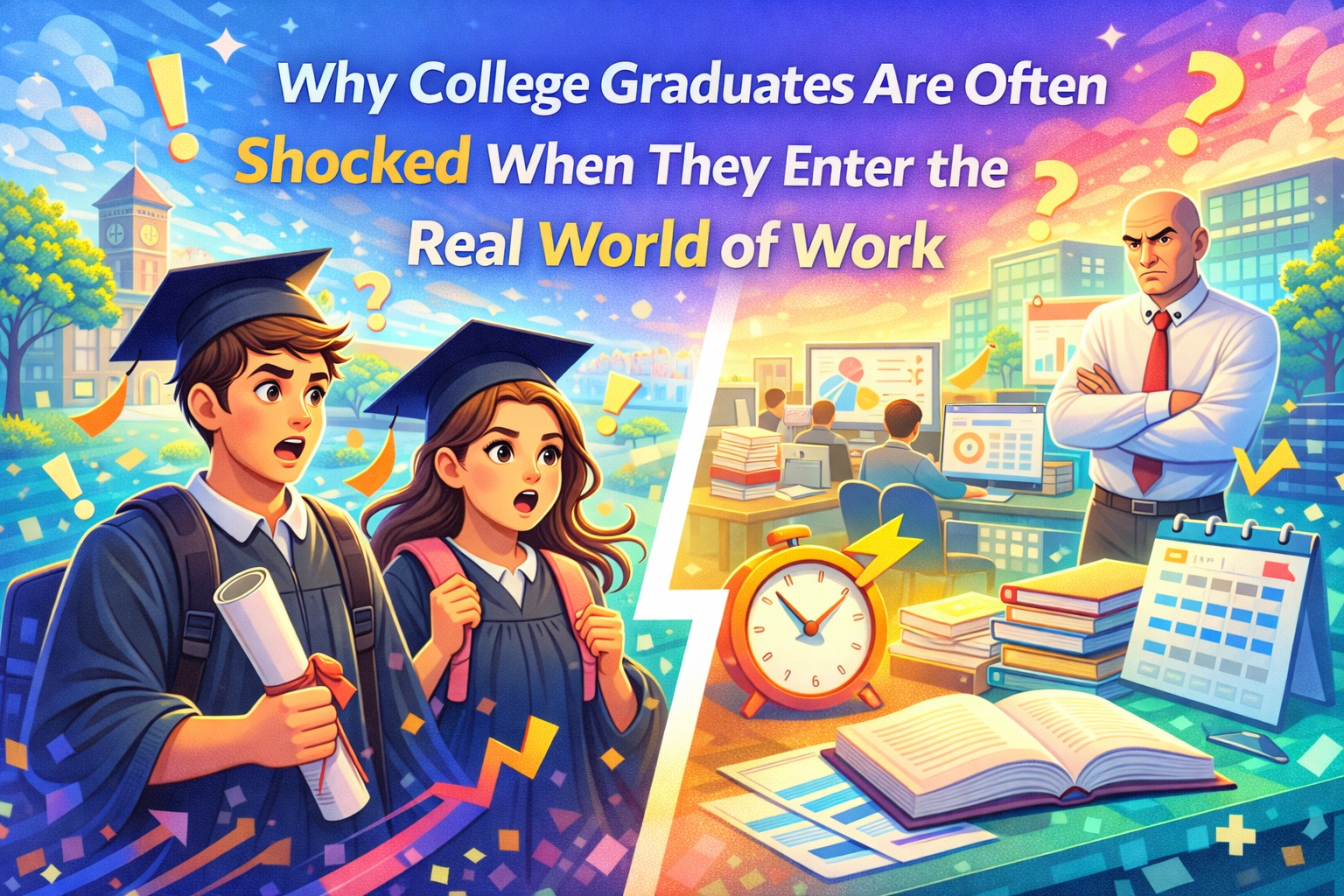
The transition from campus life to the professional world is often a phase full of surprises for many college graduates. The expectations built during their studies do not always align with the professional realities they face. This article explores the main reasons why graduates often feel “shocked” when entering the workforce for the first time, while also serving as a reflection for both the education sector and future employees.
GAP BETWEEN CAMPUS THEORY AND WORKPLACE PRACTICE
Dominance of Academic Content Over Practical Skills
In campus environments, learning processes generally focus on theory, concepts, and ideal approaches. Students are trained to understand definitions, frameworks, and academically tested theories. However, upon entering the workforce, they are confronted with real-life situations that often have no standard answers. Many graduates are surprised to realize that the theories they learned cannot always be applied directly and sometimes must be adjusted to field conditions, company culture, and resource limitations.
Graduates often feel unprepared because work demands speed, accuracy, and independent decision-making, highlighting that the professional world prioritizes problem-solving and execution over mere conceptual understanding.
WORK EXPECTATIONS THAT DO NOT MATCH REALITY
Idealized Image of the Workplace During Studies
During their studies, many students build expectations that the workplace will align with their field of study, feature a neat professional environment, and operate under structured systems. In reality, the professional world is often marked by target pressures, complex team dynamics, and tasks that may not match initial job descriptions.
This mismatch between expectation and reality causes new graduates to feel disappointed and confused, often finding themselves handling administrative tasks, basic technical work, or responsibilities outside their expertise, triggering initial shock and stress.
LACK OF SOFT SKILL PREPARATION
The Importance of Non-Technical Skills in the Professional World
In addition to academic ability, the workplace heavily demands soft skills such as communication, time management, teamwork, and professional ethics. Unfortunately, these aspects are not yet the main focus in formal education. Many academically brilliant graduates struggle to adapt to work culture, communication with supervisors, and team dynamics across ages and backgrounds.
Graduates are often surprised to find that performance evaluation depends not only on results but also on attitude, interaction style, and emotional management. Without sufficient soft skill preparation, the adaptation process becomes more challenging.
INCREASED PRESSURE AND RESPONSIBILITY
Role Shift from Student to Professional
In college, mistakes are considered part of the learning process. In contrast, in the professional world, mistakes can directly impact operations, reputation, and even financial loss. This role shift often makes graduates feel pressured due to full accountability for their tasks.
The demands of being professional, punctual, and able to work under pressure pose unique challenges. Many graduates are shocked to realize that the workplace requires consistency and mental resilience far beyond what was needed in campus life.
CONCLUSION
The phenomenon of graduates feeling shocked when entering the workforce reflects the gap between education and professional life. Differences in orientation, expectations, and job demands are the main factors triggering this condition. Therefore, a collaborative effort is needed among educational institutions, students, and the industry to bridge this gap. By providing practical skills, soft skills, and early work experience, graduates are expected to adapt faster and be better prepared for the realities of professional life.
Tentang Penulis
Gusti Ayu Tita P
Penulis — Universitas STEKOM
Penulis aktif yang berfokus pada isu-isu akademik, teknologi pendidikan, dan pengembangan sumber daya manusia di lingkungan kampus.