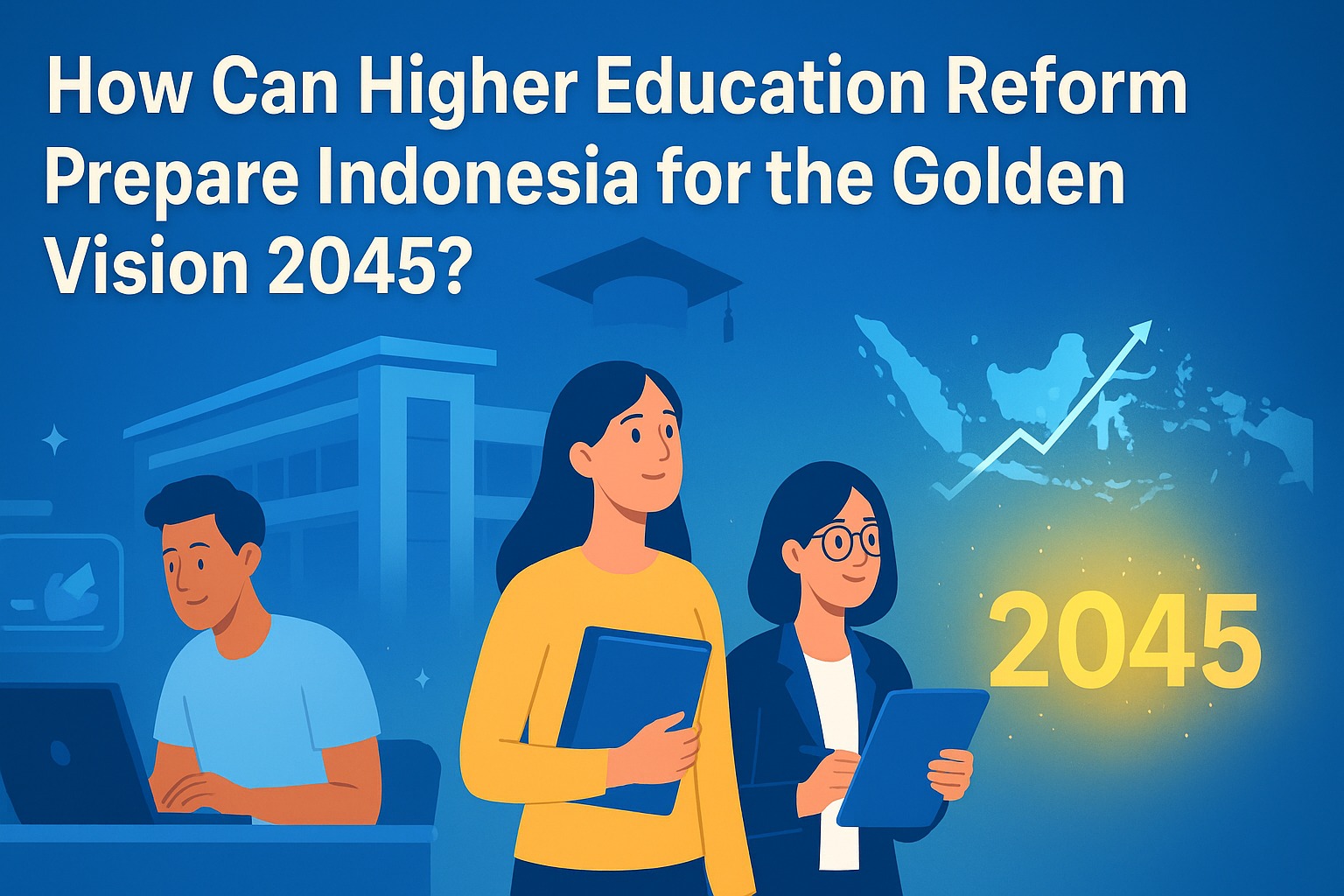
The Golden Indonesia Vision 2045 represents the nation’s aspiration to become a developed country with high-quality human resources (HR) who are globally competitive and adaptive to rapid changes. To achieve this vision, reform in the higher education sector is one of the most crucial components. Universities are not only institutions that produce graduates but also centers of innovation, research, and technological development.
This article discusses how higher education reform can strengthen Indonesia’s foundation toward achieving the major vision of 2045.
WHY HIGHER EDUCATION IS THE FOUNDATION OF GOLDEN INDONESIA 2045
Higher education plays a strategic role in shaping high-quality human resources. Several key reasons include:
- 50% of future jobs require high-level skills, which can only be acquired through advanced education.
- Innovation and university-led research are major drivers of industrial and technological development.
- Universities serve as hubs for producing leaders, scientists, technocrats, and professionals who will guide national development.
Without reform, higher education will struggle to keep up with the increasingly fast-paced and competitive labor market.
CURRENT CHALLENGES IN INDONESIA’S HIGHER EDUCATION SECTOR
Before discussing reforms, it is important to understand the core problems still faced by Indonesia’s higher education system:
1. Quality Gaps Between Institutions
Significant differences remain between major universities in big cities and institutions located in rural areas.
2. Curricula That Are Not Fully Adaptive
Many study programs still teach materials that are misaligned with modern industry needs.
3. Limited Campus–Industry Collaboration
Yet industries are the end users of university-trained talent.
4. Research With Limited Impact
Although research output is increasing, only a small portion is commercialized or used for national needs.
5. Uneven Adoption of Educational Technology
Digital transformation is still uneven, especially in non-urban regions.
REFORM DIRECTIONS FOR HIGHER EDUCATION TOWARD INDONESIA EMAS 2045
To achieve Golden Indonesia 2045, higher education reform can be directed toward the following key areas:
1. Future-Oriented Curriculum Transformation
Reform must ensure that curricula:
- Prioritize 21st-century skills: critical thinking, creativity, collaboration, and communication
- Integrate digital literacy such as AI, big data, cloud computing, and cybersecurity
- Emphasize project-based learning so students experience real-world challenges
Curricula must remain flexible and able to adapt to technological and labor market developments.
2. Strengthening Campus–Industry Collaboration
This synergy is essential to produce job-ready graduates. Collaboration may include:
- Certified internships
- Teaching factory programs
- Joint applied research
- Partner companies absorbing graduates
Robust collaboration bridges the gap between academia and industry needs.
3. Improving Quality and Expanding Access to Higher Education
Reform must ensure equitable quality through:
- Development of digital campuses in rural areas
- Scholarships and financial support
- Increased lecturer competency
- National quality standards
Equal access ensures that all Indonesian youth have equal opportunities to become high-quality human resources.
4. Fostering a Research and Innovation Culture
Strong research is the engine of developed nations. Reform should:
- Increase research funding
- Encourage commercialization (hilirisasi) of research outputs
- Support technology and startup incubation
- Connect academia with industry and government
This will position universities as national innovation centers.
5. Digitalization of Higher Education
Digital transformation is essential for navigating Industries 4.0 and 5.0. Steps include:
- Implementing hybrid or online learning
- Using AI for educational processes
- Establishing national learning platforms and data centers
- Providing digital competency training for lecturers and students
Digitalization improves efficiency, accessibility, and learning quality.
IMPACT OF HIGHER EDUCATION REFORM ON GOLDEN INDONESIA 2045
If reforms are consistently implemented, the impacts include:
- Creation of globally competitive human resources
- Increased national productivity
- Growth of local innovations and technologies
- Strengthening of knowledge-based industries
- A society that is adaptive, creative, and independent
These are the essential foundations for Indonesia to become a developed nation by 2045.
CONCLUSION
Higher education reform is a strategic step that cannot be delayed. Indonesia needs a modern, inclusive, adaptive, and innovation-based education system to prepare excellent human resources. Through curriculum transformation, campus–industry collaboration, equitable access, a strong research culture, and digitalization, Indonesia will be increasingly prepared to realize the great vision of Golden Indonesia 2045.
About the Author
Gusti Ayu Tita
Author — STEKOM University
An active author focused on academic issues, educational technology, and human resource development in the campus environment.