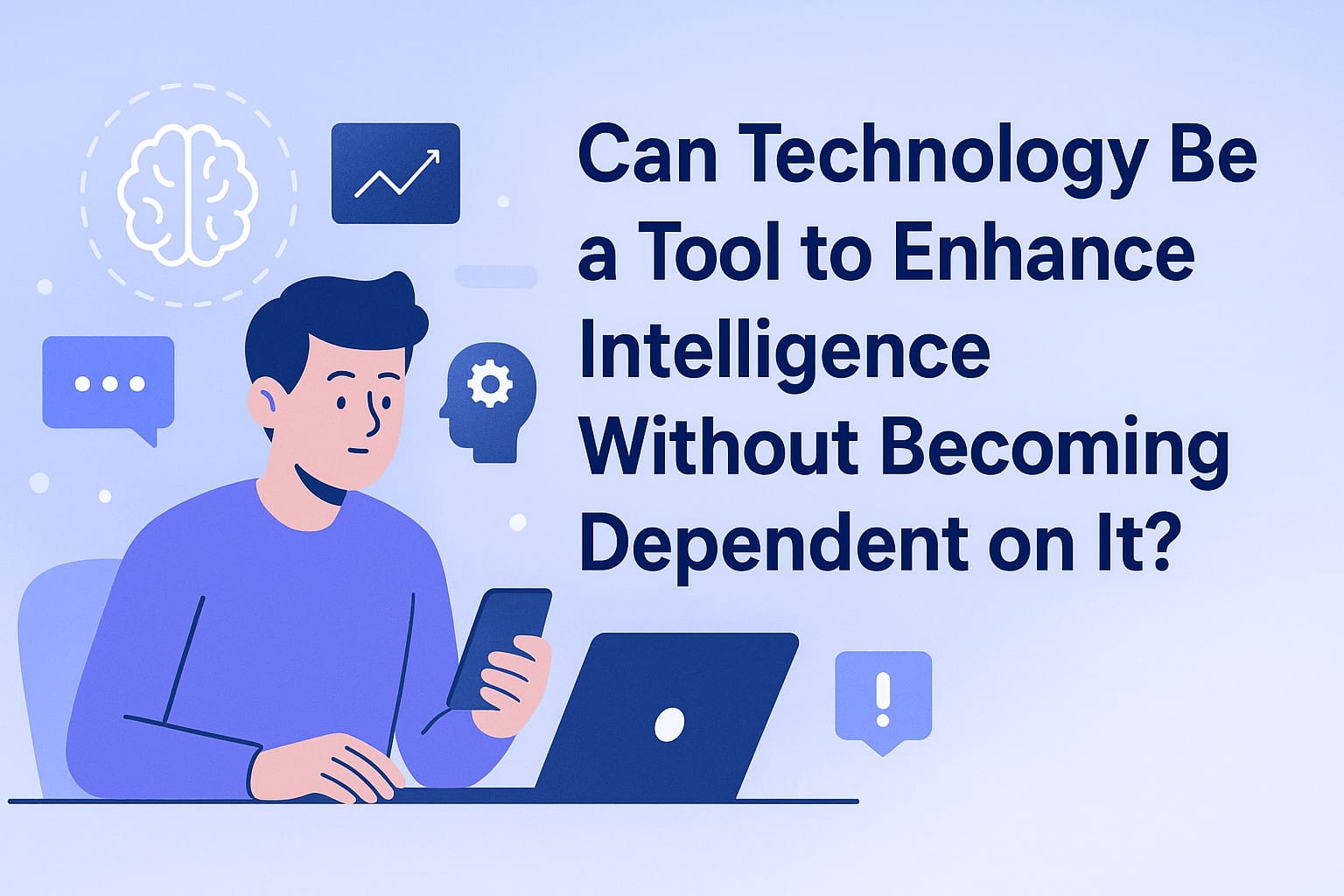
In an increasingly connected world, technology has become an undeniable solution to various challenges in our daily lives. From the way we work to how we interact and learn, technology offers countless conveniences. However, alongside these benefits comes an important question: **can technology be used to enhance our intelligence without making us dependent on it?** This article explores how we can use technology effectively to boost intelligence without falling into dependency.
TECHNOLOGY AS A LEARNING SUPPORT TOOL
Technology has brought a major revolution to the world of education. Access to information is no longer restricted by time or location. Platforms like Coursera, edX, and Khan Academy allow anyone to learn a wide range of subjects—from science and art to technical skills—either for free or at low cost. This gives us the opportunity to expand our knowledge and abilities without limitations.
However, technology is not a magical solution. If we rely solely on devices and apps without deeply understanding the material, we may lose the ability to think critically and analyze information independently. Therefore, technology should function as a supporting tool, not a replacement for the learning process itself.
USING APPS TO TRAIN COGNITIVE ABILITIES
One way technology can improve intelligence is through applications designed to train cognitive skills, such as brain-training apps or educational games. Apps like Lumosity or Peak offer various exercises that help enhance memory, concentration, problem-solving, and other intelligence-related abilities.
Even so, using these apps must remain balanced. While they can help sharpen our mind, true intelligence does not rely solely on digital exercises. Deep thinking and applying knowledge in real-world contexts are crucial elements that must still be practiced directly.
THE RISK OF TECHNOLOGY DEPENDENCE
One of the biggest challenges in using technology to improve intelligence is the risk of dependency. When technology becomes our primary tool for everything, we may lose essential basic skills such as critical thinking, independent problem-solving, and remembering information without assistance.
For example, people now rarely do mental calculations because using a calculator is easier. Many also depend heavily on GPS instead of using their natural sense of direction. Such dependency can weaken our ability to handle situations that require independent thinking without technological help.
FINDING BALANCE: TECHNOLOGY AS A TOOL, NOT A SUBSTITUTE
The key lies in balancing the use of technology to support our intelligence while maintaining essential basic skills. Technology can accelerate learning and simplify access to information, but we must not forget the importance of independent thinking, reflection, and applying knowledge in real life.
For instance, you can use a language-learning app to speed up vocabulary acquisition, but you still need to practice speaking with native speakers to develop real communication skills. With this balance, technology serves as an enhancer, not a replacement, for natural thinking and learning processes.
SKILLS THAT MUST BE MAINTAINED: INDEPENDENT THINKING AND CREATIVITY
Although technology is extremely helpful, we must continue training our critical, creative, and analytical thinking skills. Independent thinking involves filtering information, questioning sources, and drawing conclusions based on personal understanding. True intelligence requires more than access to information—it demands the ability to process and apply knowledge in real-world contexts.
For example, scientists or artists may use advanced software to support their creative or analytical work, but they still need deep insight and imagination to produce original and meaningful outcomes. Creativity and critical thinking are aspects that cannot be replaced by machines or algorithms.
CONCLUSION
Technology can be an extraordinary tool for enhancing intelligence, but only when used wisely. It offers easier access to information and cognitive training, yet we must be cautious not to fall into dependency. True intelligence requires critical, creative, and independent thinking.
By using technology in a balanced and responsible way, we can benefit from its advantages without losing essential cognitive abilities. This balance allows us to thrive in a digital world without becoming overly dependent on technology.
About the Author
Gusti Ayu Tita
Author — STEKOM University
An active author focused on academic issues, educational technology, and human resource development in the campus environment.