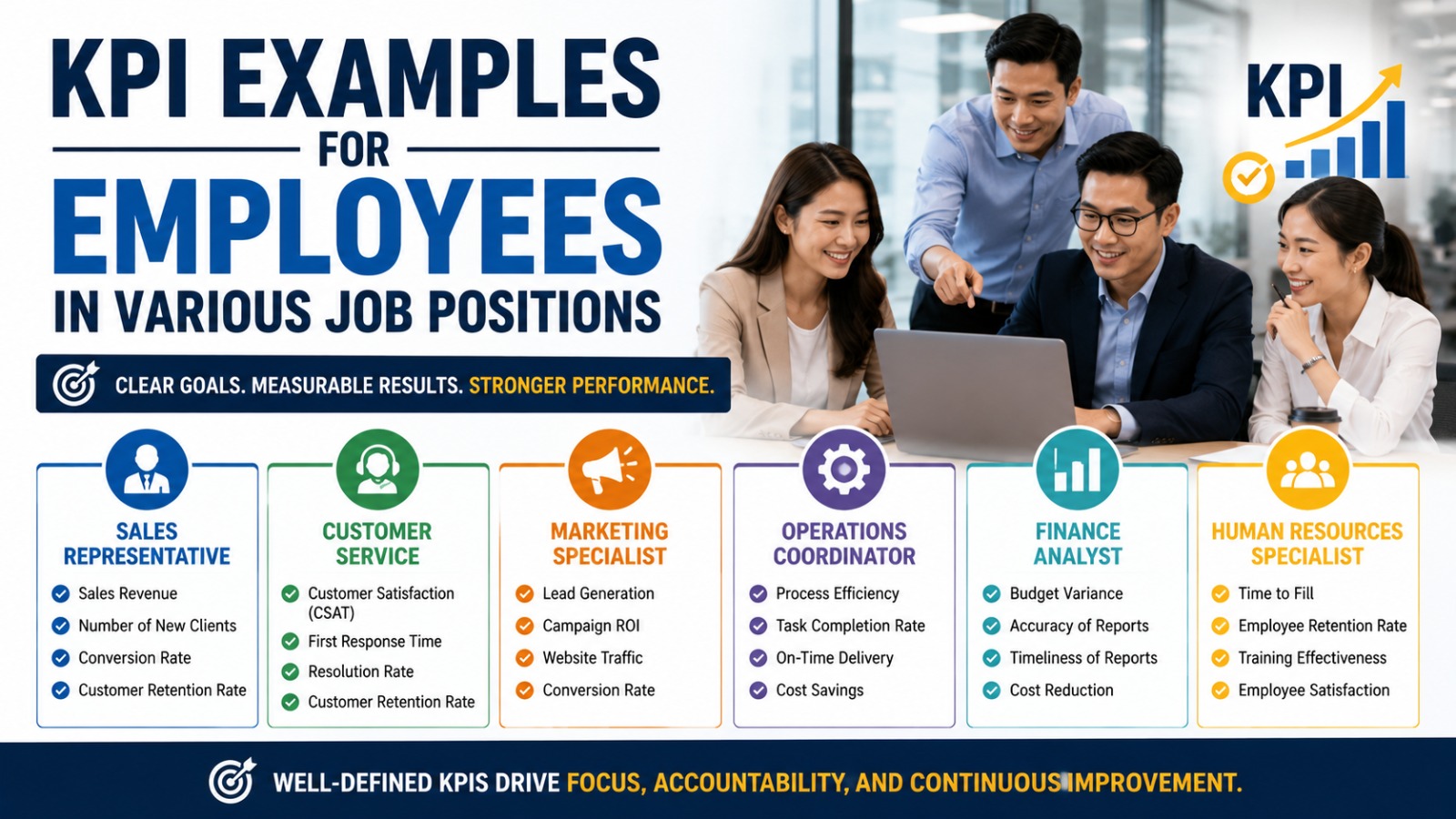
Key Performance Indicators (KPIs) are measurable values used to evaluate employee performance and productivity in the workplace. Companies use KPIs to track progress, measure success, and ensure employees contribute effectively to organizational goals.
Different job positions require different KPI standards because each role has unique responsibilities and objectives. Well-designed KPIs help employees understand expectations, improve accountability, and increase overall business performance.
WHY KPIS ARE IMPORTANT IN THE WORKPLACE
KPIs provide clear performance measurements that help both employees and managers evaluate work results objectively. Effective KPIs can:
- Improve productivity
- Clarify employee goals
- Increase accountability
- Support performance evaluations
- Encourage professional growth
When employees understand how their performance is measured, they are more motivated to achieve company targets.
CHARACTERISTICS OF EFFECTIVE KPIS
Good KPIs should be:
- Specific
- Measurable
- Achievable
- Relevant
- Time-bound
These characteristics help organizations create fair and realistic performance standards.
KPI EXAMPLES FOR SALES EMPLOYEES
Sales employees focus on generating revenue and building customer relationships. Their KPIs usually measure sales performance and client management.
COMMON SALES KPIS
- Monthly sales revenue
- Number of new customers acquired
- Sales target achievement percentage
- Customer retention rate
- Average deal value
- Number of client meetings conducted
These KPIs help companies monitor sales growth and employee effectiveness.
KPI EXAMPLES FOR CUSTOMER SERVICE STAFF
Customer service employees are responsible for maintaining customer satisfaction and resolving problems efficiently.
COMMON CUSTOMER SERVICE KPIS
- Customer satisfaction score
- Average response time
- Problem resolution rate
- Number of customer complaints handled
- Customer retention rate
- Service quality rating
Strong customer service KPIs improve client loyalty and company reputation.
KPI EXAMPLES FOR HUMAN RESOURCES EMPLOYEES
Human resources professionals manage recruitment, employee relations, and workforce development.
COMMON HR KPIS
- Employee turnover rate
- Time required to fill vacancies
- Employee satisfaction score
- Training completion rate
- Recruitment success rate
- Employee attendance improvement
These indicators help HR departments maintain workforce stability and employee engagement.
KPI EXAMPLES FOR MARKETING EMPLOYEES
Marketing employees focus on promoting products, increasing brand awareness, and generating leads.
COMMON MARKETING KPIS
- Website traffic growth
- Social media engagement rate
- Number of qualified leads generated
- Conversion rate
- Return on marketing investment
- Campaign performance results
Marketing KPIs help businesses measure promotional effectiveness and audience reach.
KPI EXAMPLES FOR ADMINISTRATIVE STAFF
Administrative employees support daily business operations and organizational efficiency.
COMMON ADMINISTRATIVE KPIS
- Task completion accuracy
- Document processing speed
- Attendance and punctuality
- Scheduling efficiency
- Internal support satisfaction score
- Filing and data management accuracy
These KPIs help ensure smooth office operations and productivity.
KPI EXAMPLES FOR FINANCE EMPLOYEES
Finance employees manage budgeting, financial reporting, and company financial health.
COMMON FINANCE KPIS
- Budget accuracy
- Financial reporting completion time
- Cost reduction percentage
- Invoice processing speed
- Error rate in financial reports
- Cash flow management efficiency
Financial KPIs support better business decision-making and financial stability.
KPI EXAMPLES FOR IT EMPLOYEES
Information technology employees are responsible for maintaining systems, networks, and technical support.
COMMON IT KPIS
- System uptime percentage
- Technical issue resolution time
- Cybersecurity incident rate
- User satisfaction score
- Project completion rate
- Network performance stability
IT KPIs help organizations maintain reliable and secure technology systems.
KPI EXAMPLES FOR PRODUCTION EMPLOYEES
Production staff focus on manufacturing efficiency, product quality, and workplace safety.
COMMON PRODUCTION KPIS
- Production output volume
- Product defect rate
- Machine downtime percentage
- Workplace safety compliance
- Production target achievement
- Operational efficiency rate
These KPIs improve manufacturing productivity and quality control.
TIPS FOR IMPLEMENTING KPIS EFFECTIVELY
To ensure KPIs deliver positive results, companies should:
- Align KPIs with business goals
- Communicate expectations clearly
- Review KPIs regularly
- Provide employee feedback
- Use realistic performance targets
Employees should also receive support and guidance to achieve their KPI objectives successfully.
CONCLUSION
KPIs are valuable tools for measuring employee performance across different job positions. Every department requires specific indicators that reflect its responsibilities and organizational goals.
By implementing clear and measurable KPIs, companies can improve productivity, strengthen accountability, and support employee development. Effective performance measurement benefits both employees and organizations by creating a more focused and results-driven workplace.
About the Author
Gusti Ayu Tita P
Author — STEKOM University
An active author focused on academic issues, educational technology, and human resource development in the campus environment.